## Layer Diagram: Agora Architecture
### Overview
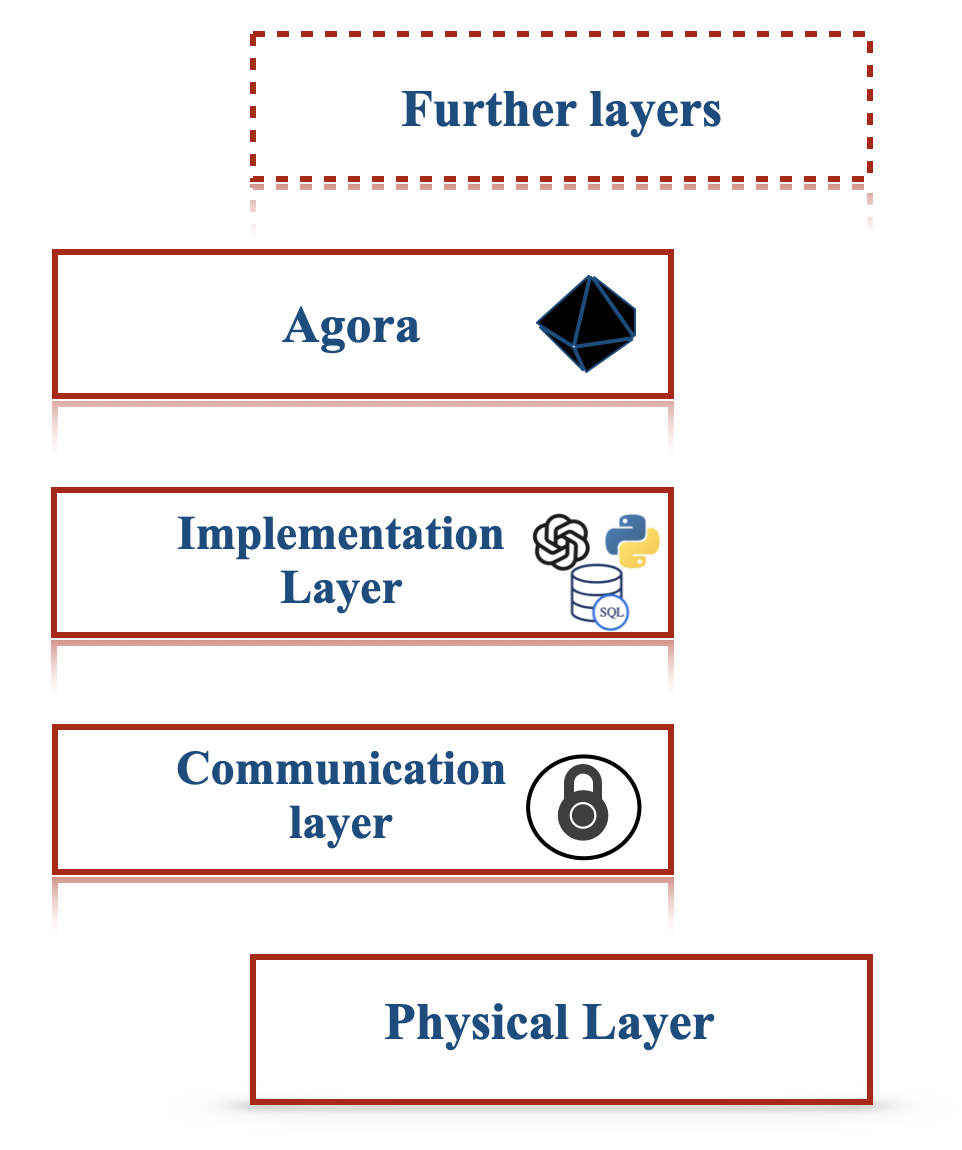
The image is a diagram illustrating a layered architecture, likely for a software system or platform named "Agora." The diagram depicts four distinct layers, stacked vertically, with an additional layer indicated above the top layer. Each layer is represented by a rectangular box with a label and associated icons.
### Components/Axes
* **Layers (from top to bottom):**
* Further layers (indicated with a dashed border)
* Agora
* Implementation Layer
* Communication layer
* Physical Layer
* **Icons:**
* Agora Layer: A black geometric shape resembling a multifaceted crystal or polyhedron.
* Implementation Layer: Icons representing ChatGPT, Python, and SQL database.
* Communication Layer: A padlock icon.
### Detailed Analysis or ### Content Details
* **Further layers:** Located at the top of the diagram, enclosed in a dashed red border. The text reads "Further layers".
* **Agora:** Located below "Further layers". The text reads "Agora". A black geometric shape is present to the right of the text.
* **Implementation Layer:** Located below "Agora". The text reads "Implementation Layer". Icons representing ChatGPT, Python, and SQL database are present to the right of the text.
* **Communication layer:** Located below "Implementation Layer". The text reads "Communication layer". A padlock icon is present to the right of the text.
* **Physical Layer:** Located at the bottom of the diagram. The text reads "Physical Layer".
### Key Observations
* The diagram presents a layered architecture, with each layer representing a different level of abstraction or functionality.
* The "Further layers" box suggests that the architecture may have additional layers not explicitly shown in the diagram.
* The icons associated with each layer provide hints about the technologies or concepts involved in that layer. For example, the Implementation Layer uses ChatGPT, Python, and SQL. The Communication layer uses a padlock, suggesting security or encryption.
### Interpretation
The diagram illustrates a layered architecture for the Agora system. The layers are arranged in a stack, suggesting a hierarchical relationship where each layer builds upon the layers below it. The "Physical Layer" likely represents the hardware or infrastructure on which the system runs. The "Communication layer" likely handles network communication and security. The "Implementation Layer" likely contains the core logic and functionality of the system, using technologies like ChatGPT, Python, and SQL. The "Agora" layer likely represents the user-facing interface or application. The "Further layers" box suggests that the architecture may be more complex than what is shown in the diagram, with additional layers for specific features or functionalities.