## Code Snippet: Dynamic Integer Sequence Creation
### Overview
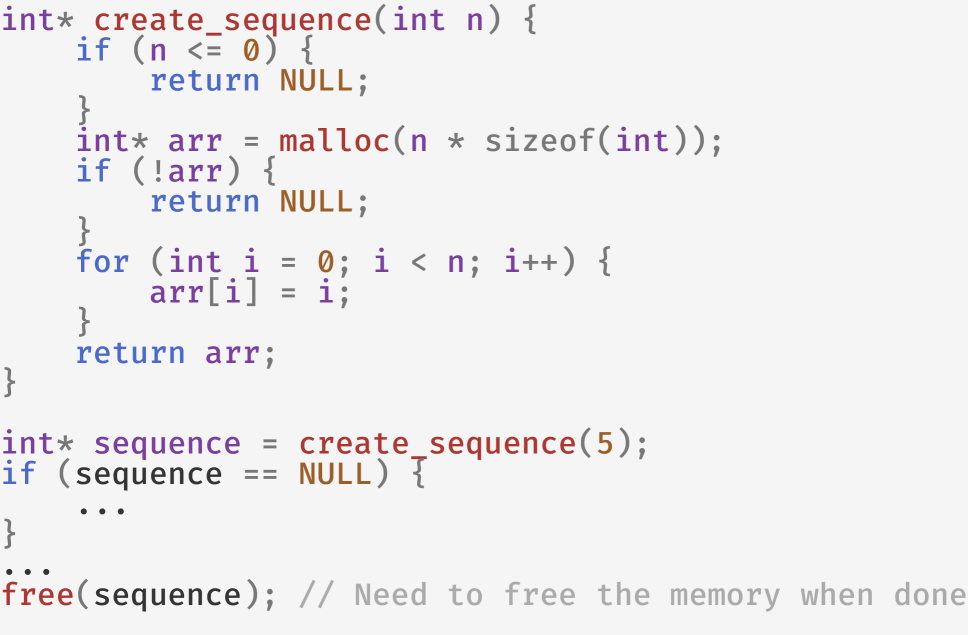
The image shows a C programming snippet demonstrating dynamic memory allocation for an integer array, with a function to generate a sequence of integers from 0 to n-1. The code includes error handling for invalid input and memory allocation failures, followed by an example usage and memory cleanup.
### Components/Axes
1. **Function Definition**: `int* create_sequence(int n)`
- Purpose: Creates an integer array of size `n` filled with values 0 to n-1
2. **Memory Allocation**: `malloc(n * sizeof(int))`
- Checks for allocation success using `!arr`
3. **Loop Initialization**: `for (int i = 0; i < n; i++)`
- Fills array with sequential values
4. **Example Usage**: `int* sequence = create_sequence(5);`
5. **Memory Cleanup**: `free(sequence);`
### Detailed Analysis
1. **Function Logic**:
- Returns `NULL` for invalid input (n ≤ 0)
- Allocates memory for `n` integers
- Returns `NULL` if allocation fails
- Populates array with values 0 to n-1
- Returns the populated array
2. **Memory Management**:
- Uses `malloc` for dynamic allocation
- Includes null check after allocation
- Demonstrates proper cleanup with `free()`
3. **Example Execution**:
- Creates sequence of 5 elements (0-4)
- Shows null check pattern for returned pointer
- Includes comment about memory cleanup responsibility
### Key Observations
- **Input Validation**: Explicit handling of n ≤ 0 cases
- **Error Propagation**: Returns NULL on allocation failure
- **Zero-Based Indexing**: Array values match C array indexing
- **Resource Management**: Explicit memory freeing demonstrated
- **Code Structure**: Follows typical C function pattern with error checking
### Interpretation
This code demonstrates fundamental C programming concepts:
1. **Dynamic Memory Management**: Shows proper use of `malloc`/`free` with error checking
2. **Array Initialization**: Implements sequential value population
3. **Defensive Programming**: Includes multiple null checks
4. **Resource Ownership**: Clearly demonstrates caller responsibility for memory deallocation
The example usage (`create_sequence(5)`) illustrates the function's practical application, while the comment about memory cleanup serves as documentation for proper resource management practices. The code follows standard C conventions for error handling and memory management.