## Diagram: Directed Node Connections
### Overview
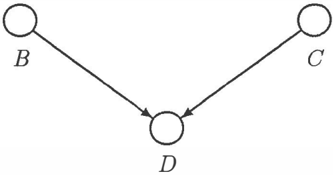
The image depicts a simple directed graph with three nodes labeled **B**, **C**, and **D**. Arrows indicate unidirectional relationships: one from **B** to **D** and another from **C** to **D**. No additional labels, legends, or numerical data are present.
### Components/Axes
- **Nodes**:
- **B**: Positioned at the top-left.
- **C**: Positioned at the top-right.
- **D**: Positioned at the bottom-center.
- **Edges**:
- **B → D**: Arrow originates at **B** and terminates at **D**.
- **C → D**: Arrow originates at **C** and terminates at **D**.
- **No legends, axis titles, or scales** are visible.
### Detailed Analysis
- **Node Placement**:
- **B** and **C** are spatially equidistant from the center, flanking **D** symmetrically.
- **D** acts as a central convergence point for both **B** and **C**.
- **Edge Directionality**:
- All edges are unidirectional, with no bidirectional or self-looping connections.
- No edge labels or weights are provided.
### Key Observations
1. **Centralized Dependency**: **D** receives input from both **B** and **C**, suggesting a role as a sink or aggregator.
2. **Symmetry**: The layout is balanced, with **B** and **C** mirroring each other relative to **D**.
3. **Minimalism**: The diagram lacks annotations, colors, or contextual metadata beyond node labels.
### Interpretation
This diagram likely represents a simplified workflow, dependency graph, or process flow where **B** and **C** contribute to or influence **D**. The absence of additional context (e.g., edge labels, node attributes) limits granular interpretation. However, the directional arrows emphasize causality or sequential relationships: **B** and **C** precede **D** in the depicted process.
**Notable Patterns**:
- **D** is the sole recipient of input, indicating potential bottlenecks or centralization risks if scaled.
- The lack of outgoing edges from **D** suggests it may be a terminal node or require external processing beyond the diagram’s scope.
**Underlying Implications**:
- The structure could model systems where two independent sources (B/C) converge on a single target (D), such as data pipelines, decision trees, or resource allocation models.
- Further analysis would require additional metadata (e.g., edge weights, node capacities) to quantify relationships.