## Diagram: Computational Complexity Relationships
### Overview
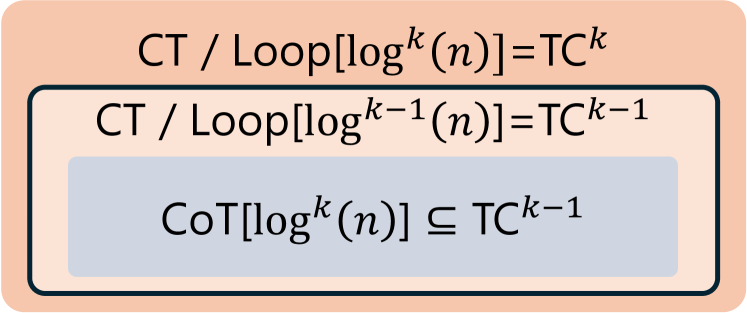
The diagram presents a hierarchical relationship between computational complexity classes (CT, Loop, CoT, TC) parameterized by logarithmic terms and exponents. It uses three horizontal sections to illustrate dependencies between these classes across different logarithmic scales.
### Components/Axes
1. **Top Section**
- Label: `CT / Loop[log^k(n)] = TC^k`
- Color: Light beige background
- Position: Topmost horizontal band
2. **Middle Section**
- Label: `CT / Loop[log^{k-1}(n)] = TC^{k-1}`
- Color: Light beige background
- Position: Middle horizontal band
3. **Bottom Section**
- Label: `CoT[log^k(n)] ⊆ TC^{k-1}`
- Color: Dark blue background
- Position: Bottom horizontal band
**Key Symbols**:
- `⊆` (subset symbol) in bottom section
- Exponent notation: `log^k(n)` and `log^{k-1}(n)`
- Class abbreviations: CT, Loop, CoT, TC
### Detailed Analysis
1. **Top Section**
- Equation: `CT / Loop[log^k(n)] = TC^k`
- Interpretation: Computational Time (CT) divided by Loop complexity at logarithmic scale `log^k(n)` equals Time Complexity (TC) raised to the k-th power.
2. **Middle Section**
- Equation: `CT / Loop[log^{k-1}(n)] = TC^{k-1}`
- Interpretation: Similar to the top section but with reduced logarithmic scale (`k-1`), resulting in TC raised to the (k-1)-th power.
3. **Bottom Section**
- Equation: `CoT[log^k(n)] ⊆ TC^{k-1}`
- Interpretation: Computational Overhead Time (CoT) at `log^k(n)` is a subset of TC raised to the (k-1)-th power, indicating hierarchical inclusion.
### Key Observations
- **Exponent Progression**: The middle section reduces the logarithmic exponent from `k` to `k-1`, correlating with a proportional reduction in TC's exponent.
- **Subset Relationship**: The bottom section introduces a subset notation (`⊆`), suggesting CoT is bounded by TC^{k-1} but not necessarily equal.
- **Color Coding**: The darker blue in the bottom section may imply a distinct category or stricter constraint compared to the lighter beige sections.
### Interpretation
The diagram illustrates a **hierarchical dependency** between computational complexity classes:
1. **Reduction Principle**: Decreasing the logarithmic exponent (`k → k-1`) proportionally reduces the Time Complexity exponent (TC^k → TC^{k-1}).
2. **Inclusion Relationship**: CoT at `log^k(n)` is constrained within TC^{k-1}, implying CoT is a specialized or optimized variant of TC under specific conditions.
3. **Structural Implication**: The use of division (`/`) in the top/middle sections suggests a normalization or efficiency metric, while the subset notation in the bottom section emphasizes containment rather than equivalence.
This structure likely models computational trade-offs in algorithmic design, where logarithmic scaling and exponent adjustments govern performance bounds.