## Diagram: Object Configuration Transformation
### Overview
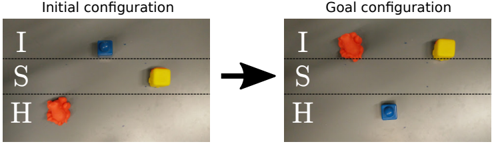
The image displays a two-panel diagram illustrating a transformation from an "Initial configuration" to a "Goal configuration." It depicts the rearrangement of three distinct objects across three labeled positions or lanes. The diagram is likely from a robotics, planning, or puzzle-solving context, demonstrating a target state for an object manipulation task.
### Components/Axes
* **Panels:** Two side-by-side rectangular panels.
* **Left Panel:** Labeled "Initial configuration" at the top.
* **Right Panel:** Labeled "Goal configuration" at the top.
* **Positions/Lanes:** Each panel contains three horizontal lanes, demarcated by dashed lines. They are labeled on the left side with single letters:
* **I** (Top lane)
* **S** (Middle lane)
* **H** (Bottom lane)
* **Objects:** Three distinct 3D-rendered objects are present in each panel.
* A **blue cube**.
* A **yellow cube**.
* An **orange sphere**.
* **Transformation Indicator:** A solid black arrow points from the center of the "Initial configuration" panel to the center of the "Goal configuration" panel, indicating the direction of change.
### Detailed Analysis
**Initial Configuration (Left Panel):**
* **Lane I (Top):** Contains the **blue cube**. Positioned roughly in the center of the lane.
* **Lane S (Middle):** Contains the **yellow cube**. Positioned roughly in the center of the lane.
* **Lane H (Bottom):** Contains the **orange sphere**. Positioned roughly in the center of the lane.
**Goal Configuration (Right Panel):**
* **Lane I (Top):** Contains the **orange sphere**. Positioned roughly in the center of the lane.
* **Lane S (Middle):** Contains the **yellow cube**. Positioned roughly in the center of the lane.
* **Lane H (Bottom):** Contains the **blue cube**. Positioned roughly in the center of the lane.
**Transformation Summary:**
The change involves a swap of the objects between lanes I and H. The object in lane S (the yellow cube) remains in its original position.
### Key Observations
1. **Object Permanence & Identity:** The same three objects (blue cube, yellow cube, orange sphere) are present in both configurations. Their identities (color and shape) are preserved.
2. **Fixed Point:** The yellow cube in the middle lane (S) is the only object that does not change position between the initial and goal states.
3. **Symmetric Swap:** The transformation is a clean, symmetric exchange: the object from the top lane moves to the bottom lane, and the object from the bottom lane moves to the top lane.
4. **Spatial Consistency:** Within each panel, objects are centered within their respective lanes. The lane labels (I, S, H) are consistently placed on the far left.
### Interpretation
This diagram defines a clear **rearrangement goal**. It provides the "before" and "after" states for a task, implying that an agent (e.g., a robot, a software planner) must execute actions to move the objects from the initial layout to the goal layout.
The data suggests a task with the following constraints or characteristics:
* **Selective Movement:** Only two of the three objects require relocation. The system must recognize that the yellow cube is already in its goal state and should not be moved.
* **Specific Target Mapping:** The goal is not just a general "sort by color/shape" but a precise mapping of object identity to lane identity (Blue Cube -> H, Orange Sphere -> I, Yellow Cube -> S).
* **Underlying Logic:** The labels "I", "S", "H" could be abbreviations for specific locations, states, or categories (e.g., Input, Storage, Home; or In, Safe, Hazard). The transformation might represent a logical operation like swapping input and home positions while keeping a storage item fixed. The absence of other data (like coordinates or action sequences) indicates this is a high-level specification, not a detailed motion plan.