## Flowchart: Multimodal Processing Pipeline with Reinforcement Learning
### Overview
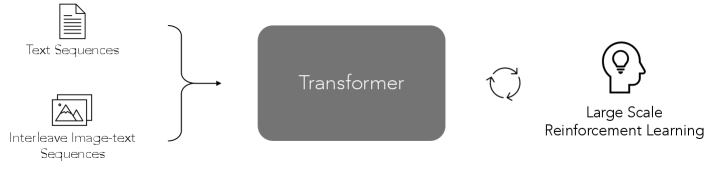
The image depicts a technical workflow diagram illustrating a multimodal processing pipeline. It shows the integration of text and image-text sequences through a Transformer model, followed by large-scale reinforcement learning. The diagram uses directional arrows to indicate data flow and feedback loops.
### Components/Axes
1. **Input Components**:
- **Text Sequences**: Represented by a document icon (top-left)
- **Interleave Image-text Sequences**: Represented by a picture icon (bottom-left)
2. **Processing Component**:
- **Transformer**: Central gray block labeled "Transformer"
3. **Output Component**:
- **Large Scale Reinforcement Learning**: Represented by a brain icon with a lightbulb (right side)
4. **Flow Indicators**:
- Double-sided arrow between input components and Transformer
- Circular arrow connecting Transformer output to reinforcement learning
### Detailed Analysis
- **Text Sequences** and **Interleave Image-text Sequences** are positioned vertically on the left side, suggesting sequential or parallel input processing.
- The **Transformer** block occupies the central position, acting as the core processing unit.
- The **Large Scale Reinforcement Learning** component is isolated on the right, receiving processed output from the Transformer.
- Arrows indicate bidirectional relationships:
- Forward flow from inputs → Transformer → Reinforcement Learning
- Feedback loop from Reinforcement Learning back to Transformer
### Key Observations
1. The diagram emphasizes multimodal integration through the "Interleave Image-text Sequences" component.
2. The Transformer's central position highlights its role as the primary processing engine.
3. The circular arrow between Transformer and Reinforcement Learning suggests iterative model improvement.
4. No numerical data or quantitative metrics are present in the diagram.
### Interpretation
This pipeline demonstrates a hybrid approach to AI model development:
1. **Multimodal Foundation**: Combines pure text and image-text data for comprehensive input representation.
2. **Transformer Processing**: Utilizes state-of-the-art architecture for sequence modeling and cross-modal understanding.
3. **Reinforcement Learning Integration**: Implements large-scale optimization through feedback-driven learning, likely for:
- Improving cross-modal alignment
- Enhancing sequence prediction accuracy
- Optimizing model performance through iterative refinement
The feedback loop between Transformer and Reinforcement Learning implies a self-improving system where model outputs are continuously optimized through reinforcement signals. This architecture suggests applications in complex tasks requiring both multimodal understanding and adaptive learning capabilities, such as advanced dialogue systems or cross-modal content generation.