## Radial Chart: Math Problem Categories
### Overview
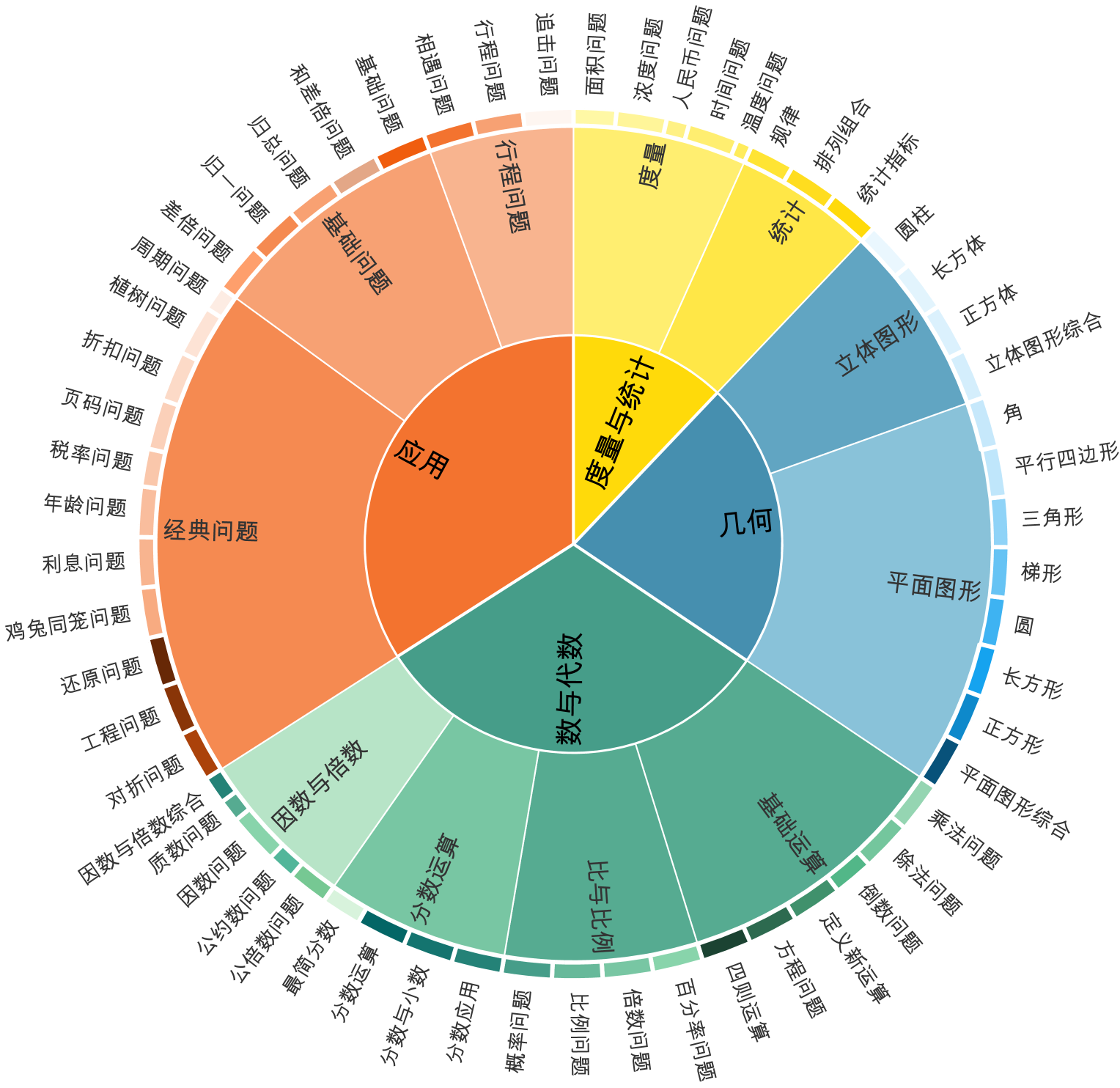
The image is a radial chart illustrating the categorization of math problems. The chart is divided into several layers, each representing a broader category that branches into more specific subcategories. The chart is written in Chinese.
### Components/Axes
* **Center:** The innermost layer is labeled "度量与统计" (Dùliàng yǔ tǒngjì), which translates to "Measurement and Statistics."
* **Second Layer:** This layer is divided into four main categories:
* "应用" (Yìngyòng) - Application (Orange)
* "几何" (Jǐhé) - Geometry (Blue)
* "数与代数" (Shù yǔ dàishù) - Numbers and Algebra (Green)
* "度量" (Dùliàng) - Measurement (Yellow)
* "统计" (Tǒngjì) - Statistics (Yellow)
* **Outer Layers:** These layers contain subcategories of math problems, branching out from the main categories.
### Detailed Analysis or ### Content Details
**1. 应用 (Yìngyòng) - Application (Orange):**
* "行程问题" (Xíngchéng wèntí) - Travel Problems
* "追击问题" (Zhuījī wèntí) - Pursuit Problems
* "相遇问题" (Xiāngyù wèntí) - Meeting Problems
* "基础问题" (Jīchǔ wèntí) - Basic Problems
* "和差倍问题" (Hé chā bèi wèntí) - Sum, Difference, and Multiple Problems
* "归总问题" (Guīzǒng wèntí) - Total Return Problems
* "归一问题" (Guī yī wèntí) - Unitary Method Problems
* "差倍问题" (Chā bèi wèntí) - Difference and Multiple Problems
* "周期问题" (Zhōuqí wèntí) - Period Problems
* "植树问题" (Zhí shù wèntí) - Tree Planting Problems
* "折扣问题" (Zhékòu wèntí) - Discount Problems
* "页码问题" (Yèmǎ wèntí) - Page Number Problems
* "税率问题" (Shuìlǜ wèntí) - Tax Rate Problems
* "年龄问题" (Niánlíng wèntí) - Age Problems
* "利息问题" (Lìxī wèntí) - Interest Problems
* "鸡兔同笼问题" (Jī tù tóng lóng wèntí) - Chicken and Rabbit in the Same Cage Problems
* "还原问题" (Huányuán wèntí) - Restoration Problems
* "工程问题" (Gōngchéng wèntí) - Work Problems
* "经典问题" (Jīngdiǎn wèntí) - Classic Problems
**2. 几何 (Jǐhé) - Geometry (Blue):**
* "立体图形综合" (Lìtǐ túxíng zònghé) - Comprehensive Solid Geometry
* "正方体" (Zhèngfāngtǐ) - Cube
* "长方体" (Chángfāngtǐ) - Cuboid
* "圆柱" (Yuánzhù) - Cylinder
* "立体图形" (Lìtǐ túxíng) - Solid Geometry
* "统计指标" (Tǒngjì zhǐbiāo) - Statistical Indicators
* "排列组合" (Páilie zǔhé) - Permutations and Combinations
* "角" (Jiǎo) - Angle
* "平行四边形" (Píngxíng sìbiānxíng) - Parallelogram
* "三角形" (Sānjiǎoxíng) - Triangle
* "梯形" (Tīxíng) - Trapezoid
* "圆" (Yuán) - Circle
* "长方形" (Chángfāngxíng) - Rectangle
* "正方形" (Zhèngfāngxíng) - Square
* "平面图形综合" (Píngmiàn túxíng zònghé) - Comprehensive Plane Geometry
* "平面图形" (Píngmiàn túxíng) - Plane Geometry
**3. 数与代数 (Shù yǔ dàishù) - Numbers and Algebra (Green):**
* "比例问题" (Bǐlì wèntí) - Proportion Problems
* "倍数问题" (Bèishù wèntí) - Multiple Problems
* "百分率问题" (Bǎifēn lǜ wèntí) - Percentage Problems
* "四则运算" (Sìzéi yùsuàn) - Four Arithmetic Operations
* "方程问题" (Fāngchéng wèntí) - Equation Problems
* "定义新运算" (Dìngyì xīn yùsuàn) - Defined New Operations
* "倒数问题" (Dàoshù wèntí) - Reciprocal Problems
* "除法问题" (Chúfǎ wèntí) - Division Problems
* "乘法问题" (Chéngfǎ wèntí) - Multiplication Problems
* "基础运算" (Jīchǔ yùsuàn) - Basic Operations
* "比与比例" (Bǐ yǔ bǐlì) - Ratio and Proportion
* "概率问题" (Gàilǜ wèntí) - Probability Problems
* "分数应用" (Fēnshù yìngyòng) - Fraction Applications
* "分数与小数" (Fēnshù yǔ xiǎoshù) - Fractions and Decimals
* "分数运算" (Fēnshù yùsuàn) - Fraction Operations
* "最简分数" (Zuì jiǎn fēnshù) - Simplest Fraction
* "公倍数问题" (Gōngbèishù wèntí) - Common Multiple Problems
* "公约数问题" (Gōngyuēshù wèntí) - Common Factor Problems
* "因数与倍数综合" (Yīnsù yǔ bèishù zònghé) - Comprehensive Factors and Multiples
* "质数问题" (Zhìshù wèntí) - Prime Number Problems
* "因数问题" (Yīnsù wèntí) - Factor Problems
* "因数与倍数" (Yīnsù yǔ bèishù) - Factors and Multiples
**4. 度量 (Dùliàng) - Measurement (Yellow):**
* "规律" (Guīlǜ) - Pattern
* "温度问题" (Wēndù wèntí) - Temperature Problems
* "时间问题" (Shíjiān wèntí) - Time Problems
* "人民币问题" (Rénmínbì wèntí) - RMB Problems
* "浓度问题" (Nóngdù wèntí) - Concentration Problems
* "面积问题" (Miànjī wèntí) - Area Problems
### Key Observations
* The chart provides a hierarchical breakdown of math problems, starting from broad categories and drilling down to specific types.
* The "Application" category has the most subcategories, indicating a wide range of real-world problem-solving scenarios.
* The "Geometry" category covers both solid and plane geometry concepts.
* The "Numbers and Algebra" category includes various arithmetic operations, fractions, ratios, and probability.
* The "Measurement" category focuses on practical measurement-related problems.
### Interpretation
The radial chart serves as a visual guide for categorizing and understanding different types of math problems. It highlights the relationships between broad mathematical concepts and specific problem-solving techniques. This type of chart is useful for students, teachers, and anyone interested in organizing and navigating the landscape of mathematical problems. The chart suggests that problem-solving in mathematics is highly interconnected, with various concepts and techniques building upon each other.