## Grouped Bar Chart: Accuracy of PoG vs. PoG-E by SPARQL Path Length
### Overview
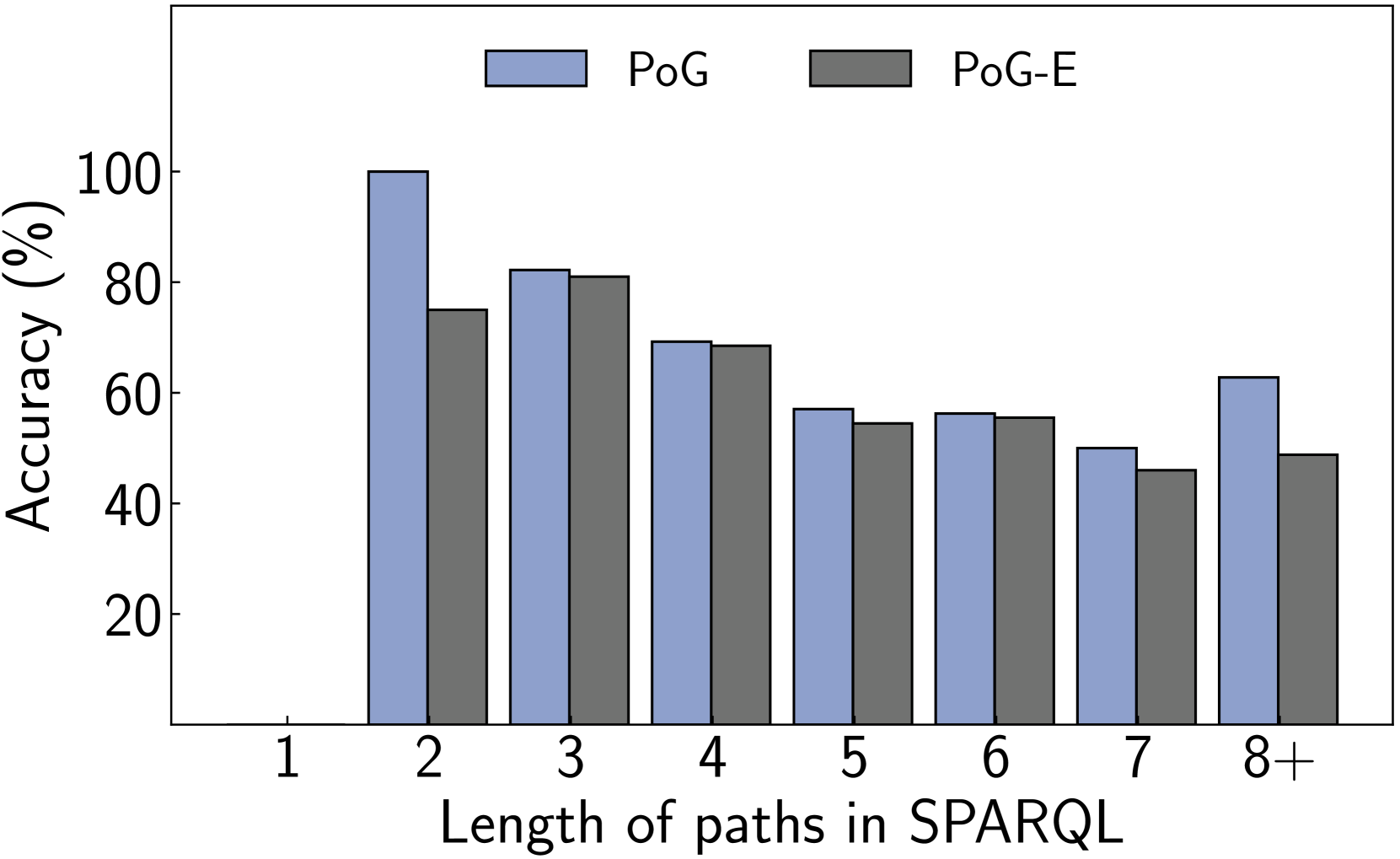
The image is a grouped bar chart comparing the accuracy (in percentage) of two methods, labeled "PoG" and "PoG-E," across different lengths of paths in SPARQL queries. The chart demonstrates how the performance of each method changes as the complexity (path length) of the query increases.
### Components/Axes
* **Chart Type:** Grouped (clustered) bar chart.
* **X-Axis:** Labeled **"Length of paths in SPARQL"**. It has categorical tick marks for path lengths: **1, 2, 3, 4, 5, 6, 7, and 8+**.
* **Y-Axis:** Labeled **"Accuracy (%)"**. It is a linear scale ranging from 0 to 100, with major tick marks at intervals of 20 (0, 20, 40, 60, 80, 100).
* **Legend:** Positioned at the **top center** of the chart area.
* **PoG:** Represented by a light blue (periwinkle) bar.
* **PoG-E:** Represented by a dark gray bar.
* **Data Series:** Two series of bars, one for each method, grouped together for each x-axis category.
### Detailed Analysis
The following table reconstructs the approximate accuracy values for each method at each path length. Values are estimated from the bar heights relative to the y-axis.
| Length of paths in SPARQL | PoG Accuracy (Approx. %) | PoG-E Accuracy (Approx. %) |
| :--- | :--- | :--- |
| 1 | No data plotted | No data plotted |
| 2 | 100 | ~75 |
| 3 | ~82 | ~80 |
| 4 | ~70 | ~69 |
| 5 | ~58 | ~55 |
| 6 | ~57 | ~56 |
| 7 | ~50 | ~46 |
| 8+ | ~62 | ~49 |
**Trend Verification:**
* **PoG (Light Blue):** The trend line slopes downward from a peak at path length 2 (100%) to a low at length 7 (~50%), with a notable upward rebound at length 8+ (~62%).
* **PoG-E (Dark Gray):** The trend line shows a consistent, gradual downward slope from its highest point at length 2 (~75%) to its lowest at length 7 (~46%), with a very slight increase at length 8+ (~49%).
### Key Observations
1. **Performance Gap:** PoG consistently achieves higher accuracy than PoG-E across all reported path lengths where data is present (2 through 8+).
2. **Peak Performance:** Both methods achieve their highest accuracy at the shortest measured path length (2). PoG reaches a perfect 100% here.
3. **General Decline:** There is a clear general trend of decreasing accuracy for both methods as the SPARQL path length increases from 2 to 7.
4. **Anomaly at 8+:** The expected downward trend is broken at the "8+" category. PoG shows a significant recovery in accuracy (~62%), while PoG-E shows only a marginal increase (~49%). This suggests PoG may handle very long paths better than the general trend would predict.
5. **Convergence Points:** The performance of the two methods is closest at path lengths 3, 4, and 6, where the difference in bar heights is minimal (within ~2-3 percentage points).
6. **Missing Data:** No accuracy data is plotted for a path length of 1.
### Interpretation
The data suggests that the **PoG method is generally more accurate than PoG-E** for generating or answering SPARQL queries of varying path complexities. The strong performance of PoG at length 2 (100%) indicates it is highly reliable for simpler queries.
The **inverse relationship between path length and accuracy** for both methods (from length 2 to 7) demonstrates that increasing query complexity—measured by the number of hops or relationships in the path—poses a significant challenge, leading to a drop in performance. This is a common pattern in knowledge graph and semantic web tasks.
The **notable outlier is the "8+" category for PoG**. Its accuracy rebound suggests one of two possibilities: 1) The "8+" bin may contain a different distribution of query types that PoG is better suited for, or 2) The method has a specific architectural advantage for handling very long-range dependencies that does not scale linearly with intermediate lengths. This anomaly would be a critical point for further investigation in a technical paper.
The **relatively small performance gap at lengths 3, 4, and 6** indicates that for mid-complexity queries, the choice between PoG and PoG-E may depend on other factors like computational cost or recall, as their accuracy is nearly equivalent. The widening gap at lengths 2, 7, and 8+ highlights the scenarios where PoG's advantage is most pronounced.