## Association Diagram: "rob" to "arrest"
### Overview
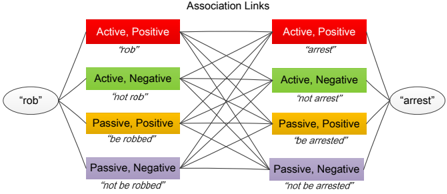
The image is a diagram illustrating association links between the words "rob" and "arrest". It shows how these words can be connected through active/passive and positive/negative associations. The diagram uses colored rectangles to represent these associations, with lines connecting the initial word "rob" to these associations and then to the final word "arrest".
### Components/Axes
* **Title:** Association Links
* **Nodes:**
* Left Node: "rob" (oval shape)
* Right Node: "arrest" (oval shape)
* **Association Blocks (Left Side):**
* Red: Active, Positive; "rob"
* Green: Active, Negative; "not rob"
* Orange: Passive, Positive; "be robbed"
* Purple: Passive, Negative; "not be robbed"
* **Association Blocks (Right Side):**
* Red: Active, Positive; "arrest"
* Green: Active, Negative; "not arrest"
* Orange: Passive, Positive; "be arrested"
* Purple: Passive, Negative; "not be arrested"
* **Links:** Lines connecting "rob" to each of the four association blocks on the left, and lines connecting each of those blocks to each of the four association blocks on the right, and lines connecting each of the four association blocks on the right to "arrest".
### Detailed Analysis
The diagram visually represents the different ways the words "rob" and "arrest" can be associated. Each association block is defined by two attributes: Active/Passive and Positive/Negative.
* **Left Side ("rob"):**
* **Red (Active, Positive):** The action of robbing is actively performed, and the outcome is positive (from the perspective of the robber). The associated word is "rob".
* **Green (Active, Negative):** The action of robbing is actively performed, and the outcome is negative (from the perspective of the victim). The associated phrase is "not rob".
* **Orange (Passive, Positive):** The subject is passively receiving the action of being robbed, and the outcome is positive (perhaps in a twisted sense, like insurance payout). The associated phrase is "be robbed".
* **Purple (Passive, Negative):** The subject is passively receiving the action of being robbed, and the outcome is negative. The associated phrase is "not be robbed".
* **Right Side ("arrest"):**
* **Red (Active, Positive):** The action of arresting is actively performed, and the outcome is positive (from the perspective of law enforcement). The associated word is "arrest".
* **Green (Active, Negative):** The action of arresting is actively performed, and the outcome is negative (from the perspective of the person being arrested). The associated phrase is "not arrest".
* **Orange (Passive, Positive):** The subject is passively receiving the action of being arrested, and the outcome is positive (perhaps in a sense of justice being served). The associated phrase is "be arrested".
* **Purple (Passive, Negative):** The subject is passively receiving the action of being arrested, and the outcome is negative. The associated phrase is "not be arrested".
The lines connecting the blocks show all possible combinations of associations between "rob" and "arrest".
### Key Observations
* The diagram highlights the multifaceted relationships between two seemingly straightforward words.
* The use of Active/Passive and Positive/Negative attributes provides a structured way to analyze these relationships.
* The diagram demonstrates how a single action (robbery) can lead to different outcomes and perspectives, ultimately connecting to another action (arrest).
### Interpretation
The diagram illustrates the complex web of associations that can exist between words, going beyond simple definitions. It demonstrates how actions can be viewed from different perspectives (active vs. passive) and with varying outcomes (positive vs. negative). The connections between "rob" and "arrest" are not direct but are mediated by these different associations, showing the potential for nuanced understanding of language and events. The diagram suggests that understanding the context and perspective is crucial for interpreting the relationship between actions and their consequences.