\n
## Diagram: Knowledge Graph Representation
### Overview
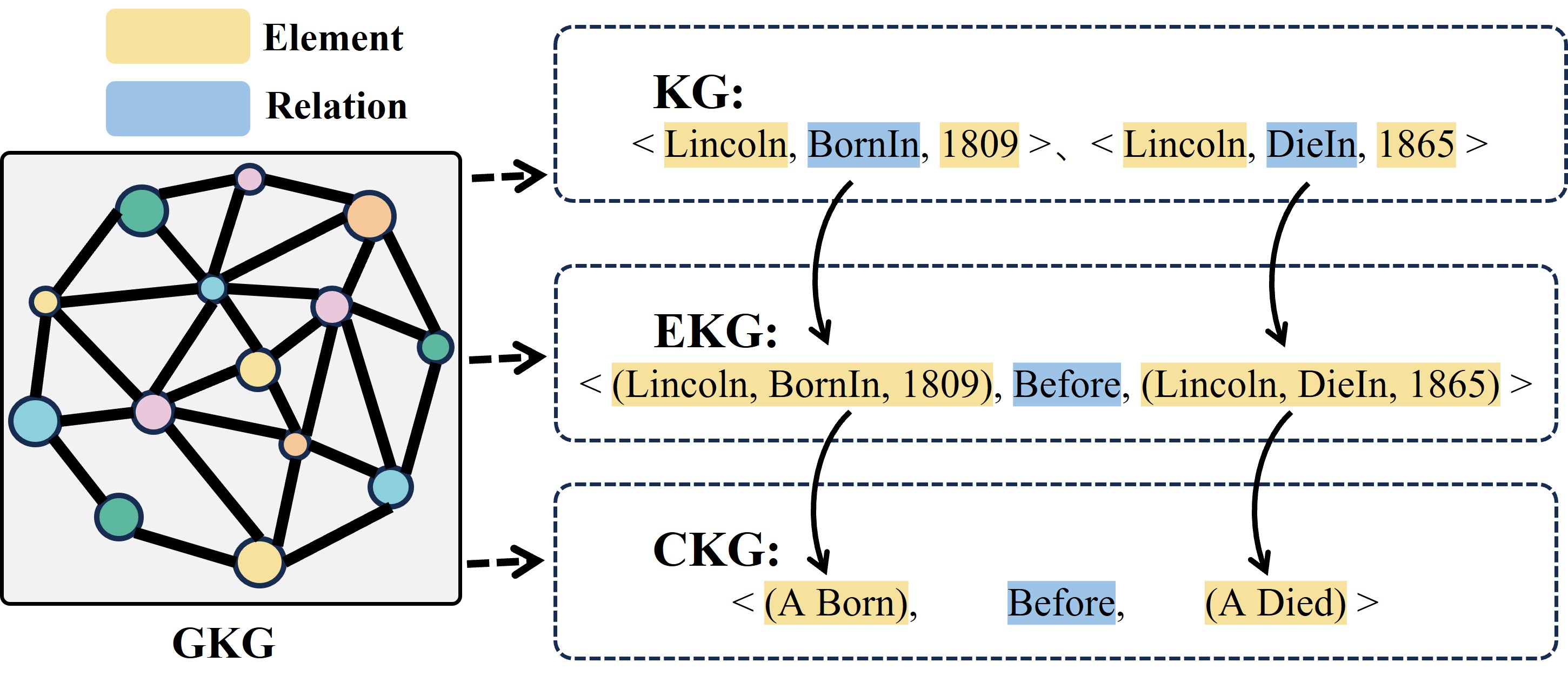
The image presents a diagram illustrating the transformation of a Knowledge Graph (KG) into an Event Knowledge Graph (EKG) and a Common Knowledge Graph (CKG). It visually represents how relationships between entities are structured and abstracted across these different graph types. The left side shows a complex graph structure labeled "GKG", while the right side shows three boxes representing KG, EKG, and CKG, with example relationships within each.
### Components/Axes
The diagram consists of the following components:
* **GKG (Graph Knowledge Graph):** A complex network of nodes (purple) and edges (gray) representing entities and their relationships.
* **KG (Knowledge Graph):** A box containing two example relationships: `<Lincoln, BornIn, 1809>` and `<Lincoln, DieIn, 1865>`.
* **EKG (Event Knowledge Graph):** A box containing a single example relationship: `<(Lincoln, BornIn, 1809), Before, (Lincoln, DieIn, 1865)>`.
* **CKG (Common Knowledge Graph):** A box containing a single example relationship: `<(A Born), Before, (A Died)>`.
* **Legend:** Located in the top-left corner, defining the color coding:
* Yellow: "Element"
* Blue: "Relation"
* **Arrows:** Arrows connect the GKG to each of the KG, EKG, and CKG boxes, indicating a transformation or projection process.
### Detailed Analysis or Content Details
Let's break down the content within each section:
* **GKG:** This is a complex graph with approximately 20 nodes (purple circles) interconnected by numerous edges (gray lines). The exact number of nodes and edges is difficult to determine precisely without a higher-resolution image. The graph appears to be fully connected or nearly so.
* **KG:** This section represents a simplified knowledge graph. It contains two triples:
* `<Lincoln, BornIn, 1809>`: Lincoln was born in 1809.
* `<Lincoln, DieIn, 1865>`: Lincoln died in 1865.
* **EKG:** This section represents an event knowledge graph. It contains one triple:
* `<(Lincoln, BornIn, 1809), Before, (Lincoln, DieIn, 1865)>`: The event "Lincoln was born in 1809" happened before the event "Lincoln died in 1865".
* **CKG:** This section represents a common knowledge graph. It contains one triple:
* `<(A Born), Before, (A Died)>`: The event "A was born" happened before the event "A died".
### Key Observations
* The diagram illustrates a progression from a detailed graph (GKG) to more abstract representations (KG, EKG, CKG).
* The EKG and CKG represent relationships *between* events, rather than relationships between entities and attributes as in the KG.
* The CKG generalizes the relationship found in the EKG, using "A" instead of "Lincoln".
* The legend clearly defines the visual representation of "Element" (yellow) and "Relation" (blue).
### Interpretation
The diagram demonstrates a method for representing knowledge at different levels of abstraction. The GKG represents a rich, detailed knowledge base. The KG extracts specific facts about entities. The EKG focuses on temporal relationships between events involving those entities. Finally, the CKG generalizes these relationships into common-sense knowledge applicable to any entity.
The transformation from GKG to KG involves selecting specific relationships. The transformation from KG to EKG involves creating new relationships *between* existing relationships, specifically focusing on temporal order. The transformation from EKG to CKG involves generalization, replacing specific entities with abstract placeholders.
This approach is useful for tasks such as reasoning about events, making inferences, and building more robust knowledge-based systems. The diagram highlights the importance of representing knowledge not only as facts about entities but also as relationships between events and common-sense knowledge. The use of triples (subject, predicate, object) is a standard way to represent knowledge in knowledge graphs.