\n
## Diagram: Knowledge Graph Reasoning Path
### Overview
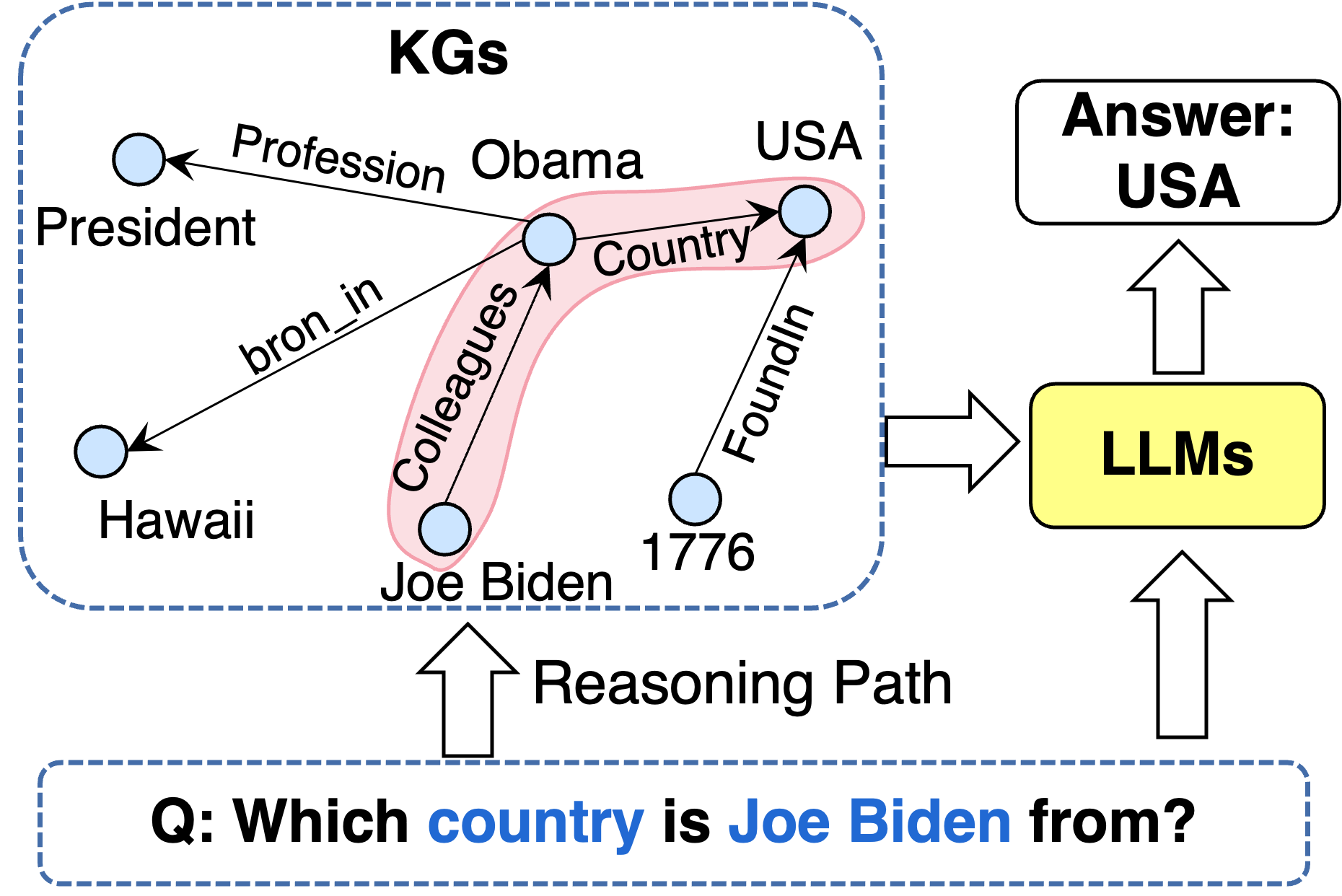
The image depicts a diagram illustrating a reasoning path used by Large Language Models (LLMs) to answer a question using Knowledge Graphs (KGs). The diagram shows how a question is processed through a KG to arrive at an answer.
### Components/Axes
The diagram consists of several key components:
* **Question:** "Q: Which country is Joe Biden from?" – Located at the bottom of the diagram, enclosed in a rounded rectangle with a dark brown fill.
* **Reasoning Path:** An arrow labeled "Reasoning Path" points upwards from the question towards the Knowledge Graph.
* **Knowledge Graphs (KGs):** A dashed-border rectangle labeled "KGs" in the top-left of the diagram, containing nodes and edges representing entities and relationships.
* **LLMs:** A yellow rectangle labeled "LLMs" in the center-right of the diagram, representing the Large Language Model.
* **Answer:** A dark green rectangle labeled "Answer: USA" in the top-right of the diagram.
* **Nodes:** Represent entities like "Joe Biden", "Obama", "USA", "Hawaii", "President", and "1776".
* **Edges:** Represent relationships between entities, labeled as "bron_in", "Colleagues", "Country", and "FoundIn".
* **Arrows:** Indicate the flow of information from the question to the KGs, from the KGs to the LLMs, and from the LLMs to the answer.
### Detailed Analysis or Content Details
The Knowledge Graph (KGs) section shows the following relationships:
* "Joe Biden" is related to "Hawaii" via the edge labeled "bron_in".
* "Joe Biden" is related to "Obama" via the edge labeled "Colleagues".
* "Obama" is related to "USA" via the edge labeled "Country".
* "USA" is related to "1776" via the edge labeled "FoundIn".
* "President" is related to "Obama" via the edge labeled "Profession".
The diagram shows a flow of information:
1. The question "Which country is Joe Biden from?" is posed.
2. The Reasoning Path directs the LLM to the KGs.
3. The LLM processes the information within the KGs, following the relationships between entities.
4. The LLM arrives at the answer "USA".
### Key Observations
The diagram highlights the use of a knowledge graph to provide context and reasoning for answering a question. The path taken through the graph demonstrates how the LLM can infer the answer by connecting related entities. The diagram emphasizes the importance of structured knowledge representation in enabling LLMs to perform complex reasoning tasks.
### Interpretation
This diagram illustrates a simplified model of how LLMs leverage knowledge graphs to answer questions. The KGs provide a structured representation of facts and relationships, allowing the LLM to "reason" by traversing the graph and identifying relevant information. The diagram suggests that the LLM doesn't simply retrieve information but rather constructs a reasoning path to arrive at the answer. The use of a visual representation helps to understand the complex process of knowledge retrieval and reasoning within an LLM system. The diagram is a conceptual illustration and doesn't represent the full complexity of LLM architectures or knowledge graph implementations. It serves as a pedagogical tool to explain the core concept of KG-augmented LLMs.