## Diagram: Causal Diffusion Modeling Architecture
### Overview
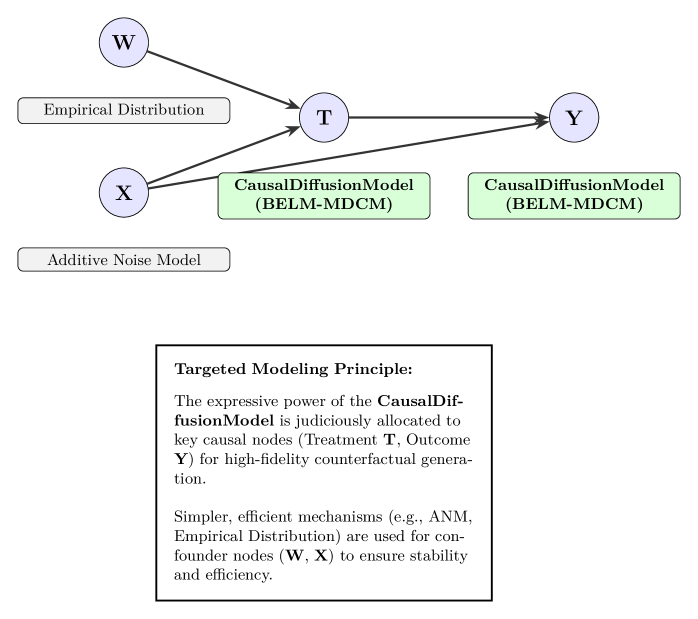
The diagram illustrates a hierarchical causal modeling system with nodes representing data distributions, causal models, and noise mechanisms. Arrows indicate directional relationships and data flow between components.
### Components/Axes
- **Nodes**:
- **W**: Empirical Distribution
- **X**: Input/Founder Node
- **Y**: Outcome Node
- **T**: Treatment Node
- **Arrows**:
- **W → T**: Labeled "Empirical Distribution"
- **T → Y**: Labeled "CausalDiffusionModel (BELM-MDCM)"
- **X → T**: Labeled "CausalDiffusionModel (BELM-MDCM)"
- **X → Additive Noise Model**: Implied by connection
- **Text Box**: Contains "Targeted Modeling Principle" with explanatory text
### Detailed Analysis
1. **Empirical Distribution (W)**:
- Positioned at the top-left, feeding into Treatment (T)
- Represents observed data distribution
2. **CausalDiffusionModel (BELM-MDCM)**:
- Appears twice in the diagram:
- Between T and Y (outcome generation)
- Between X and T (treatment modeling)
- Highlighted in green boxes, emphasizing its central role
3. **Additive Noise Model**:
- Connected to X, suggesting noise injection at the input stage
4. **Targeted Modeling Principle**:
- Text box explains:
- CausalDiffusionModel's role in allocating causal nodes (T, Y)
- Use of simpler mechanisms (ANM, Empirical Distribution) for stability
- Focus on high-fidelity counterfactual generation
### Key Observations
- **Hierarchical Flow**: Data flows from empirical distribution (W) through treatment (T) to outcome (Y)
- **Dual Causal Model Usage**: BELM-MDCM operates at both treatment and outcome levels
- **Noise Injection**: Additive Noise Model modifies input (X) before processing
- **Principle Alignment**: Architecture directly implements the stated modeling philosophy
### Interpretation
This architecture demonstrates a causal inference system where:
1. Empirical data (W) is processed through a treatment model (T) using causal diffusion
2. The outcome (Y) is generated via another causal diffusion step
3. Input stability is maintained through noise modeling at the founder node (X)
4. The system prioritizes causal node allocation (T, Y) for high-fidelity generation while using simpler mechanisms for foundational stability
The diagram visually reinforces the principle that complex causal modeling (BELM-MDCM) should be reserved for key causal nodes, while simpler methods handle foundational elements. The dual use of CausalDiffusionModel suggests its versatility in different stages of the causal chain.