## Scatter Plot: MUSHRA Score vs. Bitrate (kbps)
### Overview
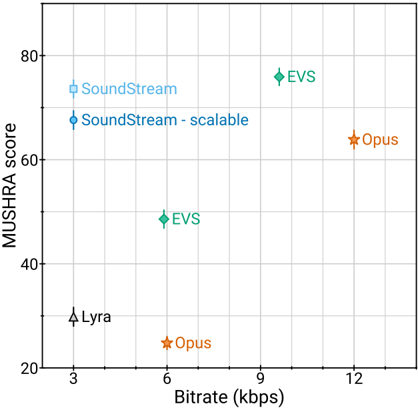
The image is a scatter plot comparing audio codec performance using MUSHRA scores (y-axis) against bitrate (x-axis). Five data points represent different audio systems: SoundStream, SoundStream - scalable, EVS, Opus, and Lyra. The plot highlights trade-offs between compression efficiency (bitrate) and perceived quality (MUSHRA score).
### Components/Axes
- **X-axis (Bitrate)**: Labeled "Bitrate (kbps)" with values from 3 to 12 kbps.
- **Y-axis (MUSHRA Score)**: Labeled "MUSHRA score" with values from 20 to 80.
- **Legend**: Located in the top-left corner, mapping symbols to systems:
- Blue square: SoundStream
- Blue circle: SoundStream - scalable
- Green diamond: EVS
- Orange star: Opus
- Black triangle: Lyra
### Detailed Analysis
- **SoundStream**:
- Blue square at (3 kbps, 70 MUSHRA).
- Blue circle (scalable version) at (3 kbps, 65 MUSHRA).
- **EVS**:
- Green diamond at (6 kbps, 50 MUSHRA).
- Green diamond at (9 kbps, 75 MUSHRA).
- **Opus**:
- Orange star at (12 kbps, 65 MUSHRA).
- Orange star at (12 kbps, 25 MUSHRA).
- **Lyra**:
- Black triangle at (3 kbps, 30 MUSHRA).
### Key Observations
1. **Bitrate-Quality Trade-off**: Higher bitrates generally correlate with higher MUSHRA scores (e.g., EVS at 9 kbps scores 75 vs. 50 at 6 kbps).
2. **Outliers**:
- Opus at 12 kbps has two divergent scores (65 and 25), suggesting variability in performance under specific conditions.
- Lyra consistently underperforms, with the lowest score (30) at the lowest bitrate (3 kbps).
3. **Scalability Impact**: SoundStream - scalable (blue circle) scores 5 MUSHRA points lower than the non-scalable version at the same bitrate.
### Interpretation
The plot demonstrates that codec efficiency and quality vary significantly. Efficient codecs like Opus and EVS achieve competitive scores at lower bitrates, but Opus shows inconsistency at 12 kbps. Lyra’s low scores indicate inferior quality or higher compression artifacts. The scalable version of SoundStream sacrifices some quality for adaptability, while EVS maintains higher scores at mid-to-high bitrates. The data underscores the importance of balancing bitrate constraints with perceptual quality in audio encoding.