## Bar Chart: AUROC by Representation Type and Hallucination Association
### Overview
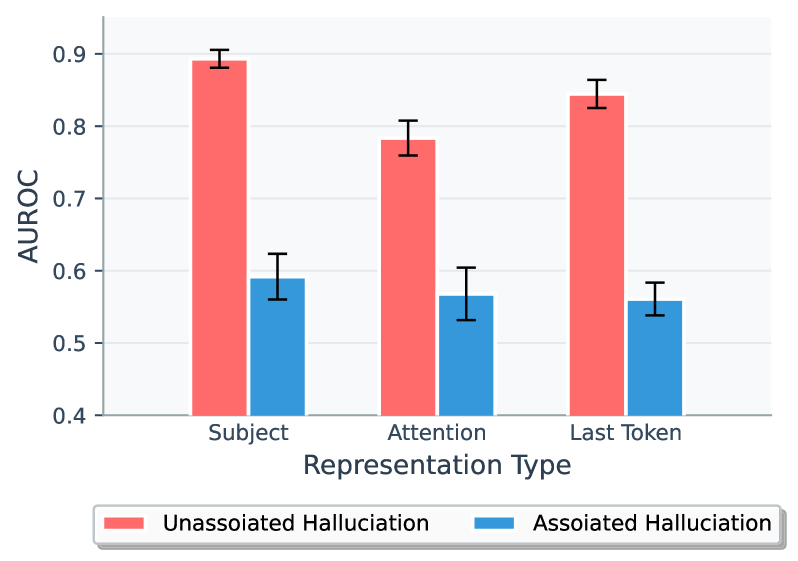
The image is a bar chart comparing the Area Under the Receiver Operating Characteristic curve (AUROC) for different representation types (Subject, Attention, Last Token) in the context of hallucination association (Unassociated vs. Associated). The chart displays the AUROC values for each representation type, separated by whether the hallucination is unassociated (red bars) or associated (blue bars). Error bars are included on each bar, indicating the uncertainty in the AUROC measurement.
### Components/Axes
* **Y-axis:** AUROC, ranging from 0.4 to 0.9.
* **X-axis:** Representation Type, with categories: Subject, Attention, Last Token.
* **Legend:** Located at the bottom of the chart.
* Red: Unassoiated Halluciation
* Blue: Assoiated Halluciation
### Detailed Analysis
The chart presents AUROC values for two types of hallucinations (Unassociated and Associated) across three representation types (Subject, Attention, and Last Token).
**Unassociated Hallucination (Red Bars):**
* **Subject:** AUROC is approximately 0.89, with an error range of +/- 0.01.
* **Attention:** AUROC is approximately 0.78, with an error range of +/- 0.03.
* **Last Token:** AUROC is approximately 0.84, with an error range of +/- 0.02.
**Associated Hallucination (Blue Bars):**
* **Subject:** AUROC is approximately 0.59, with an error range of +/- 0.03.
* **Attention:** AUROC is approximately 0.56, with an error range of +/- 0.04.
* **Last Token:** AUROC is approximately 0.56, with an error range of +/- 0.03.
### Key Observations
* For all representation types, the AUROC is significantly higher for unassociated hallucinations compared to associated hallucinations.
* The "Subject" representation type shows the highest AUROC for unassociated hallucinations (approximately 0.89).
* The AUROC values for associated hallucinations are relatively consistent across all three representation types, hovering around 0.56-0.59.
### Interpretation
The data suggests that the model is better at distinguishing unassociated hallucinations from non-hallucinations compared to associated hallucinations. The "Subject" representation type appears to be the most informative for detecting unassociated hallucinations, as indicated by its higher AUROC value. The lower AUROC values for associated hallucinations suggest that these types of hallucinations are more difficult to detect using the given representation types. The consistent performance across representation types for associated hallucinations might indicate that the model struggles to differentiate them regardless of the input feature.