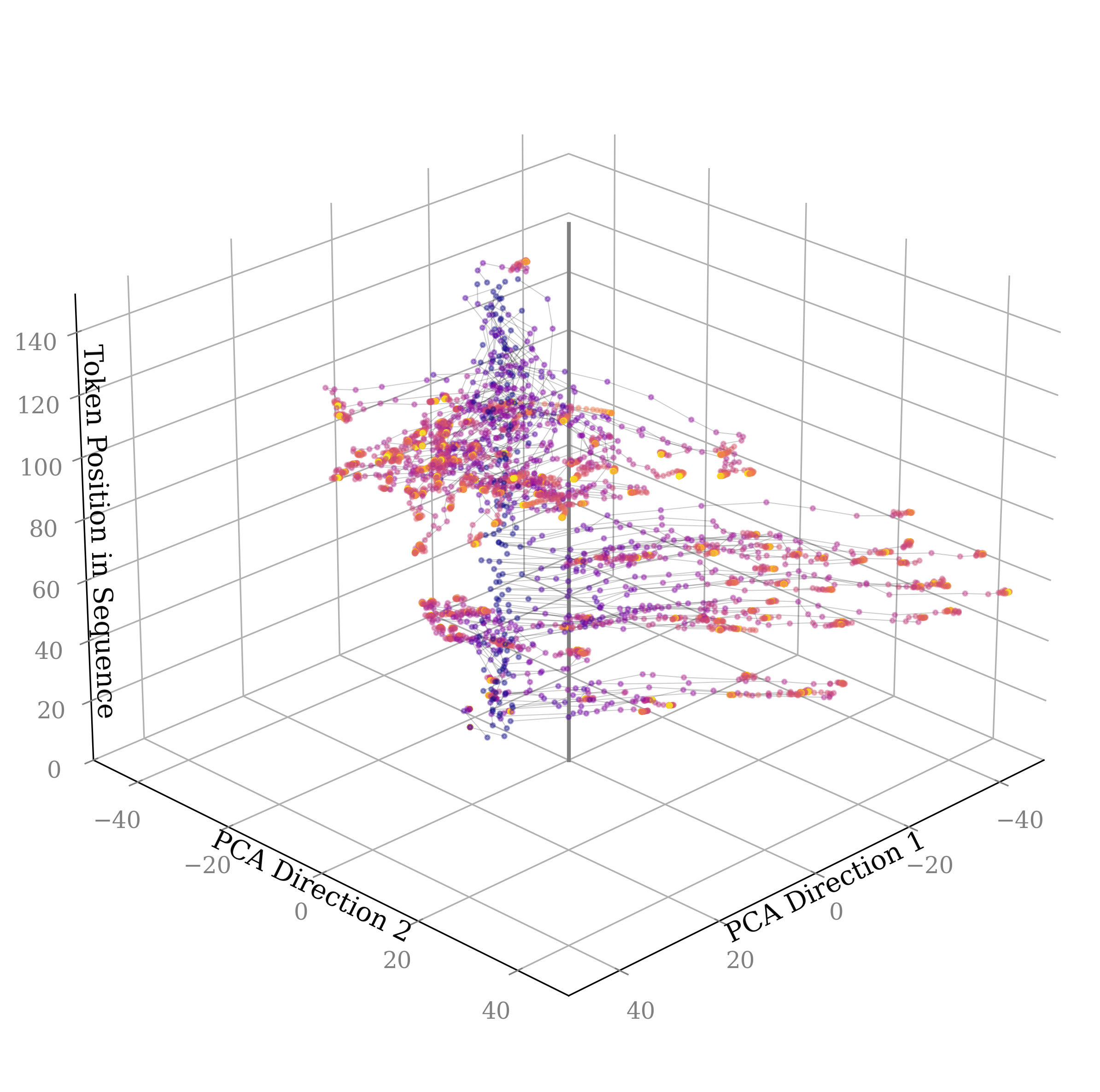
## 3D Trajectory Plot: Token Position vs. PCA Directions
### Overview
This image is a 3D scatter plot with connected lines, visualizing the trajectory of data points through a three-dimensional space defined by two Principal Component Analysis (PCA) dimensions and a sequence position. The plot suggests the evolution or path of a set of entities (likely tokens from a sequence) as they move through a reduced-dimensional feature space.
### Components/Axes
* **Chart Type:** 3D Scatter Plot with Trajectory Lines.
* **Axes:**
* **X-Axis (Bottom Right):** Labeled "PCA Direction 1". Scale ranges from approximately -40 to 40, with major tick marks at -40, -20, 0, 20, 40.
* **Y-Axis (Bottom Left):** Labeled "PCA Direction 2". Scale ranges from approximately -40 to 40, with major tick marks at -40, -20, 0, 20, 40.
* **Z-Axis (Vertical, Left Side):** Labeled "Token Position in Sequence". Scale ranges from 0 to 140, with major tick marks at 0, 20, 40, 60, 80, 100, 120, 140.
* **Data Representation:** Individual data points are plotted as small spheres. These points are connected by thin, semi-transparent gray lines, indicating a sequential or temporal relationship between them.
* **Color Encoding:** The data points follow a color gradient. Points at lower "Token Position in Sequence" values (near the bottom of the Z-axis) are predominantly dark purple/blue. As the token position increases, the color shifts through magenta and red, with points at the highest positions (near Z=140) appearing orange/yellow. This gradient likely encodes a fourth variable, such as time, attention weight, or another metric, but **no legend is present to define it explicitly**.
* **Spatial Layout:** The plot is viewed from an isometric perspective. The origin (0,0,0) is at the bottom center of the 3D grid. The grid lines are light gray.
### Detailed Analysis
* **Spatial Distribution & Trend:** The data forms a complex, branching, and somewhat funnel-shaped structure.
* **At low Token Positions (Z ≈ 0-40):** Points are tightly clustered in a narrow region of the PCA space, roughly centered around (PCA1 ≈ 0, PCA2 ≈ 0). The color is dark purple.
* **At mid Token Positions (Z ≈ 40-100):** The trajectory spreads out significantly. The cluster expands, with points occupying a wider range in both PCA Direction 1 (from approx. -30 to +30) and PCA Direction 2 (from approx. -20 to +20). The color transitions to magenta and red.
* **At high Token Positions (Z ≈ 100-140):** The structure becomes more diffuse and branched. Several distinct "arms" or clusters extend outward. One prominent branch extends towards positive PCA Direction 1 and slightly positive PCA Direction 2. Another extends towards negative PCA Direction 1. The points here are orange and yellow.
* **Connectivity:** The gray connecting lines show that the points are not independent but form continuous paths. Multiple paths appear to diverge from the central cluster as the token position increases, suggesting different developmental trajectories for different subsets of the data.
* **Density:** The highest density of points and connections is in the central column from Z=0 to Z≈80. Above Z=100, the points become more sparse and scattered.
### Key Observations
1. **Funnel-like Expansion:** The most notable pattern is the systematic expansion of the data's footprint in the PCA-defined feature space as the token position increases. The system starts in a constrained state and evolves into a more diverse set of states.
2. **Color-Position Correlation:** There is a near-perfect correlation between the Z-axis value (Token Position) and the color of the points. This strongly implies the color gradient is a direct visual reinforcement of the sequence position, not an independent variable.
3. **Branching Trajectories:** The plot does not show a single, coherent path but rather a tree-like structure with multiple branches emerging from a common origin. This indicates divergence in the underlying process.
4. **Sparse High-Position States:** The states corresponding to the latest tokens in the sequence (highest Z values) are fewer and more isolated in the PCA space compared to the dense mid-sequence states.
### Interpretation
This visualization likely represents the internal state evolution of a sequential model (e.g., a transformer) processing a sequence of tokens. The "Token Position in Sequence" axis tracks the model's progress through the input.
* **What it suggests:** The model's internal representations (projected onto the top two PCA dimensions) start in a similar, initialization-like state for the first tokens. As it processes more context (higher token positions), these representations diversify significantly, exploring different regions of the feature space. The branching suggests that different tokens or contexts lead the model down distinct representational pathways.
* **Relationship between elements:** The PCA directions capture the primary axes of variation in the model's activations. The trajectory shows how this variation unfolds over the sequence length. The tight coupling of color and Z-axis confirms the plot's primary purpose is to show this evolution over sequence steps.
* **Notable Anomalies/Patterns:** The clear, non-random structure indicates the model's processing is highly systematic. The lack of points in certain regions of the PCA space (e.g., extreme negative PCA2 values at high token positions) may indicate constraints on the model's representational capacity or the nature of the input data. The sparse, high-position points could represent the model's final, context-specific representations for the end of the sequence, which are more unique and less densely packed than the intermediate states.