## Bar Chart: Label Correctness vs. Redundancy/Contradiction
### Overview
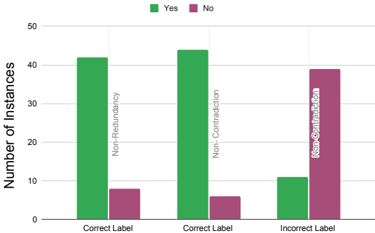
The image is a bar chart comparing the number of instances of "Yes" and "No" responses across three categories: "Correct Label" with "Non-Redundancy", "Correct Label" with "Non-Contradiction", and "Incorrect Label" with "Non-Contradiction". The chart visually represents the distribution of these responses.
### Components/Axes
* **Y-axis:** "Number of Instances", ranging from 0 to 50 in increments of 10.
* **X-axis:** Categorical, with three categories:
* "Correct Label" with "Non-Redundancy"
* "Correct Label" with "Non-Contradiction"
* "Incorrect Label" with "Non-Contradiction"
* **Legend:** Located at the top of the chart.
* Green: "Yes"
* Purple: "No"
### Detailed Analysis
* **Correct Label - Non-Redundancy:**
* "Yes" (Green): Approximately 42 instances.
* "No" (Purple): Approximately 8 instances.
* **Correct Label - Non-Contradiction:**
* "Yes" (Green): Approximately 44 instances.
* "No" (Purple): Approximately 6 instances.
* **Incorrect Label - Non-Contradiction:**
* "Yes" (Green): Approximately 11 instances.
* "No" (Purple): Approximately 39 instances.
### Key Observations
* For both "Correct Label" categories ("Non-Redundancy" and "Non-Contradiction"), the number of "Yes" instances is significantly higher than "No" instances.
* For the "Incorrect Label - Non-Contradiction" category, the number of "No" instances is significantly higher than "Yes" instances.
### Interpretation
The data suggests that when labels are correct, there is a higher likelihood of a "Yes" response, indicating agreement or confirmation. Conversely, when labels are incorrect, there is a higher likelihood of a "No" response, indicating disagreement or rejection. This highlights the importance of correct labeling in eliciting positive responses or agreement. The large difference in "Yes" vs "No" for the "Incorrect Label" category suggests a strong negative correlation between incorrect labels and positive responses.