## Heatmap: Sentence Alignment
### Overview
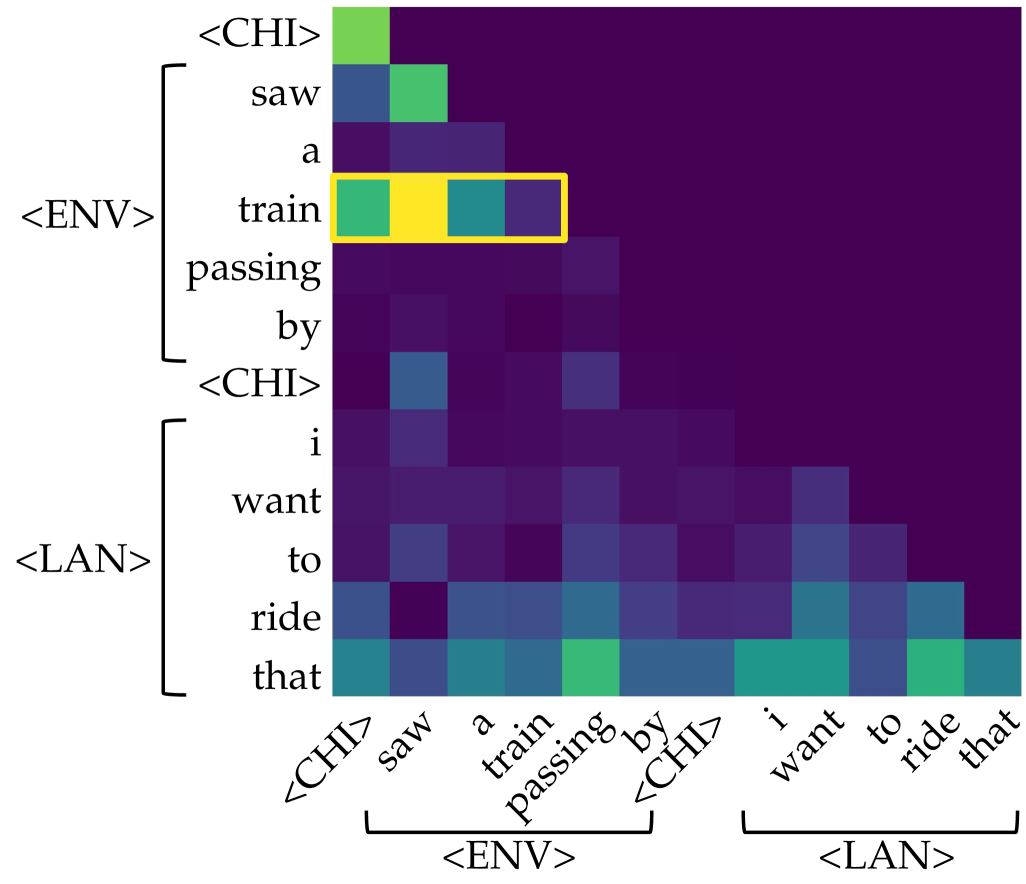
The image is a heatmap visualizing the alignment between two sentences. The x-axis and y-axis represent the words in the sentences. The color intensity of each cell indicates the strength of the alignment between the corresponding words. The heatmap is triangular, suggesting a comparison of a sentence with itself or a related sentence structure. The sentences are segmented into phrases labeled <CHI>, <ENV>, and <LAN>.
### Components/Axes
* **X-axis:** Represents the words in the sentence: "<CHI> saw a train passing by <CHI> i want to ride that".
* **Y-axis:** Represents the words in the sentence: "<CHI> saw a train passing by <CHI> i want to ride that".
* **Labels:**
* `<CHI>`: Appears at the beginning of both sentences and between "by" and "i".
* `<ENV>`: Labels the phrase "saw a train passing by" on both axes.
* `<LAN>`: Labels the phrase "i want to ride that" on both axes.
* **Color Scale:** The heatmap uses a color gradient where darker colors (purple) indicate weaker or no alignment, and lighter colors (green/yellow) indicate stronger alignment.
### Detailed Analysis
The heatmap shows the alignment between the words of the two sentences. The intensity of the color indicates the strength of the alignment.
* **"<CHI> saw a train passing by" vs. "<CHI> saw a train passing by"**:
* `<CHI>` aligns strongly with `<CHI>` (top-left corner).
* "saw" aligns strongly with "saw".
* "a" aligns strongly with "a".
* "train" aligns strongly with "train".
* "passing" aligns strongly with "passing".
* "by" aligns strongly with "by".
* **"<CHI> i want to ride that" vs. "<CHI> i want to ride that"**:
* `<CHI>` aligns strongly with `<CHI>`.
* "i" aligns strongly with "i".
* "want" aligns strongly with "want".
* "to" aligns strongly with "to".
* "ride" aligns strongly with "ride".
* "that" aligns strongly with "that".
* **Cross-Phrase Alignment:**
* There is some alignment between the phrases, but it is weaker than the within-phrase alignment. For example, there is a weak alignment between "train" in the <ENV> phrase and "want" in the <LAN> phrase.
* **Highlighted Region:** A yellow box highlights the alignment between "train" in the y-axis and "a", "train", and "passing" in the x-axis.
### Key Observations
* The heatmap is symmetrical along the diagonal, indicating that the alignment is reciprocal.
* The strongest alignments occur between identical words within the same phrase.
* The alignment between different phrases is weaker, suggesting less semantic similarity.
* The highlighted region emphasizes the relationship between the word "train" and its surrounding context.
### Interpretation
The heatmap visualizes the semantic relationships between words in a sentence. The strong diagonal alignment indicates that the sentence is internally consistent and that words are most strongly related to themselves. The weaker off-diagonal alignments suggest more distant semantic relationships. The segmentation into <CHI>, <ENV>, and <LAN> phrases provides a higher-level structure for understanding the sentence. The highlighted region draws attention to the context surrounding the word "train," suggesting its importance in the sentence. The heatmap could be used to analyze the coherence and structure of sentences, or to compare the semantic similarity of different sentences.