## Bar Chart: Accuracy vs. Length of Paths in SPARQL
### Overview
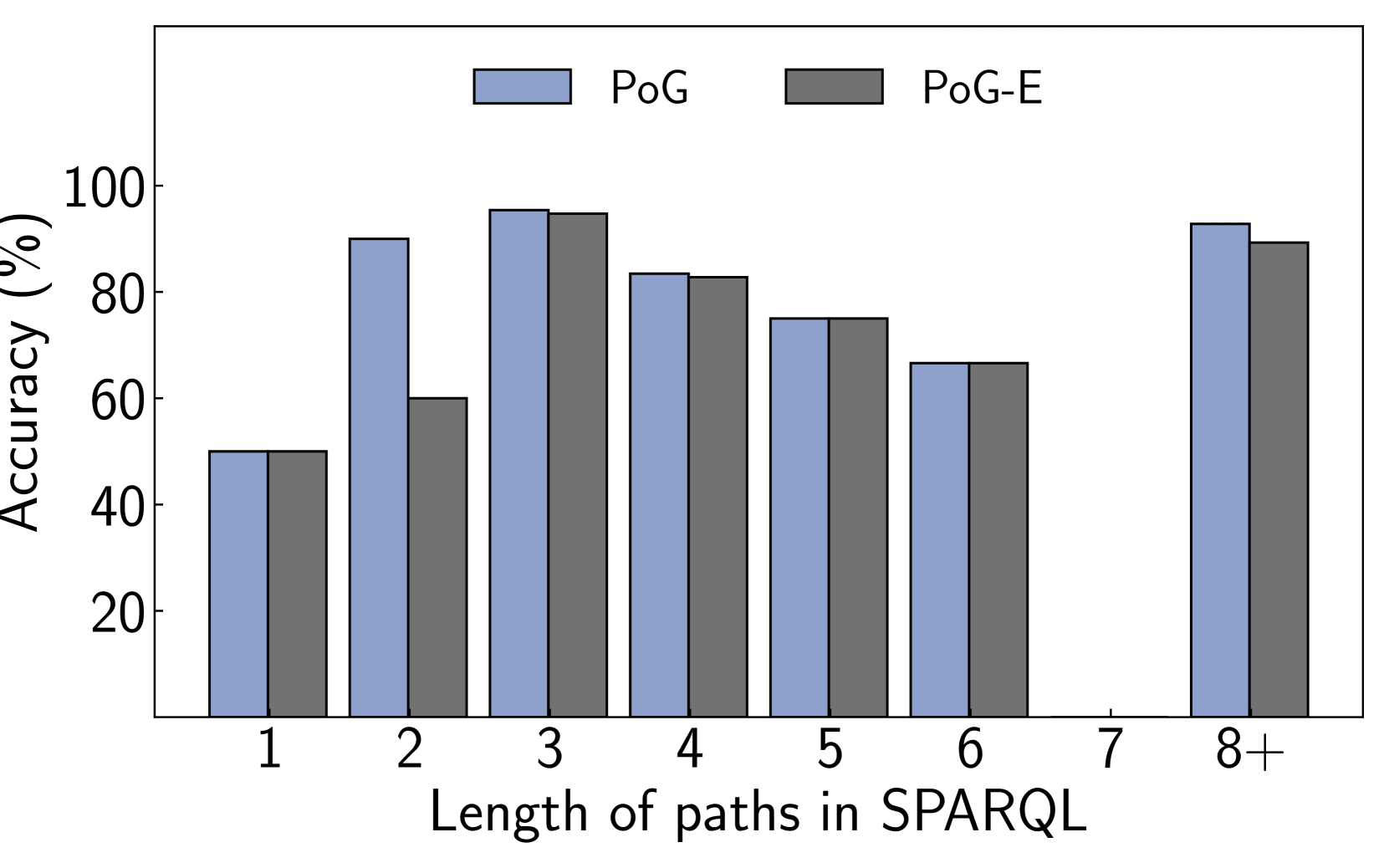
This image is a bar chart that displays the accuracy of two methods, "PoG" and "PoG-E", across different lengths of paths in SPARQL queries. The x-axis represents the length of paths, categorized from 1 to 6, and then a combined category "8+". The y-axis represents the accuracy in percentage.
### Components/Axes
* **Title**: Implicitly, the chart is about the performance of "PoG" and "PoG-E" based on SPARQL path length.
* **Y-axis Label**: "Accuracy (%)"
* **Scale**: Linear, ranging from 0 to 100, with major tick marks at 20, 40, 60, 80, and 100.
* **X-axis Label**: "Length of paths in SPARQL"
* **Categories**: 1, 2, 3, 4, 5, 6, 7, 8+
* **Legend**: Located at the top-center of the chart.
* **"PoG"**: Represented by a light blue rectangle.
* **"PoG-E"**: Represented by a dark gray rectangle.
### Detailed Analysis
The chart displays paired bars for each category on the x-axis, representing "PoG" (light blue) and "PoG-E" (dark gray).
* **Path Length 1**:
* PoG: Approximately 50% accuracy.
* PoG-E: Approximately 50% accuracy.
* **Path Length 2**:
* PoG: Approximately 90% accuracy.
* PoG-E: Approximately 60% accuracy.
* **Path Length 3**:
* PoG: Approximately 96% accuracy.
* PoG-E: Approximately 95% accuracy.
* **Path Length 4**:
* PoG: Approximately 82% accuracy.
* PoG-E: Approximately 82% accuracy.
* **Path Length 5**:
* PoG: Approximately 76% accuracy.
* PoG-E: Approximately 76% accuracy.
* **Path Length 6**:
* PoG: Approximately 66% accuracy.
* PoG-E: Approximately 66% accuracy.
* **Path Length 7**: No data is presented for path length 7.
* **Path Length 8+**:
* PoG: Approximately 90% accuracy.
* PoG-E: Approximately 88% accuracy.
### Key Observations
* For path length 1, both PoG and PoG-E show similar, moderate accuracy.
* For path length 2, PoG significantly outperforms PoG-E.
* For path lengths 3, 4, 5, and 6, both methods exhibit very similar accuracy levels, with PoG-E being slightly lower or equal to PoG in most cases.
* For path length 8+, both methods show high accuracy, with PoG being slightly higher than PoG-E.
* There is a noticeable dip in accuracy for both methods between path lengths 3 and 6, before a recovery at path length 8+.
* Path length 7 is not represented in the data.
### Interpretation
This bar chart demonstrates the performance of two methods, PoG and PoG-E, in relation to the complexity of SPARQL queries, as measured by the length of the paths within them.
* **Initial Performance (Length 1)**: The similar accuracy at path length 1 suggests that both methods are equally capable of handling very simple queries.
* **Divergence at Length 2**: The significant drop in PoG-E's accuracy at path length 2, while PoG maintains high accuracy, indicates a potential weakness in PoG-E for queries of this specific complexity. This could imply that PoG-E struggles with a particular type of path structure or reasoning required for length 2 paths.
* **Convergence and Decline (Lengths 3-6)**: The convergence of accuracy between PoG and PoG-E for path lengths 3 through 6, and the general decline in accuracy from length 3 to length 6, suggests that as path lengths increase, the task becomes more challenging for both methods. The close performance suggests they might be encountering similar limitations or benefiting from similar underlying mechanisms as complexity grows. The slight edge of PoG in some of these categories might indicate a marginal advantage in handling these intermediate complexities.
* **Recovery at Length 8+**: The resurgence in accuracy for both methods at path length 8+ is notable. This could imply that for very long and complex paths, the methods might employ different strategies or that the nature of these long paths allows for more robust pattern matching or inference, leading to improved performance compared to intermediate lengths. The slight lead of PoG here might suggest it's more resilient to the highest levels of complexity.
* **Missing Data (Length 7)**: The absence of data for path length 7 is an anomaly that prevents a complete understanding of the trend. It's unclear if this is an intentional omission or a data gap.
Overall, the data suggests that PoG is generally more robust or consistently performs better, especially at path length 2 and slightly at longer path lengths. PoG-E shows comparable performance to PoG in many intermediate and longer path lengths but struggles significantly at path length 2. The dip and subsequent recovery in accuracy across path lengths indicate a non-linear relationship between SPARQL path length and the effectiveness of these methods.