\n
## Text Document: User Prompt & Generated Questions
### Overview
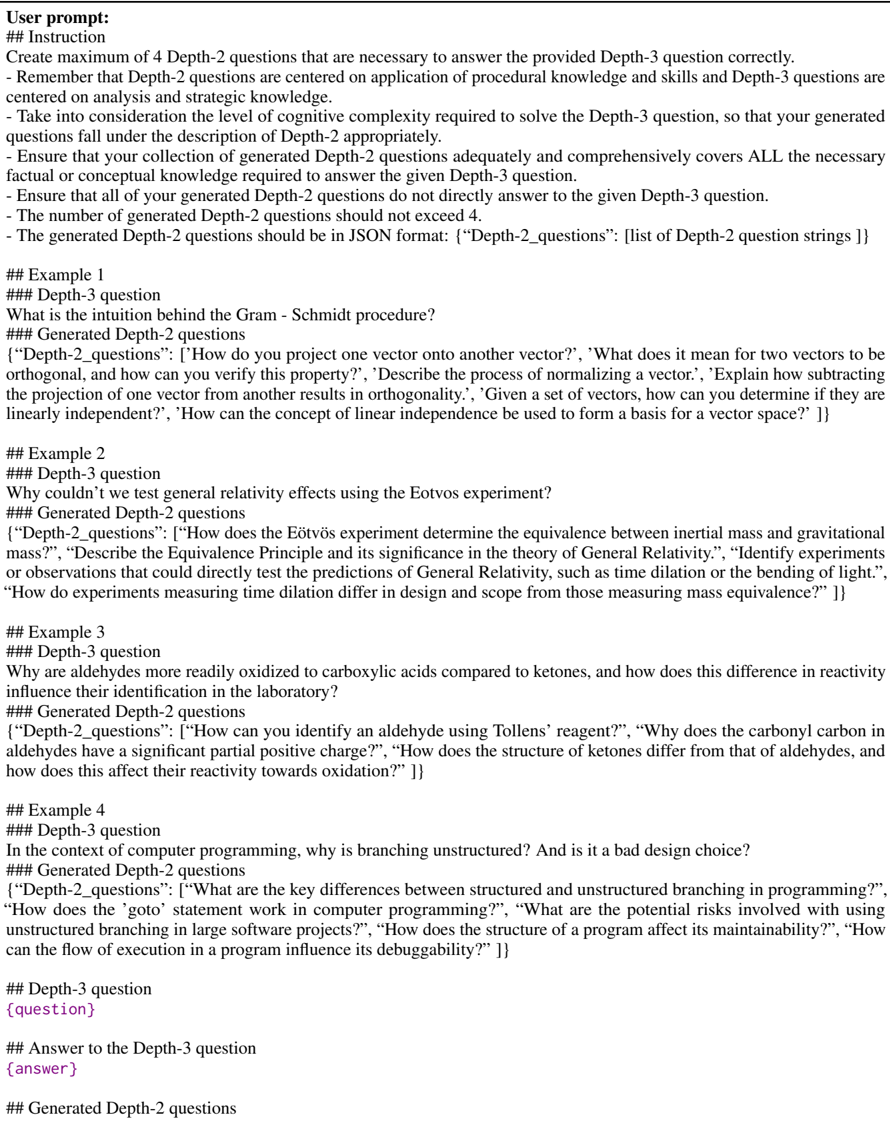
The image presents a text document containing a series of prompts and generated questions related to scientific and mathematical concepts. The document appears to be structured around a "Depth-3 question" followed by a set of "Depth-2 questions" designed to aid in answering the primary question. The document is formatted with hashtags indicating the type of question and example numbers.
### Components/Axes
The document consists of text organized into sections delineated by hashtags. The sections are:
* `#Instruction`
* `#Example 1`
* `#Depth-3 question`
* `#Generated Depth-2 questions`
* `#Example 2`
* `#Depth-3 question`
* `#Generated Depth-2 questions`
* `#Example 3`
* `#Depth-3 question`
* `#Generated Depth-2 questions`
* `#Example 4`
* `#Depth-3 question`
* `#Generated Depth-2 questions`
* `#Additional Instruction`
### Detailed Analysis or Content Details
**#Instruction:**
"Create maximum of 4 Depth-2 questions that are necessary to answer the provided Depth-3 question correctly.
- Remember that Depth-2 questions are centered on application of procedural knowledge and skills and Depth-3 questions are centered on analysis and strategic knowledge.
- Take into consideration the level of cognitive complexity required to solve the Depth-3 question, so that your generated questions fall under the description of Depth-2 appropriately.
- Ensure that your collection of generated Depth-2 questions adequately and comprehensively covers ALL the necessary factual or conceptual knowledge required to answer the given Depth-3 question.
- Ensure that all of your generated Depth-2 questions do not directly answer to the given Depth-3 question.
- The number of generated Depth-2 questions should not exceed 4.
The generated Depth-2 questions should be in JSON format: {"Depth-2_questions": [list of Depth-2 question strings]}"
**#Example 1:**
`#Depth-3 question`
What is the intuition behind the Gram - Schmidt procedure?
`#Generated Depth-2 questions`
("Depth-2_questions": ["How do you project one vector onto another vector?", "What does it mean for two vectors to be orthogonal, and how can you verify this property?", "Describe the process of normalizing a vector.", "Explain how subtracting the projection of one vector from another results in orthogonality.", "Given a set of vectors, how can you determine if they are linearly independent?", "How can the concept of linear independence be used to form a basis for a vector space?"])
**#Example 2:**
`#Depth-3 question`
Why couldn’t we test general relativity effects using the Eötvös experiment?
`#Generated Depth-2 questions`
("Depth-2_questions": ["How does the Eötvös experiment determine the equivalence between inertial mass and gravitational mass?", "Describe the Equivalence Principle and its significance in the theory of General Relativity.", "Identify experiments or observations that could directly test the predictions of General Relativity, such as time dilation or the bending of light.", "How do experiments measuring time dilation differ in design and scope from those measuring mass equivalence?"])
**#Example 3:**
`#Depth-3 question`
Why are aldehydes more readily oxidized to carboxylic acids compared to ketones, and how does this difference in reactivity influence their identification in the laboratory?
`#Generated Depth-2 questions`
("Depth-2_questions": ["How can you identify an aldehyde using Tollens’ reagent?", "Why does the carbonyl carbon in aldehyde have a significant partial positive charge?", "Describe the mechanism of oxidation of aldehydes to carboxylic acids.", "What structural features of ketones hinder their oxidation to carboxylic acids?"])
**#Example 4:**
`#Depth-3 question`
Explain the role of the electron-hole pair in photoconductivity, and how does the wavelength of incident light affect the efficiency of this process?
`#Generated Depth-2 questions`
("Depth-2_questions": ["What is the energy band gap in a semiconductor?", "Describe the process of electron-hole pair generation when a photon is absorbed by a semiconductor.", "How does the energy of a photon relate to its wavelength?", "Explain how the concentration of electron-hole pairs influences the conductivity of a semiconductor."])
**#Additional Instruction:**
"Please confirm that you understand the instructions and the format of the expected output."
### Key Observations
The document consistently follows a pattern of posing a complex "Depth-3" question and then breaking it down into more manageable "Depth-2" questions. The "Depth-2" questions are presented as a JSON formatted string. The questions cover a range of scientific disciplines, including linear algebra, physics (general relativity), organic chemistry, and semiconductor physics.
### Interpretation
The document demonstrates a pedagogical approach to problem-solving, emphasizing the importance of decomposing complex questions into smaller, more focused inquiries. The use of "Depth-2" questions suggests a strategy for building foundational knowledge and procedural skills necessary to tackle more challenging analytical problems. The JSON format for the "Depth-2" questions indicates an intention for automated processing or integration with a question-answering system. The final instruction serves as a confirmation prompt, ensuring the user understands the task requirements. The document is a clear example of instructional design focused on fostering deeper understanding through structured questioning.