## Diagram: Hierarchical Generative Model Architecture
### Overview
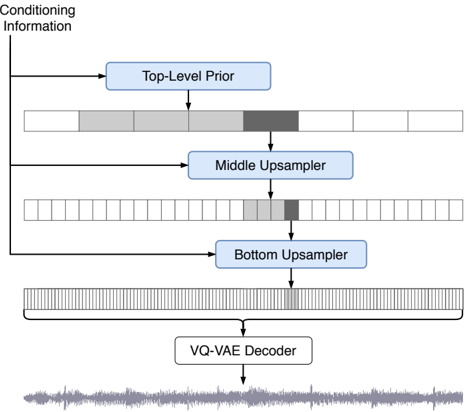
The image illustrates a hierarchical generative model architecture, likely designed for audio synthesis. The diagram depicts a flow where "Conditioning Information" is injected into three sequential processing stages (Top-Level Prior, Middle Upsampler, and Bottom Upsampler). These stages progressively increase the resolution of latent representations, which are then processed by a VQ-VAE (Vector Quantized Variational Autoencoder) Decoder to produce a final audio waveform.
### Components/Axes
* **Input Source:** "Conditioning Information" (represented by a vertical line on the far left).
* **Processing Blocks (Blue Rectangles):**
* **Top-Level Prior:** Located at the top.
* **Middle Upsampler:** Located in the center.
* **Bottom Upsampler:** Located below the middle section.
* **Latent Representation Bars (Horizontal):**
* **Top Bar:** Low resolution (8 segments).
* **Middle Bar:** Medium resolution (24 segments).
* **Bottom Bar:** High resolution (dense grid, approximately 64+ segments).
* **Output Block (White Rectangle):** "VQ-VAE Decoder" (bottom center).
* **Final Output:** Audio waveform (bottom).
### Detailed Analysis
The diagram follows a top-down flow, with specific interactions between the components:
1. **Conditioning Information:** This input is distributed horizontally to all three processing blocks (Top-Level Prior, Middle Upsampler, and Bottom Upsampler).
2. **Top-Level Prior:**
* Receives "Conditioning Information."
* Outputs to the first horizontal bar (8 segments).
* The bar contains a highlighted region (one dark grey segment followed by three light grey segments).
3. **Middle Upsampler:**
* Receives input from the "Top-Level Prior" (via the first bar) and "Conditioning Information."
* Outputs to the second horizontal bar (24 segments).
* The highlighted region from the top bar is propagated and expanded here (one dark grey segment followed by three light grey segments).
4. **Bottom Upsampler:**
* Receives input from the "Middle Upsampler" (via the second bar) and "Conditioning Information."
* Outputs to the third horizontal bar (dense grid).
* The highlighted region is further propagated and expanded here.
5. **VQ-VAE Decoder:**
* Takes the final, high-resolution latent representation from the third bar.
* Produces the final audio waveform shown at the very bottom.
### Key Observations
* **Resolution Scaling:** There is a clear hierarchical increase in resolution. The top bar has 8 segments, the middle has 24 (3x increase), and the bottom has a significantly higher density, suggesting a factor-of-3 or factor-of-4 upsampling at each stage.
* **Information Propagation:** The specific pattern of shading (one dark grey cell followed by three light grey cells) acts as a visual marker for a specific latent feature or "token" being tracked and refined through the hierarchy.
* **Global Conditioning:** The "Conditioning Information" is applied globally, meaning the model uses the same external context (e.g., text, class labels, or style) to guide the generation at every level of the hierarchy.
### Interpretation
This diagram represents a **Hierarchical VQ-VAE** or a similar autoregressive audio generation model (such as Jukebox).
* **The Logic:** The model separates the generation task into different temporal scales. The "Top-Level Prior" models the coarse, long-term structure of the audio (low resolution). The "Upsamplers" then fill in the details (medium and high resolution) based on the coarse structure and the conditioning information.
* **Why it matters:** This architecture is necessary because generating raw audio (which has a very high sample rate, e.g., 44.1kHz) directly is computationally prohibitive. By compressing the audio into discrete latent codes (the bars) and generating them hierarchically, the model can maintain long-term coherence while efficiently generating high-fidelity audio.
* **The "Reading Between the Lines":** The highlighted grey segments suggest that the model is not generating the entire sequence at once, but rather refining a specific "window" or "token" of information as it moves down the hierarchy, ensuring that the high-resolution output remains consistent with the low-resolution "plan" established by the Top-Level Prior.