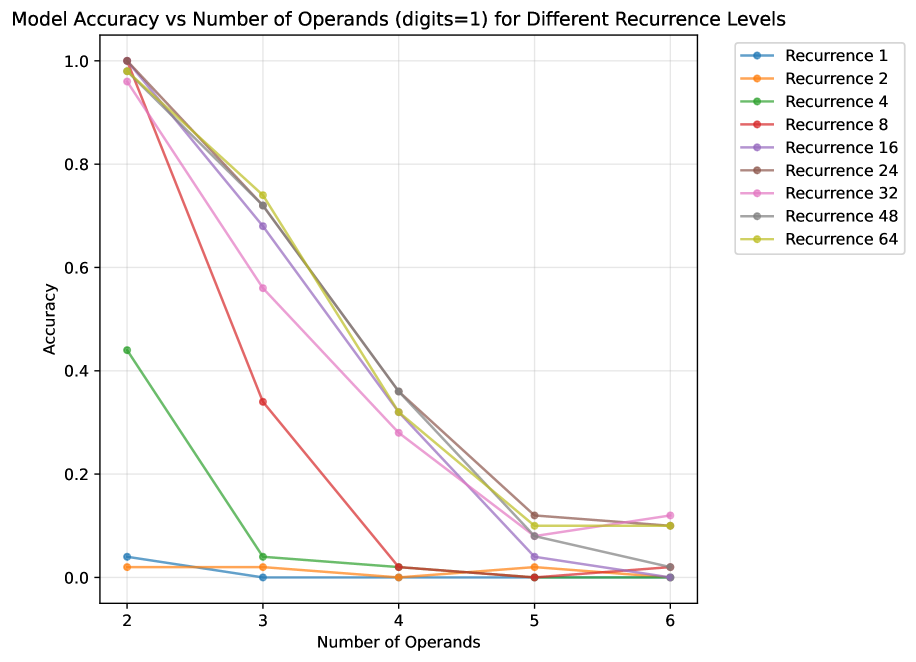
## Line Chart: Model Accuracy vs Number of Operands (digits=1) for Different Recurrence Levels
### Overview
This is a line chart plotting model accuracy against the number of operands for a task involving single-digit numbers. The chart compares the performance of models configured with nine different "Recurrence Levels." The overall trend shows a sharp decline in accuracy as the number of operands increases for all but the lowest recurrence levels.
### Components/Axes
* **Chart Title:** "Model Accuracy vs Number of Operands (digits=1) for Different Recurrence Levels"
* **X-Axis:**
* **Label:** "Number of Operands"
* **Scale:** Linear, with major tick marks at integers 2, 3, 4, 5, and 6.
* **Y-Axis:**
* **Label:** "Accuracy"
* **Scale:** Linear, ranging from 0.0 to 1.0, with major tick marks at 0.0, 0.2, 0.4, 0.6, 0.8, and 1.0.
* **Legend:** Positioned in the top-right corner, outside the main plot area. It lists nine data series, each associated with a unique color and marker:
1. Recurrence 1 (Blue, circle marker)
2. Recurrence 2 (Orange, circle marker)
3. Recurrence 4 (Green, circle marker)
4. Recurrence 8 (Red, circle marker)
5. Recurrence 16 (Purple, circle marker)
6. Recurrence 24 (Brown, circle marker)
7. Recurrence 32 (Pink, circle marker)
8. Recurrence 48 (Gray, circle marker)
9. Recurrence 64 (Yellow-green, circle marker)
### Detailed Analysis
The chart displays nine data series, each representing a different recurrence level. All series are plotted with lines connecting circular data points at each integer value on the x-axis.
**Trend Verification & Data Points (Approximate):**
* **Recurrence 1 (Blue):** The line is nearly flat and very close to the bottom of the chart. Accuracy starts at ~0.04 for 2 operands and remains at or near 0.0 for 3, 4, 5, and 6 operands.
* **Recurrence 2 (Orange):** Similar to Recurrence 1, this line is flat and near zero. Accuracy is ~0.02 for 2 operands and ~0.0 for 3, 4, 5, and 6 operands.
* **Recurrence 4 (Green):** Shows a steep downward slope. Accuracy starts at ~0.44 for 2 operands, drops sharply to ~0.04 for 3 operands, and then declines slowly to ~0.02 for 4 operands and ~0.0 for 5 and 6 operands.
* **Recurrence 8 (Red):** Exhibits a very steep downward slope. Accuracy is high at ~1.0 for 2 operands, plummets to ~0.34 for 3 operands, falls further to ~0.02 for 4 operands, and is ~0.0 for 5 and 6 operands.
* **Recurrence 16 (Purple):** Shows a steep downward slope. Accuracy starts at ~0.98 for 2 operands, decreases to ~0.68 for 3 operands, ~0.28 for 4 operands, ~0.04 for 5 operands, and ~0.0 for 6 operands.
* **Recurrence 24 (Brown):** Follows a steep downward trajectory. Accuracy is ~0.99 for 2 operands, ~0.72 for 3 operands, ~0.36 for 4 operands, ~0.12 for 5 operands, and ~0.02 for 6 operands.
* **Recurrence 32 (Pink):** Displays a steep downward slope. Accuracy is ~0.96 for 2 operands, ~0.56 for 3 operands, ~0.28 for 4 operands, ~0.08 for 5 operands, and ~0.12 for 6 operands (a slight uptick).
* **Recurrence 48 (Gray):** Shows a steep downward slope. Accuracy is ~0.99 for 2 operands, ~0.72 for 3 operands, ~0.36 for 4 operands, ~0.08 for 5 operands, and ~0.02 for 6 operands.
* **Recurrence 64 (Yellow-green):** Exhibits a steep downward slope. Accuracy is ~0.99 for 2 operands, ~0.74 for 3 operands, ~0.32 for 4 operands, ~0.10 for 5 operands, and ~0.10 for 6 operands.
### Key Observations
1. **Universal Performance Degradation:** All models, regardless of recurrence level, experience a significant drop in accuracy as the number of operands increases from 2 to 6.
2. **Recurrence Level Impact:** Higher recurrence levels (16, 24, 32, 48, 64) start with near-perfect accuracy (~0.96-1.0) for 2 operands, while lower levels (1, 2, 4) start much lower or near zero.
3. **Convergence at High Complexity:** By 5 and 6 operands, the accuracy of all models converges to a low range (approximately 0.0 to 0.12), with the exception of Recurrence 32 at 6 operands (~0.12).
4. **Steepness of Decline:** The rate of accuracy loss is most dramatic for models that start with high accuracy (Recurrence 8 and above). For example, Recurrence 8 drops from ~1.0 to ~0.34 with just one additional operand.
5. **Anomaly:** The data point for Recurrence 32 at 6 operands (~0.12) is slightly higher than its value at 5 operands (~0.08), breaking the consistent downward trend seen in all other series. This could be a measurement artifact or a point of interest.
### Interpretation
The data demonstrates a clear inverse relationship between task complexity (number of operands) and model accuracy for this single-digit arithmetic task. The "Recurrence Level" appears to be a critical hyperparameter that determines the model's initial capacity: higher recurrence enables near-perfect performance on the simplest task (2 operands).
However, this capacity is fragile. The steep, consistent decline across all series suggests a fundamental limitation in the model's architecture or training when generalizing to more complex problems of the same type. The convergence of all models to low accuracy at 5-6 operands indicates that increasing recurrence alone is insufficient to solve the core challenge of scaling to more operands. The model likely lacks the necessary mechanism (e.g., robust working memory, systematic compositional reasoning) to handle the increased computational or representational load, regardless of its initial recurrent depth. The slight uptick for Recurrence 32 at 6 operands is intriguing but too minor to contradict the overwhelming trend; it would require replication to interpret as a meaningful signal rather than noise.