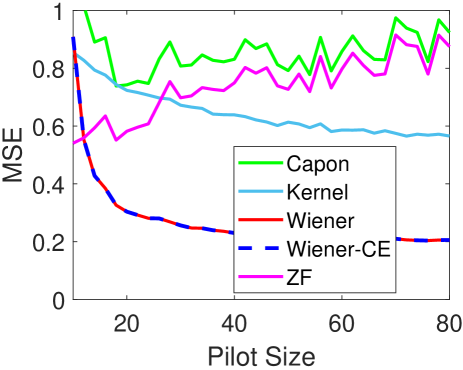
# Technical Data Extraction: MSE vs. Pilot Size Performance Chart
## 1. Document Classification
* **Type:** Line Graph (Performance Comparison)
* **Language:** English
* **Primary Metrics:** Mean Squared Error (MSE) vs. Pilot Size
## 2. Axis and Legend Extraction
### Axis Labels
* **Y-Axis (Vertical):** `MSE` (Mean Squared Error)
* **Scale:** 0 to 1
* **Markers:** 0, 0.2, 0.4, 0.6, 0.8, 1
* **X-Axis (Horizontal):** `Pilot Size`
* **Scale:** Approximately 10 to 80
* **Markers:** 20, 40, 60, 80
### Legend Information
The legend is located in the lower-right quadrant of the plot area. It contains five entries:
1. **Capon:** Solid Green line
2. **Kernel:** Solid Light Blue line
3. **Wiener:** Solid Red line
4. **Wiener-CE:** Dashed Dark Blue line (Overlaid on Wiener)
5. **ZF:** Solid Magenta line
---
## 3. Component Analysis and Trend Verification
### Region 1: High-Performance Series (Wiener & Wiener-CE)
* **Trend:** Both lines follow an identical downward exponential-like decay. They start at the highest MSE (~0.9) at the lowest pilot size and rapidly drop, stabilizing at the lowest MSE relative to all other methods.
* **Visual Check:** The dashed dark blue line (Wiener-CE) sits directly on top of the solid red line (Wiener), indicating identical performance across the pilot size range.
* **Data Points:**
* Pilot Size ~10: MSE ≈ 0.9
* Pilot Size ~20: MSE ≈ 0.3
* Pilot Size 40-80: MSE plateaus between 0.2 and 0.25.
### Region 2: Mid-Performance Series (Kernel)
* **Trend:** A steady, linear-like downward slope. It does not exhibit the rapid initial drop of the Wiener filters but shows consistent improvement as pilot size increases.
* **Visual Check:** Solid light blue line.
* **Data Points:**
* Pilot Size ~10: MSE ≈ 0.85
* Pilot Size 40: MSE ≈ 0.65
* Pilot Size 80: MSE ≈ 0.58
### Region 3: High-Error/Unstable Series (Capon & ZF)
* **Trend (Capon):** Highly volatile with a general downward trend initially, followed by significant fluctuations at higher pilot sizes. It maintains the highest overall MSE.
* **Trend (ZF):** Starts low (~0.55), but trends **upward** with significant volatility as pilot size increases, eventually performing worse than the Kernel method.
* **Visual Check:** Capon (Green) is consistently the top-most line; ZF (Magenta) fluctuates between the Kernel and Capon lines.
* **Data Points (Capon):**
* Pilot Size ~10: MSE ≈ 1.0
* Pilot Size 40: MSE ≈ 0.82
* Pilot Size 80: MSE ≈ 0.92 (Fluctuating)
* **Data Points (ZF):**
* Pilot Size ~10: MSE ≈ 0.55
* Pilot Size 40: MSE ≈ 0.75
* Pilot Size 80: MSE ≈ 0.88 (Fluctuating)
---
## 4. Summary of Findings
* **Best Performers:** **Wiener** and **Wiener-CE** are the most effective, achieving the lowest MSE (~0.2) with a pilot size of 40 or greater. Their performance is indistinguishable from each other.
* **Most Stable Improvement:** The **Kernel** method shows the most predictable, steady improvement, though it never reaches the low error levels of the Wiener methods.
* **Least Effective:** The **Capon** method consistently yields the highest error.
* **Counter-Intuitive Trend:** The **ZF** (Zero Forcing) method shows a general **increase** in MSE as Pilot Size increases, suggesting it may be sensitive to noise or overfitting as more pilot data is introduced in this specific scenario.