## Flowchart: Division Algorithm
### Overview
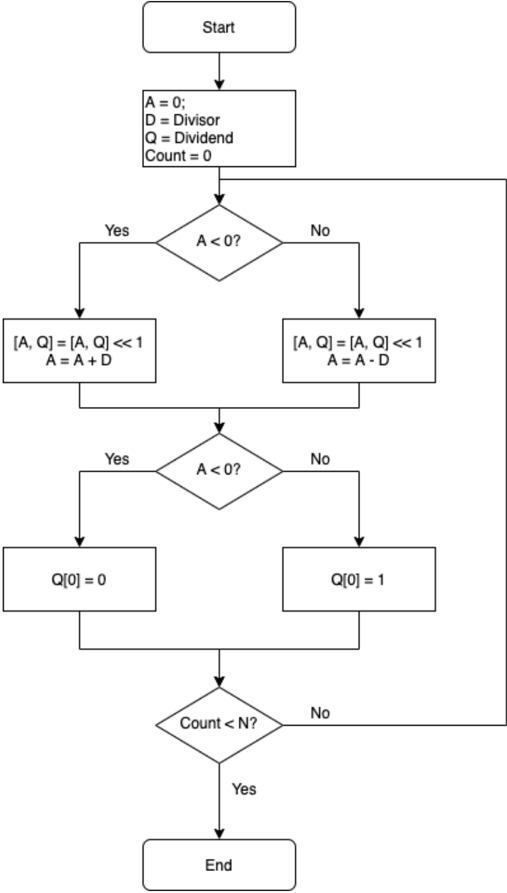
The image is a flowchart illustrating a division algorithm. It outlines the steps involved in dividing two numbers, using iterative subtraction and bit shifting.
### Components/Axes
* **Start:** The beginning of the algorithm.
* **Initialization:** A = 0, D = Divisor, Q = Dividend, Count = 0.
* **Decision 1:** A < 0? (Diamond shape indicating a conditional check).
* **Yes Branch:** \[A, Q] = \[A, Q] << 1, A = A + D
* **No Branch:** \[A, Q] = \[A, Q] << 1, A = A - D
* **Decision 2:** A < 0? (Diamond shape indicating a conditional check).
* **Yes Branch:** Q\[0] = 0
* **No Branch:** Q\[0] = 1
* **Decision 3:** Count < N? (Diamond shape indicating a conditional check).
* **Yes Branch:** Proceeds to "End".
* **No Branch:** Loops back to "Decision 1: A < 0?".
* **End:** The termination point of the algorithm.
### Detailed Analysis or Content Details
1. **Start:** The algorithm begins at the "Start" block.
2. **Initialization:**
* A is initialized to 0.
* D is set to the Divisor.
* Q is set to the Dividend.
* Count is initialized to 0.
3. **First Conditional Check (A < 0?):**
* If A is less than 0 ("Yes" branch):
* \[A, Q] is left-shifted by 1 bit (\[A, Q] = \[A, Q] << 1).
* A is updated by adding D to it (A = A + D).
* If A is not less than 0 ("No" branch):
* \[A, Q] is left-shifted by 1 bit (\[A, Q] = \[A, Q] << 1).
* A is updated by subtracting D from it (A = A - D).
4. **Second Conditional Check (A < 0?):**
* If A is less than 0 ("Yes" branch):
* The least significant bit of Q (Q\[0]) is set to 0.
* If A is not less than 0 ("No" branch):
* The least significant bit of Q (Q\[0]) is set to 1.
5. **Third Conditional Check (Count < N?):**
* If Count is less than N ("Yes" branch):
* The algorithm terminates at the "End" block.
* If Count is not less than N ("No" branch):
* The algorithm loops back to the first conditional check (A < 0?).
### Key Observations
* The algorithm uses bit shifting and iterative subtraction to perform division.
* The value of 'A' is crucial in determining the next steps.
* The 'Count' variable controls the number of iterations.
* The algorithm terminates when 'Count' reaches 'N'.
### Interpretation
The flowchart represents a division algorithm that likely implements a non-restoring division method. The algorithm iteratively refines the quotient (Q) and remainder (A) by shifting and subtracting (or adding) the divisor (D). The conditional checks ensure the correct adjustment of the quotient bits. The 'Count < N?' condition suggests that 'N' represents the desired number of bits in the quotient or a maximum number of iterations. The algorithm effectively simulates the process of long division using binary arithmetic.