## Bar Chart: Mean Bias vs. Averaging Period
### Overview
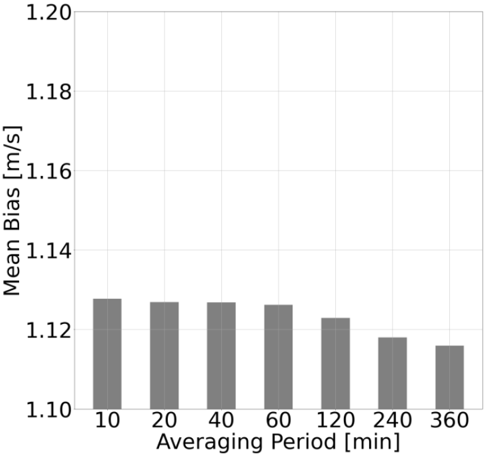
The image is a bar chart displaying the relationship between "Mean Bias [m/s]" and "Averaging Period [min]". The x-axis represents averaging periods (10, 20, 40, 60, 120, 240, 360 minutes), and the y-axis represents mean bias values ranging from 1.10 to 1.20 m/s. The chart shows a gradual decrease in mean bias as the averaging period increases.
### Components/Axes
- **X-axis (Averaging Period [min])**: Categories labeled as 10, 20, 40, 60, 120, 240, 360 minutes.
- **Y-axis (Mean Bias [m/s])**: Scale from 1.10 to 1.20 m/s, with grid lines for reference.
- **Bars**: Gray-colored bars represent mean bias values for each averaging period.
- **Legend**: Not visible in the image.
### Detailed Analysis
- **10 min**: Mean bias ≈ 1.13 m/s (highest value).
- **20 min**: Mean bias ≈ 1.125 m/s.
- **40 min**: Mean bias ≈ 1.125 m/s.
- **60 min**: Mean bias ≈ 1.125 m/s.
- **120 min**: Mean bias ≈ 1.12 m/s.
- **240 min**: Mean bias ≈ 1.115 m/s.
- **360 min**: Mean bias ≈ 1.11 m/s (lowest value).
### Key Observations
- The mean bias decreases consistently as the averaging period increases.
- The largest drop occurs between 10 min (1.13 m/s) and 120 min (1.12 m/s).
- Values stabilize at lower levels for longer averaging periods (e.g., 240 min and 360 min).
- No legend is present to confirm color coding or data series.
### Interpretation
The chart suggests that increasing the averaging period reduces mean bias, likely due to the smoothing effect of longer data aggregation. This trend implies that longer averaging periods may improve measurement accuracy by minimizing short-term fluctuations. However, the absence of a legend limits the ability to confirm data series or color associations. The gradual decline in bias highlights the importance of balancing averaging period length with computational or practical constraints in data analysis.