## Question Answering Example: MetaQA 2-Hop Correct Example
### Overview
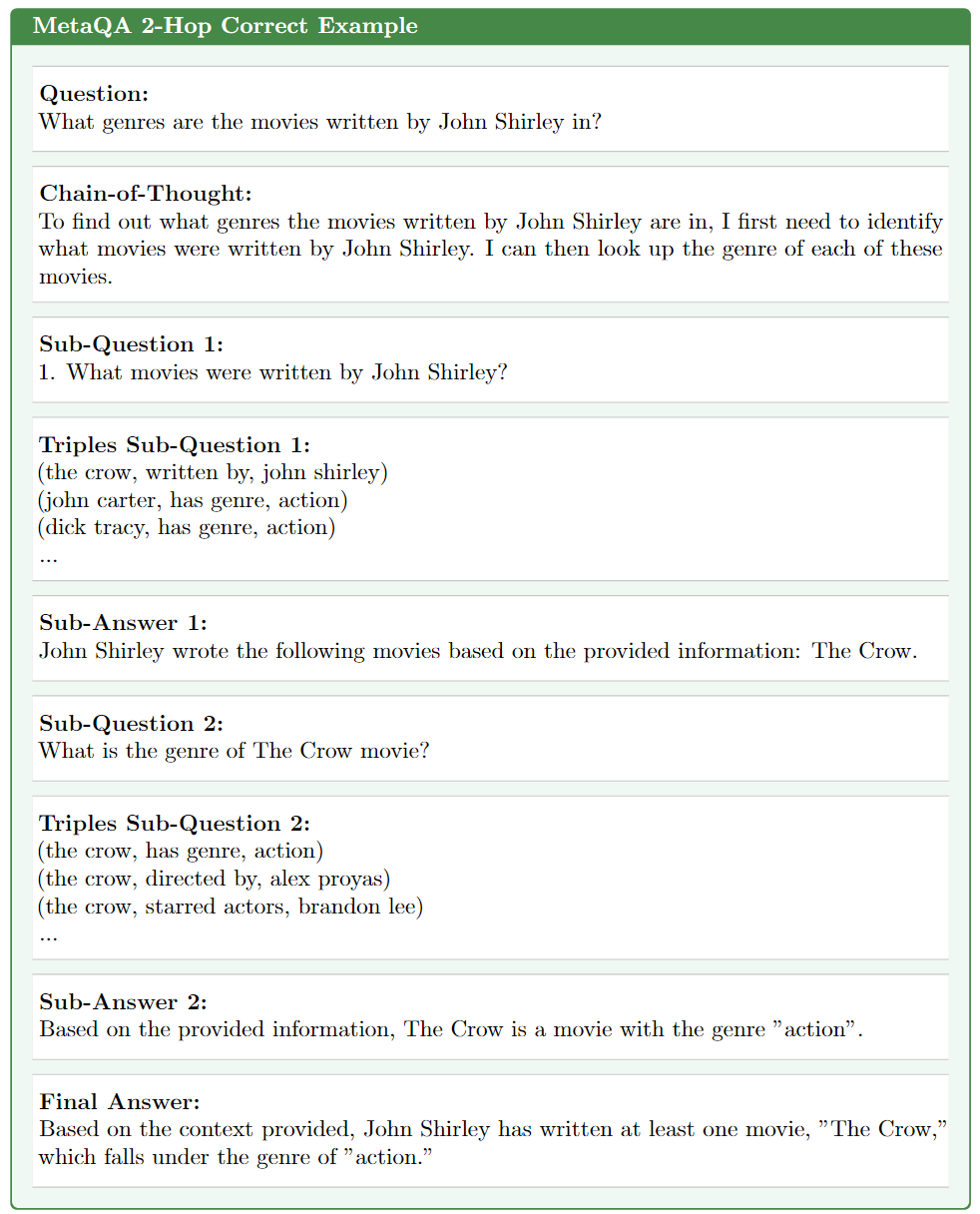
The image presents an example of a multi-hop question-answering process using the MetaQA dataset. It demonstrates how a complex question is broken down into sub-questions, answered using provided information, and then combined to form a final answer. The example focuses on identifying the genres of movies written by John Shirley.
### Components/Axes
The example is structured as follows:
* **Title:** MetaQA 2-Hop Correct Example
* **Question:** "What genres are the movies written by John Shirley in?"
* **Chain-of-Thought:** A textual explanation of the reasoning process.
* **Sub-Question 1:** "What movies were written by John Shirley?"
* **Triples Sub-Question 1:** A list of triples representing relationships:
* (the crow, written by, john shirley)
* (john carter, has genre, action)
* (dick tracy, has genre, action)
* **Sub-Answer 1:** "John Shirley wrote the following movies based on the provided information: The Crow."
* **Sub-Question 2:** "What is the genre of The Crow movie?"
* **Triples Sub-Question 2:** A list of triples representing relationships:
* (the crow, has genre, action)
* (the crow, directed by, alex proyas)
* (the crow, starred actors, brandon lee)
* **Sub-Answer 2:** "Based on the provided information, The Crow is a movie with the genre "action"."
* **Final Answer:** "Based on the context provided, John Shirley has written at least one movie, "The Crow," which falls under the genre of "action"."
### Detailed Analysis or ### Content Details
The example demonstrates a two-hop reasoning process:
1. **First Hop:** Identifying movies written by John Shirley. The system uses triples to determine that John Shirley wrote "The Crow." Other movies like "John Carter" and "Dick Tracy" are also mentioned in the triples, but not directly attributed to John Shirley in the first sub-answer.
2. **Second Hop:** Determining the genre of "The Crow." The system uses triples to identify the genre of "The Crow" as "action." It also includes information about the director and actors of the movie.
The "Chain-of-Thought" section explains the overall strategy: first identify the movies written by John Shirley, then look up the genre of each of those movies.
### Key Observations
* The example uses triples to represent relationships between entities (movies, writers, genres, directors, actors).
* The system relies on provided information to answer the questions.
* The final answer is derived from the answers to the sub-questions.
* The example focuses on a single movie, "The Crow," to illustrate the process.
### Interpretation
The example demonstrates a basic question-answering system that can reason over structured data (triples) to answer complex questions. The system breaks down the question into smaller, more manageable sub-questions, and then combines the answers to these sub-questions to arrive at a final answer. This approach is useful for answering questions that require multiple steps of reasoning or accessing multiple sources of information. The use of triples allows the system to represent relationships between entities in a structured way, which facilitates reasoning and inference. The example highlights the importance of both knowledge representation (triples) and reasoning strategies (chain-of-thought) in question-answering systems.