\n
## Diagram: Comparison of Reasoning Approaches
### Overview
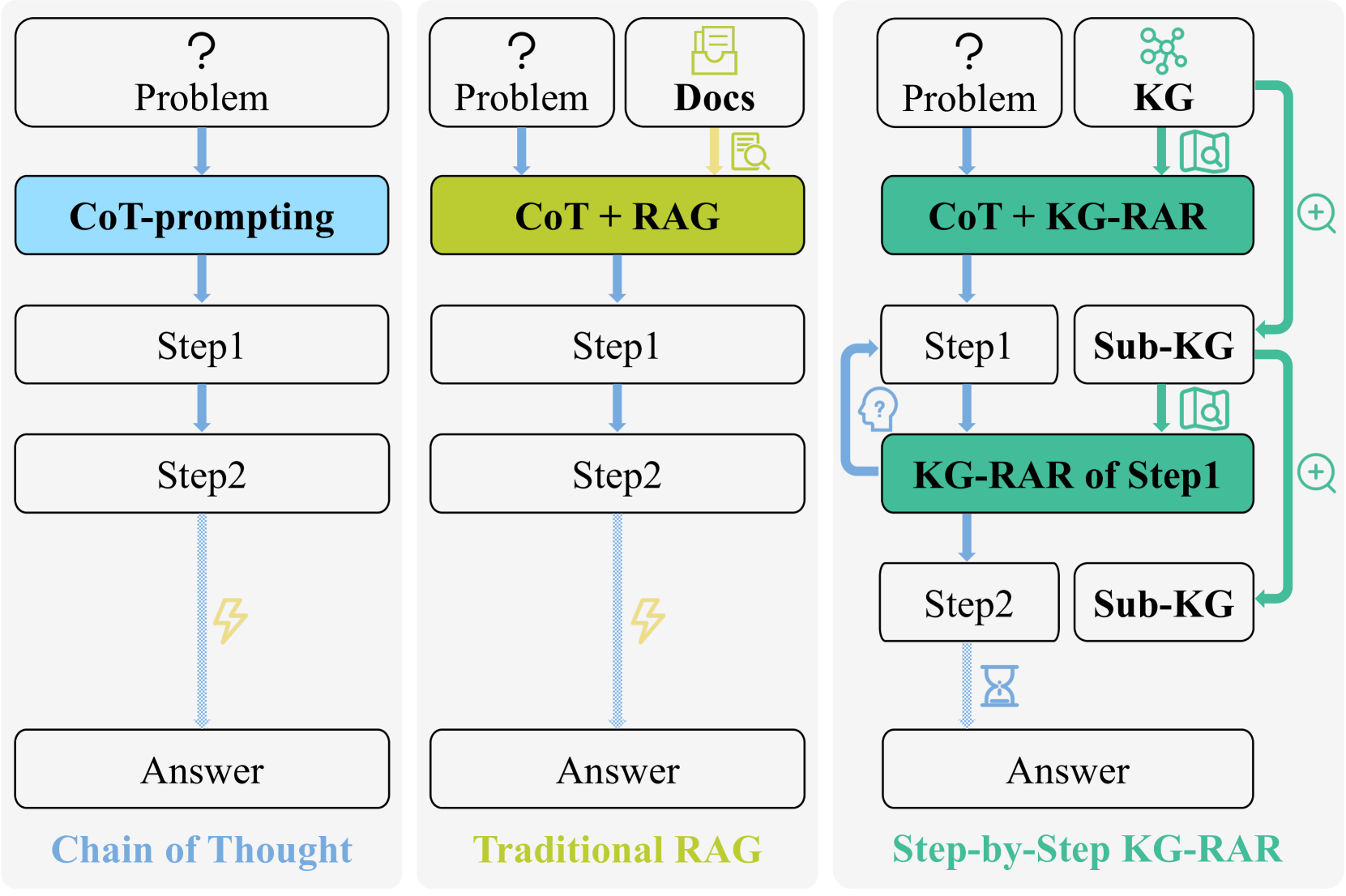
The image presents a comparative diagram illustrating three different reasoning approaches: Chain of Thought (CoT), Traditional Retrieval-Augmented Generation (RAG), and Step-by-Step Knowledge Graph Retrieval-Augmented Reasoning (KG-RAR). Each approach is depicted as a flow diagram, starting with a "Problem" input and culminating in an "Answer" output. The diagram highlights the different steps and components involved in each method.
### Components/Axes
The diagram consists of three vertically aligned columns, each representing a different approach. Each column is divided into stages:
1. **Problem:** Represented by a question mark inside a rounded rectangle.
2. **Reasoning Stage:** Labeled as "CoT-prompting", "CoT + RAG", and "CoT + KG-RAR" respectively. These are represented by rectangles.
3. **Step 1 & Step 2:** Represented by rectangles.
4. **Answer:** Represented by a rounded rectangle.
5. **Additional Components:** "Docs" and "KG" (Knowledge Graph) icons are present in the second and third columns, respectively. "Sub-KG" (Sub Knowledge Graph) is present in the third column. A magnifying glass icon is used to represent retrieval or search. A lightning bolt represents processing. A plus sign in a circle represents augmentation.
The bottom of each column is labeled with the name of the approach: "Chain of Thought", "Traditional RAG", and "Step-by-Step KG-RAR".
### Detailed Analysis or Content Details
**Column 1: Chain of Thought**
* Starts with "Problem".
* Proceeds to "CoT-prompting".
* Then to "Step1".
* Then to "Step2".
* Finally, to "Answer".
* A lightning bolt icon is placed between "Step2" and "Answer", indicating processing.
**Column 2: Traditional RAG**
* Starts with "Problem".
* Includes a "Docs" icon with a magnifying glass, indicating document retrieval.
* Proceeds to "CoT + RAG".
* Then to "Step1".
* Then to "Step2".
* Finally, to "Answer".
* A lightning bolt icon is placed between "Step2" and "Answer", indicating processing.
**Column 3: Step-by-Step KG-RAR**
* Starts with "Problem".
* Includes a "KG" icon with a magnifying glass, indicating knowledge graph retrieval.
* Proceeds to "CoT + KG-RAR".
* Then to "Step1".
* A "Sub-KG" icon with a magnifying glass is connected to "Step1".
* "KG-RAR of Step1" is placed below "Step1".
* Then to "Step2".
* A "Sub-KG" icon with a magnifying glass is connected to "Step2".
* Finally, to "Answer".
* A scale icon is placed between "Step2" and "Answer", indicating evaluation or refinement.
* A plus sign in a circle is placed between "KG" and "CoT + KG-RAR", and between "Sub-KG" and "Step1", and between "Sub-KG" and "Step2".
### Key Observations
* The "Traditional RAG" approach incorporates document retrieval ("Docs") while the "Step-by-Step KG-RAR" approach utilizes a knowledge graph ("KG").
* The "Step-by-Step KG-RAR" approach involves iterative retrieval from a "Sub-KG" at each step ("Step1" and "Step2").
* The "Step-by-Step KG-RAR" approach includes a refinement or evaluation step ("Scale" icon) before arriving at the "Answer".
* The "Chain of Thought" approach is the simplest, relying solely on prompting.
### Interpretation
The diagram illustrates a progression in complexity and sophistication of reasoning approaches. "Chain of Thought" represents a basic method, while "Traditional RAG" enhances it by incorporating external knowledge from documents. "Step-by-Step KG-RAR" represents the most advanced approach, leveraging a knowledge graph for iterative reasoning and refinement. The use of "Sub-KG" suggests a modular or hierarchical knowledge representation. The plus sign indicates augmentation of the reasoning process. The diagram suggests that incorporating external knowledge and iterative refinement can lead to more accurate and robust answers. The diagram is a conceptual illustration and does not contain specific data points or numerical values. It focuses on the *process* rather than the *results* of each approach. The diagram is intended to visually communicate the differences in architecture and flow between these three reasoning methods.