TECHNICAL ASSET FINGERPRINT
4810abecf8b0145e8f5952e1
Click to view fullscreen
Press ESC or click to close
FOUND IN PAPERS
EXPERT: healer-alpha-free VERSION 1
RUNTIME: free/openrouter/healer-alpha
INTEL_VERIFIED
## Diagram: Comparison of AI Reasoning Workflows
### Overview
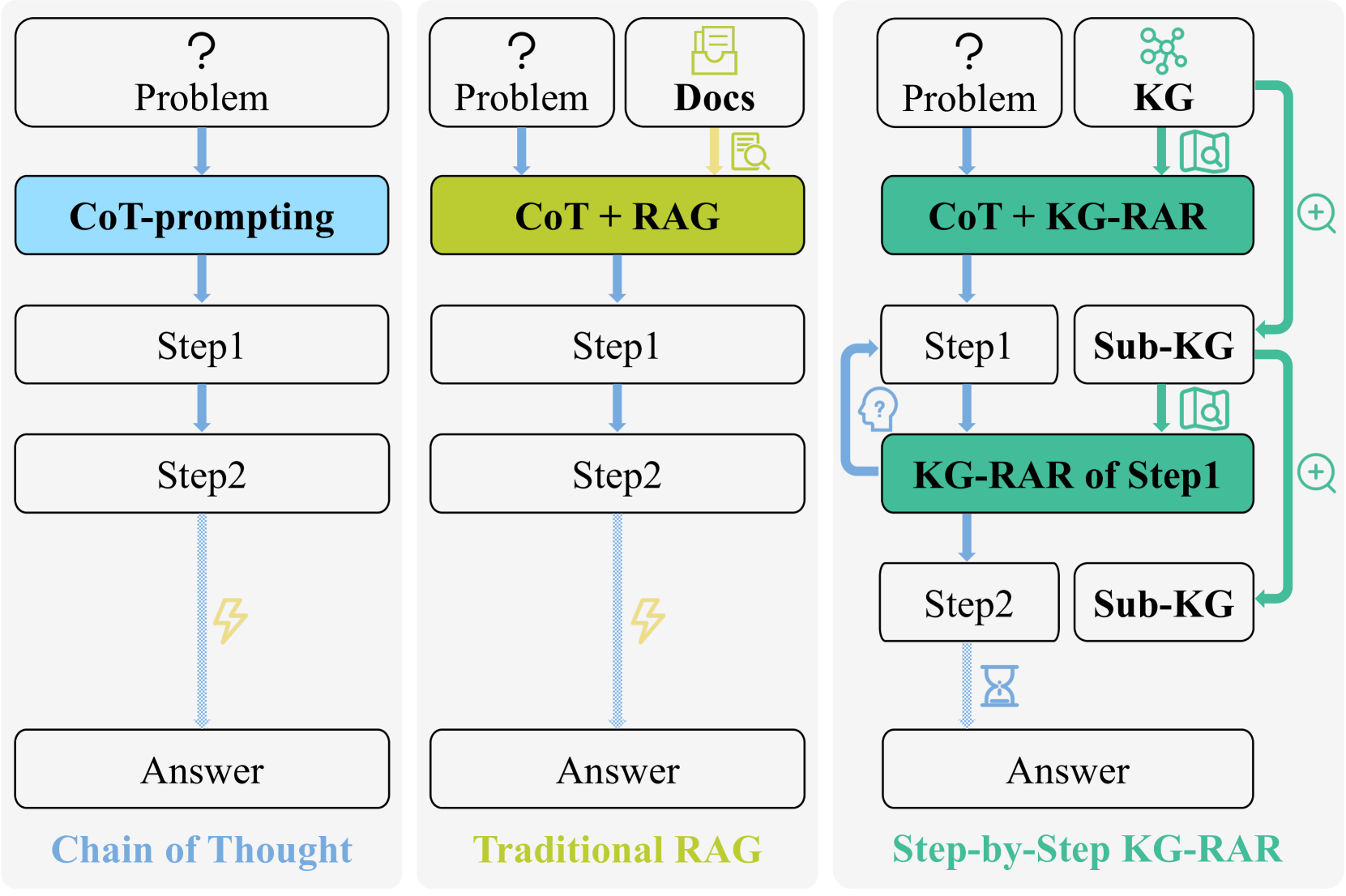
The image displays a side-by-side comparison of three distinct AI reasoning methodologies, presented as vertical flowcharts. Each panel illustrates a different approach to problem-solving, progressing from a basic method to increasingly complex, augmented systems. The diagram visually contrasts the components, data sources, and process flows of each technique.
### Components/Axes
The image is divided into three vertical panels, each with a light gray background and rounded corners. Each panel represents a complete workflow from problem input to answer output.
**Panel 1 (Left): "Chain of Thought"**
* **Title (Bottom):** "Chain of Thought" (in blue text).
* **Flow Components (Top to Bottom):**
1. A white box labeled "**Problem**" with a question mark icon above the text.
2. A blue box labeled "**CoT-prompting**".
3. A white box labeled "**Step1**".
4. A white box labeled "**Step2**".
5. A white box labeled "**Answer**".
* **Connectors & Icons:** Blue arrows connect each box sequentially. A yellow lightning bolt icon is placed on the arrow between "Step2" and "Answer".
**Panel 2 (Center): "Traditional RAG"**
* **Title (Bottom):** "Traditional RAG" (in yellow-green text).
* **Flow Components (Top to Bottom):**
1. Two white boxes at the top: "**Problem**" (with a question mark icon) and "**Docs**" (with a document icon).
2. A yellow-green box labeled "**CoT + RAG**". A small magnifying glass icon is positioned to the right of this box.
3. A white box labeled "**Step1**".
4. A white box labeled "**Step2**".
5. A white box labeled "**Answer**".
* **Connectors & Icons:** A blue arrow connects "Problem" to "CoT + RAG". A yellow arrow connects "Docs" to "CoT + RAG". Blue arrows connect the subsequent steps. A yellow lightning bolt icon is placed on the arrow between "Step2" and "Answer".
**Panel 3 (Right): "Step-by-Step KG-RAR"**
* **Title (Bottom):** "Step-by-Step KG-RAR" (in teal text).
* **Flow Components (Top to Bottom):**
1. Two white boxes at the top: "**Problem**" (with a question mark icon) and "**KG**" (with a network/graph icon).
2. A teal box labeled "**CoT + KG-RAR**". A small magnifying glass icon is positioned to the right of this box.
3. A white box labeled "**Step1**" and a white box labeled "**Sub-KG**" to its right.
4. A teal box labeled "**KG-RAR of Step1**". A small magnifying glass icon is positioned to the right of this box.
5. A white box labeled "**Step2**" and a white box labeled "**Sub-KG**" to its right.
6. A white box labeled "**Answer**".
* **Connectors & Icons:**
* A blue arrow connects "Problem" to "CoT + KG-RAR".
* A teal arrow connects "KG" to "CoT + KG-RAR".
* A blue arrow connects "CoT + KG-RAR" to "Step1".
* A teal arrow connects "KG" to the first "Sub-KG".
* A teal arrow connects the first "Sub-KG" to "KG-RAR of Step1".
* A blue arrow connects "Step1" to "KG-RAR of Step1".
* A curved blue arrow with a **head silhouette icon containing a question mark** loops from the output of "Step1" back to the input of "CoT + KG-RAR".
* A teal arrow connects "KG-RAR of Step1" to "Step2".
* A teal arrow connects the first "Sub-KG" to the second "Sub-KG".
* A teal arrow connects the second "Sub-KG" to "Step2".
* A blue arrow connects "Step2" to "Answer". An **hourglass icon** is placed on this arrow.
### Detailed Analysis
The diagram systematically compares the architecture of three AI reasoning systems:
1. **Chain of Thought (CoT):** The simplest workflow. It takes a problem, applies a prompting technique ("CoT-prompting") to break it down into sequential reasoning steps ("Step1", "Step2"), and produces an answer. The lightning bolt suggests a direct, potentially fast, generation path from the final step to the answer.
2. **Traditional RAG (Retrieval-Augmented Generation):** Enhances CoT by incorporating an external knowledge source. The process begins with both a "Problem" and relevant "Docs" (documents). These are fed into a combined "CoT + RAG" module, which presumably retrieves information from the documents to inform the step-by-step reasoning process. The workflow structure after this point mirrors the basic CoT.
3. **Step-by-Step KG-RAR (Knowledge Graph - Retrieval-Augmented Reasoning):** The most complex system. It replaces static documents with a dynamic "KG" (Knowledge Graph). The initial "CoT + KG-RAR" module uses the KG. Crucially, the process becomes iterative and granular:
* After "Step1", a specific "**Sub-KG**" (a subset or query of the main Knowledge Graph) is extracted.
* A dedicated "**KG-RAR of Step1**" module performs retrieval-augmented reasoning specifically for that step, using the Sub-KG.
* A feedback loop (indicated by the head/question mark icon) allows the outcome of Step1 to potentially refine the initial reasoning context.
* This pattern repeats for "Step2" with its own Sub-KG.
* The hourglass icon before the final "Answer" indicates this multi-stage, iterative retrieval and reasoning process is more computationally intensive or time-consuming than the previous methods.
### Key Observations
* **Progressive Complexity:** The panels show a clear evolution from internal reasoning (CoT), to reasoning with static external data (RAG), to reasoning with structured, queryable knowledge (KG-RAR).
* **Granularity of Retrieval:** Traditional RAG retrieves once at the start. Step-by-Step KG-RAR performs targeted retrieval ("Sub-KG") for each reasoning step.
* **Process Indicators:** Icons denote process characteristics: lightning bolt (fast/direct), magnifying glass (search/retrieval), head with question mark (feedback/iteration), hourglass (time-consuming).
* **Color Coding:** Each methodology is assigned a distinct color (blue, yellow-green, teal) for its core processing box and title, creating visual association.
### Interpretation
This diagram illustrates a conceptual advancement in AI reasoning systems. It argues that for complex problems, a monolithic retrieval step (Traditional RAG) is insufficient. The proposed "Step-by-Step KG-RAR" method advocates for a tighter, more dynamic integration between the reasoning process and a structured knowledge base.
The key innovation is the **decomposition of the retrieval task**. Instead of fetching all potentially relevant information at once, the system identifies the specific knowledge needed for each discrete reasoning step ("Sub-KG"). This should lead to more precise, relevant, and efficient use of external knowledge, potentially reducing hallucination and improving accuracy on multi-step problems.
The trade-off, as indicated by the hourglass, is increased complexity and likely longer processing time due to multiple retrieval and reasoning cycles. The feedback loop suggests the system can self-correct or refine its approach based on intermediate results, mimicking a more human-like, iterative problem-solving strategy. The diagram positions Step-by-Step KG-RAR as a sophisticated framework for building AI systems that can reason deeply over structured knowledge.
DECODING INTELLIGENCE...