## Line Graph: Accuracy vs Training Steps (10³)
### Overview
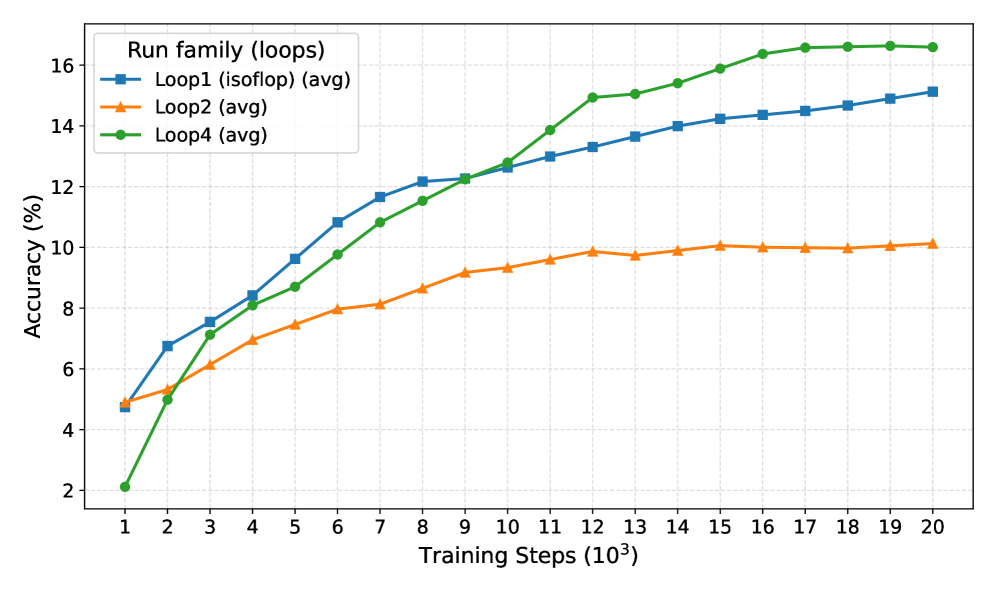
The image depicts a line graph comparing the accuracy of three training runs (Loop1, Loop2, Loop4) over 20,000 training steps (10³ increments). Accuracy is measured in percentage, with Loop4 consistently outperforming the others.
### Components/Axes
- **X-axis**: Training Steps (10³)
- Range: 1 to 20 (increments of 1)
- Label: "Training Steps (10³)"
- **Y-axis**: Accuracy (%)
- Range: 2% to 16% (increments of 2%)
- Label: "Accuracy (%)"
- **Legend**:
- Top-left corner
- Entries:
- Loop1 (isoflop) (avg): Blue squares
- Loop2 (avg): Orange triangles
- Loop4 (avg): Green circles
### Detailed Analysis
1. **Loop1 (isoflop) (avg)**:
- Starts at ~4.5% accuracy at step 1.
- Steady upward trend, reaching ~15% by step 20.
- Data points:
- Step 1: ~4.5%
- Step 5: ~9.5%
- Step 10: ~12.5%
- Step 15: ~14.5%
- Step 20: ~15%
2. **Loop2 (avg)**:
- Starts at ~4.5% accuracy at step 1.
- Slower growth, plateauing near ~10% after step 12.
- Data points:
- Step 1: ~4.5%
- Step 5: ~7.5%
- Step 10: ~9.2%
- Step 15: ~10%
- Step 20: ~10.2%
3. **Loop4 (avg)**:
- Starts at ~2% accuracy at step 1.
- Rapid initial growth, surpassing Loop1 by step 5.
- Peaks at ~16.5% by step 16, stabilizing near 16.5% by step 20.
- Data points:
- Step 1: ~2%
- Step 5: ~8.5%
- Step 10: ~13%
- Step 15: ~16%
- Step 20: ~16.5%
### Key Observations
- **Loop4 dominates** in accuracy, achieving ~16.5% by step 20, while Loop2 stagnates at ~10%.
- **Loop1** shows consistent improvement but lags behind Loop4.
- **Loop2** exhibits diminishing returns after step 12, suggesting potential inefficiencies.
- All lines exhibit upward trends, but Loop4’s growth rate is significantly higher.
### Interpretation
The graph demonstrates that **Loop4’s training methodology** (possibly involving advanced optimization or architecture) yields superior performance compared to Loop1 and Loop2. The stark divergence between Loop4 and Loop2 suggests that Loop2’s approach may suffer from suboptimal convergence or resource allocation. Loop1’s steady progress indicates a balanced but less aggressive training strategy. The data underscores the importance of algorithmic design in training efficiency, with Loop4’s rapid scaling highlighting its potential for real-world applications requiring high accuracy.