\n
## Image: Level of Detail (LoD) Comparison
### Overview
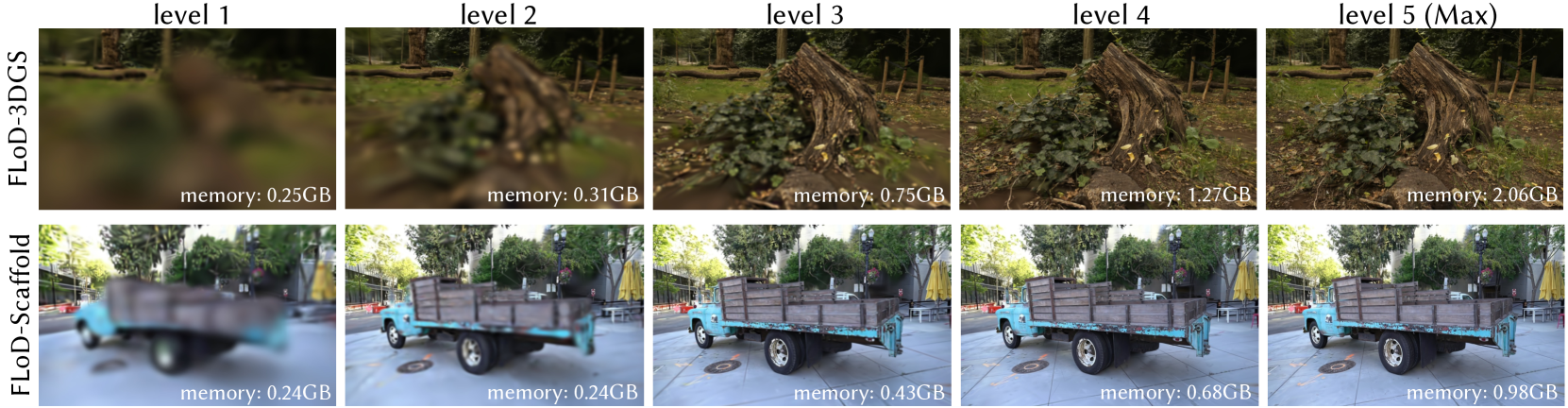
The image presents a visual comparison of two rendering techniques, "FLoD-3DGS" and "FLoD-Scaffold", across five levels of detail, ranging from "level 1" (lowest detail) to "level 5 (Max)" (highest detail). Each level displays a scene with a bush and a trailer, with associated memory usage indicated below each image.
### Components/Axes
The image is organized into two rows, representing the two rendering techniques. Each row contains five columns, representing the five levels of detail. Labels are present above each column indicating the level number. Labels are present to the left of each row indicating the rendering technique. Below each image is a "memory" label with a corresponding value in GB.
### Detailed Analysis or Content Details
**FLoD-3DGS Row:**
* **Level 1:** The image is heavily blurred, with only the general shape of the bush and background visible. Memory usage: 0.25GB.
* **Level 2:** The image is slightly less blurred than level 1, with some more detail becoming visible in the bush. Memory usage: 0.31GB.
* **Level 3:** The bush is more defined, with individual leaves becoming discernible. Memory usage: 0.75GB.
* **Level 4:** The bush is significantly more detailed, with clear leaf structure and texture. Memory usage: 1.27GB.
* **Level 5 (Max):** The image is the sharpest, with the highest level of detail in the bush and background. Memory usage: 2.06GB.
**FLoD-Scaffold Row:**
* **Level 1:** The trailer is heavily blurred, with only the general shape visible. Memory usage: 0.24GB.
* **Level 2:** The trailer is slightly less blurred than level 1, with some more detail becoming visible. Memory usage: 0.42GB.
* **Level 3:** The trailer is more defined, with individual components becoming discernible. Memory usage: 0.43GB.
* **Level 4:** The trailer is significantly more detailed, with clear structure and texture. Memory usage: 0.68GB.
* **Level 5 (Max):** The image is the sharpest, with the highest level of detail in the trailer and background. Memory usage: 0.98GB.
### Key Observations
* Memory usage increases consistently with each level of detail for both rendering techniques.
* FLoD-3DGS consistently requires more memory than FLoD-Scaffold for the same level of detail.
* The visual difference between levels 1-3 is more pronounced than between levels 4-5, suggesting diminishing returns in visual quality per unit of memory used at higher levels.
* The FLoD-Scaffold technique appears to achieve a reasonable level of detail with lower memory consumption.
### Interpretation
The image demonstrates the trade-off between visual fidelity and memory usage in rendering. The Level of Detail (LoD) techniques, FLoD-3DGS and FLoD-Scaffold, allow for dynamic adjustment of rendering complexity based on factors like distance from the viewer or available hardware resources.
The data suggests that FLoD-Scaffold is a more memory-efficient approach, potentially making it suitable for resource-constrained environments. The increasing memory usage with each level indicates that higher detail requires significantly more computational resources. The diminishing returns in visual quality at higher levels suggest that there is an optimal point where increasing detail no longer justifies the increased memory cost.
The comparison highlights the importance of choosing an appropriate LoD strategy based on the specific application requirements and hardware limitations. The image serves as a visual representation of the performance characteristics of these two rendering techniques, allowing for informed decision-making in the design of 3D graphics systems.