## Diagram: Neural Network and Spin Glass Representation
### Overview
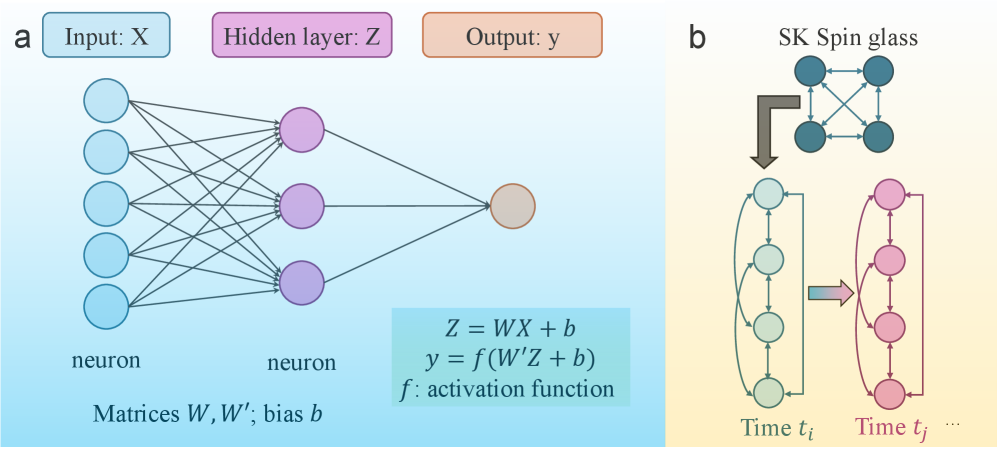
The image presents two diagrams side-by-side. Diagram (a) illustrates a simplified neural network architecture with an input layer, a hidden layer, and an output layer, along with the associated mathematical equations. Diagram (b) depicts a spin glass model, showing interconnected nodes and their evolution over time.
### Components/Axes
**Diagram (a): Neural Network**
* **Input:** Labeled "X", represented by a set of six light blue circles.
* **Hidden Layer:** Labeled "Z", represented by four purple circles.
* **Output:** Labeled "y", represented by a single light blue circle.
* **Neurons:** Labeled "neuron" below the input and hidden layers.
* **Connections:** Lines connecting neurons between layers, representing weighted connections.
* **Equations:**
* Z = WX + b
* y = f(W'Z + b)
* f: activation function
* **Matrices/Bias:** Labeled "Matrices W, W'; bias b" below the neuron labels.
**Diagram (b): Spin Glass**
* **Nodes:** Represented by circles, colored light blue and purple.
* **Connections:** Lines connecting nodes, some with arrowheads indicating direction.
* **Time:** Labeled "Time tᵢ" and "Time tⱼ", indicating the evolution of the system.
* **Title:** "SK Spin glass" at the top.
### Detailed Analysis or Content Details
**Diagram (a): Neural Network**
The neural network has 6 input nodes, 4 hidden nodes, and 1 output node. The connections between the layers are fully connected. The equations describe the forward pass of the network:
* The hidden layer's activation (Z) is calculated by multiplying the input (X) by a weight matrix (W) and adding a bias (b).
* The output (y) is calculated by applying an activation function (f) to a linear combination of the hidden layer's activation (Z), a weight matrix (W'), and a bias (b).
**Diagram (b): Spin Glass**
The spin glass model consists of interconnected nodes. The connections are not all uniform; some have arrowheads, suggesting directed interactions. The diagram shows the state of the system at two different times, tᵢ and tⱼ. The purple nodes appear to be changing state, indicated by the arrow. The connections between the nodes are complex and appear to form a network with both excitatory and inhibitory interactions.
### Key Observations
* Diagram (a) provides a simplified representation of a neural network, focusing on the core mathematical operations.
* Diagram (b) illustrates a complex system with dynamic interactions between its components.
* The spin glass model appears to be evolving over time, with nodes changing their state.
* The use of different colors (light blue and purple) in both diagrams may represent different states or types of nodes.
### Interpretation
The image juxtaposes two different models of complex systems: a neural network and a spin glass. The neural network diagram illustrates a computational model inspired by the brain, while the spin glass diagram represents a physical system with disordered interactions. Both models are used to study complex behavior and emergent properties.
The neural network diagram highlights the key components of a simple feedforward network: input, hidden layer, output, weights, and activation function. The equations provide a concise mathematical description of the network's operation.
The spin glass diagram illustrates a system with many interacting degrees of freedom. The evolution of the system over time suggests that it is dynamic and can exhibit complex behavior. The disordered interactions between the nodes are characteristic of spin glasses, which are known for their frustration and non-equilibrium behavior.
The connection between these two diagrams is that they both represent complex systems that can be modeled mathematically. The neural network is a computational model, while the spin glass is a physical model. Both models can be used to study the emergence of complex behavior from simple interactions. The diagrams suggest a potential analogy between the two systems, where the nodes in the spin glass could be seen as analogous to the neurons in the neural network.