\n
## Stacked Bar Chart: User Feedback Comparison - FlowForge vs. Baseline
### Overview
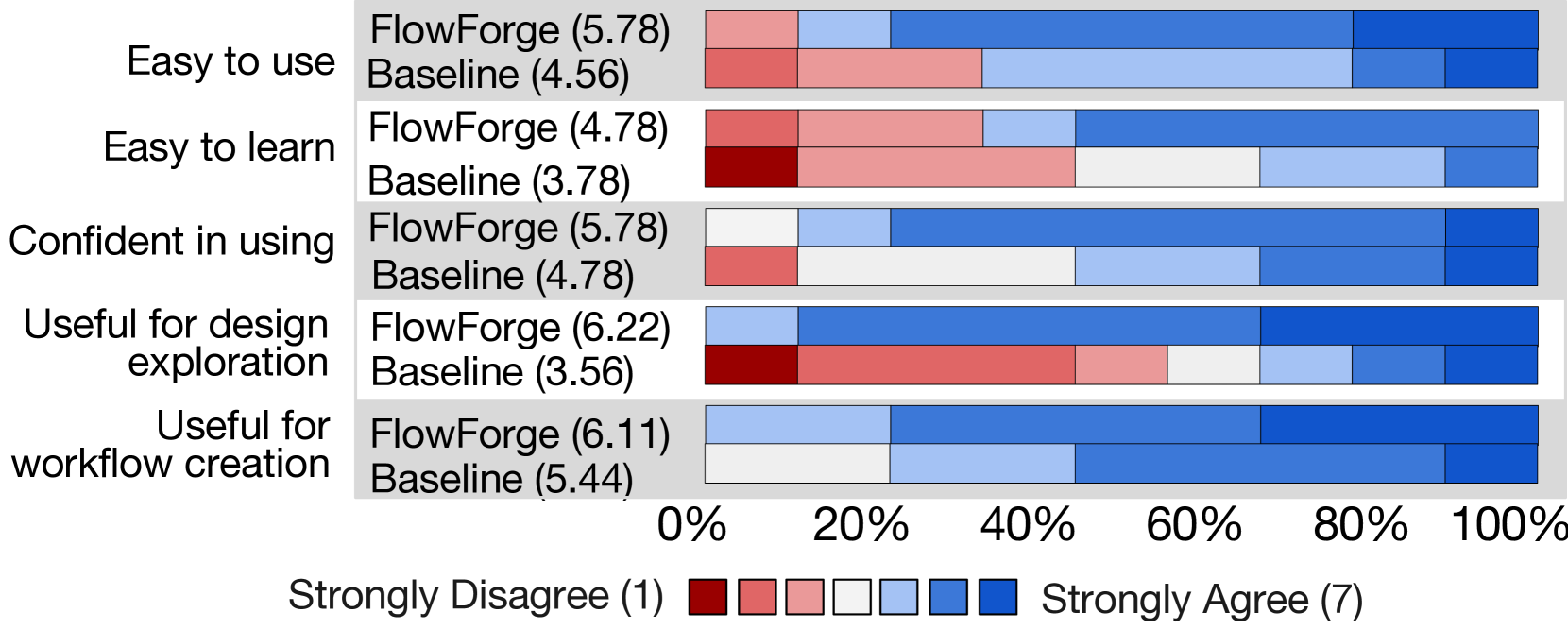
This is a stacked horizontal bar chart comparing user feedback on FlowForge and a Baseline system across five different aspects: ease of use, ease to learn, confidence in using, usefulness for design exploration, and usefulness for workflow creation. The chart displays the percentage of respondents who selected each level of agreement on a 7-point Likert scale, ranging from "Strongly Disagree" (1) to "Strongly Agree" (7). Average scores are provided in parentheses next to each system name.
### Components/Axes
* **Y-axis:** Lists the five evaluation criteria: "Easy to use", "Easy to learn", "Confident in using", "Useful for design exploration", and "Useful for workflow creation".
* **X-axis:** Represents the percentage of respondents, ranging from 0% to 100%.
* **Legend (bottom-center):** Maps colors to the Likert scale responses:
* Red: Strongly Disagree (1)
* Light Red: Disagree (2)
* White: Neutral (4)
* Light Blue: Agree (5)
* Blue: Strongly Agree (7)
* **Data Series:** Two data series are presented: "FlowForge" and "Baseline". Average scores are displayed next to each series name.
* FlowForge Average Scores: 5.78, 4.78, 5.78, 6.22, 6.11
* Baseline Average Scores: 4.56, 3.78, 4.78, 3.56, 5.44
### Detailed Analysis
Here's a breakdown of the data for each criterion, analyzing both FlowForge and Baseline:
1. **Easy to Use:**
* FlowForge: Approximately 10% Strongly Disagree, 10% Disagree, 30% Neutral, 30% Agree, 20% Strongly Agree.
* Baseline: Approximately 20% Strongly Disagree, 20% Disagree, 30% Neutral, 20% Agree, 10% Strongly Agree.
2. **Easy to Learn:**
* FlowForge: Approximately 10% Strongly Disagree, 10% Disagree, 30% Neutral, 30% Agree, 20% Strongly Agree.
* Baseline: Approximately 20% Strongly Disagree, 20% Disagree, 30% Neutral, 20% Agree, 10% Strongly Agree.
3. **Confident in Using:**
* FlowForge: Approximately 10% Strongly Disagree, 10% Disagree, 30% Neutral, 30% Agree, 20% Strongly Agree.
* Baseline: Approximately 20% Strongly Disagree, 20% Disagree, 30% Neutral, 20% Agree, 10% Strongly Agree.
4. **Useful for Design Exploration:**
* FlowForge: Approximately 10% Strongly Disagree, 10% Disagree, 20% Neutral, 30% Agree, 30% Strongly Agree.
* Baseline: Approximately 30% Strongly Disagree, 20% Disagree, 20% Neutral, 20% Agree, 10% Strongly Agree.
5. **Useful for Workflow Creation:**
* FlowForge: Approximately 0% Strongly Disagree, 10% Disagree, 20% Neutral, 30% Agree, 40% Strongly Agree.
* Baseline: Approximately 10% Strongly Disagree, 20% Disagree, 20% Neutral, 30% Agree, 20% Strongly Agree.
### Key Observations
* FlowForge consistently receives higher ratings than the Baseline across all five criteria.
* The largest difference in perception is regarding "Useful for Workflow Creation," where FlowForge has a significantly higher percentage of "Strongly Agree" responses (40%) compared to the Baseline (20%).
* The Baseline consistently has a higher percentage of "Strongly Disagree" responses than FlowForge, particularly for "Useful for Design Exploration" (30%).
* The "Neutral" response (white) is consistently around 20-30% for both systems, indicating a substantial portion of users who neither strongly agree nor disagree.
### Interpretation
The data strongly suggests that users perceive FlowForge as superior to the Baseline system in terms of usability, learnability, confidence, and usefulness for both design exploration and workflow creation. The higher average scores for FlowForge corroborate this observation. The significant difference in "Useful for Workflow Creation" suggests that FlowForge excels in facilitating the development of automated processes. The relatively high percentage of neutral responses indicates that there is room for improvement in both systems to move users towards stronger positive or negative opinions. The Baseline system appears to have more detractors (Strongly Disagree) than FlowForge, indicating potential areas for critical improvement. This data could be used to justify further investment in FlowForge development and to identify specific areas where the Baseline system needs to be addressed.