## Code Snippet: Rust Function `create_sequence`
### Overview
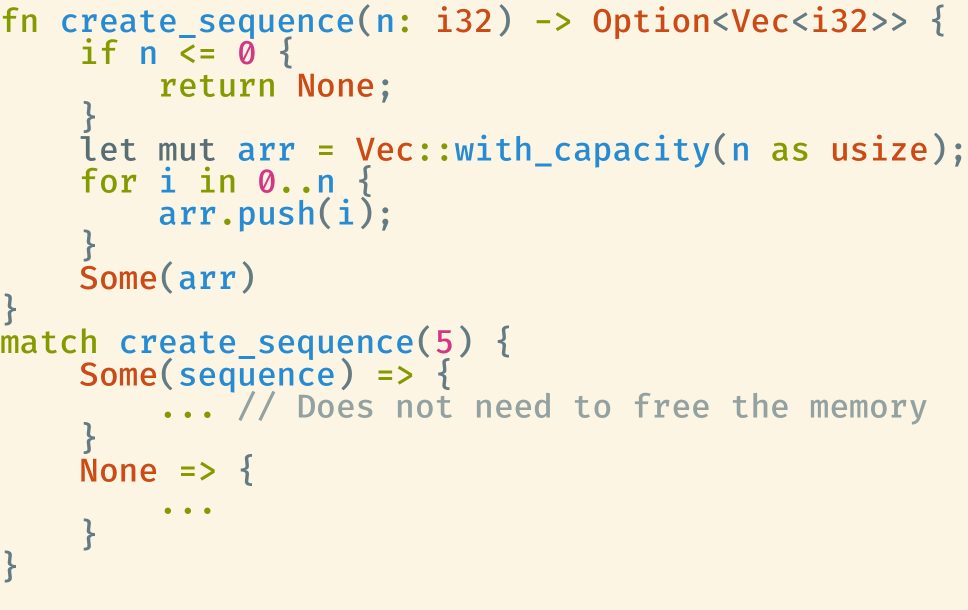
The image shows a Rust code snippet defining a function `create_sequence` that generates a sequence of integers. The function returns an `Option<Vec<i32>>`, handling edge cases and memory allocation. A `match` statement demonstrates pattern matching on the function's output.
### Components/Axes
- **Function Definition**:
- `fn create_sequence(n: i32) -> Option<Vec<i32>>`
- `fn`: Rust keyword for function definition (green).
- `create_sequence`: Function name (blue).
- `n: i32`: Parameter `n` of type `i32` (integer).
- `-> Option<Vec<i32>>`: Return type: `Option` enum wrapping a vector of 32-bit integers.
- **Control Flow**:
- `if n <= 0 { return None; }`
- Conditional check for invalid input (`n <= 0`).
- Returns `None` (red) if `n` is non-positive.
- `let mut arr = Vec::with_capacity(n as usize);`
- Initializes a mutable vector `arr` with capacity `n` (converted to `usize`).
- `for i in 0..n { arr.push(i); }`
- Populates the vector with integers from `0` to `n-1`.
- `Some(arr)`: Returns the populated vector wrapped in `Some`.
- **Pattern Matching**:
- `match create_sequence(5) {`
- Calls `create_sequence(5)` and matches the result.
- `Some(sequence) => { ... }`
- Handles the `Some` case (red).
- Comment: `// Does not need to free the memory` (gray).
- `None => { ... }`
- Handles the `None` case (red).
### Detailed Analysis
1. **Function Logic**:
- For `n <= 0`, returns `None` to indicate an empty sequence.
- For `n > 0`, allocates a vector with capacity `n` and fills it with sequential integers.
- Returns `Some(arr)` to indicate a valid sequence.
2. **Memory Management**:
- The comment `// Does not need to free the memory` suggests Rust's ownership model automatically manages memory, avoiding manual deallocation.
3. **Pattern Matching**:
- The `match` statement exhaustively handles both `Some(sequence)` and `None` cases, ensuring all possibilities are addressed.
### Key Observations
- **Edge Case Handling**: The function explicitly checks for `n <= 0` to avoid invalid memory allocation.
- **Type Safety**: Uses `Option` to signal the presence or absence of a result, preventing null pointer errors.
- **Efficiency**: Pre-allocates vector capacity to optimize performance for large `n`.
### Interpretation
This function demonstrates Rust's emphasis on safety and performance:
- **Safety**: The `Option` type and exhaustive `match` ensure all code paths are handled, eliminating runtime panics.
- **Performance**: Pre-allocating vector capacity reduces reallocations during population.
- **Memory Management**: Rust's ownership model avoids manual memory management, as noted in the comment.
The code exemplifies idiomatic Rust practices for error handling, resource management, and pattern matching.