## Screenshot: Case Study on Identification of Critical Tokens via Paraphrastic Probing
### Overview
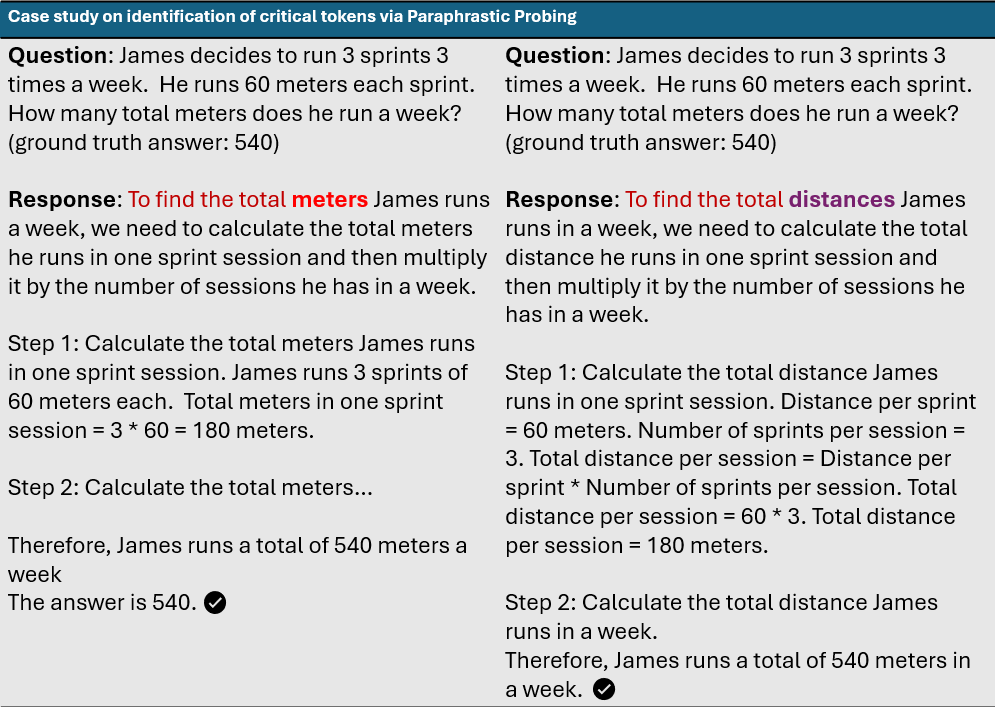
The image displays a technical case study interface with two identical questions about calculating total meters James runs weekly. Each question is followed by a response demonstrating calculation steps, with the ground truth answer (540) explicitly stated. The interface uses color highlighting (red/purple) for key terms and includes a checkmark to validate correctness.
### Components/Axes
- **Title**: "Case study on identification of critical tokens via Paraphrastic Probing" (top blue banner, white text).
- **Questions**: Two identical questions (left/right columns) asking:
*"James decides to run 3 sprints 3 times a week. He runs 60 meters each sprint. How many total meters does he run a week?"*
Ground truth answer: `(540)`.
- **Responses**:
- Left response: Focuses on "total meters" (highlighted in red).
- Right response: Focuses on "total distances" (highlighted in purple).
Both responses outline two steps:
1. Calculate meters per session (3 sprints × 60 meters = 180 meters).
2. Multiply by weekly sessions (180 × 3 = 540 meters).
- **Checkmark**: Black circle with white check (bottom-right of both responses).
### Content Details
- **Textual Elements**:
- Questions and responses are in black text on a white background.
- Key terms ("total meters," "total distances") are highlighted in red/purple.
- Steps are numbered and formatted with bullet points.
- Ground truth answers are parenthetical and bolded.
- **Visual Elements**:
- Blue banner at the top.
- Vertical alignment of questions and responses (left/right columns).
- Checkmark icon in a circular badge.
### Key Observations
1. **Paraphrastic Robustness**: The identical questions differ only in response phrasing ("meters" vs. "distances"), yet both correctly identify 540 as the answer.
2. **Step Consistency**: Both responses follow the same calculation logic but vary in wording (e.g., "sprint session" vs. "distance per session").
3. **Highlighting Strategy**: Color coding distinguishes critical terms, aiding in token identification analysis.
4. **Checkmark Placement**: Positioned at the bottom-right of each response, visually reinforcing correctness.
### Interpretation
The case study demonstrates how paraphrastic probing can identify critical tokens (e.g., "total meters") even when responses vary in wording. The consistent ground truth (540) across both questions suggests the model generalizes well to syntactic variations. The checkmark serves as a binary validation signal, critical for training models to prioritize accuracy over phrasing. The highlighted terms ("total meters/distances") likely represent the target tokens for the probing task, emphasizing the importance of semantic consistency in natural language processing tasks.