## Heatmap: Sentence Alignment
### Overview
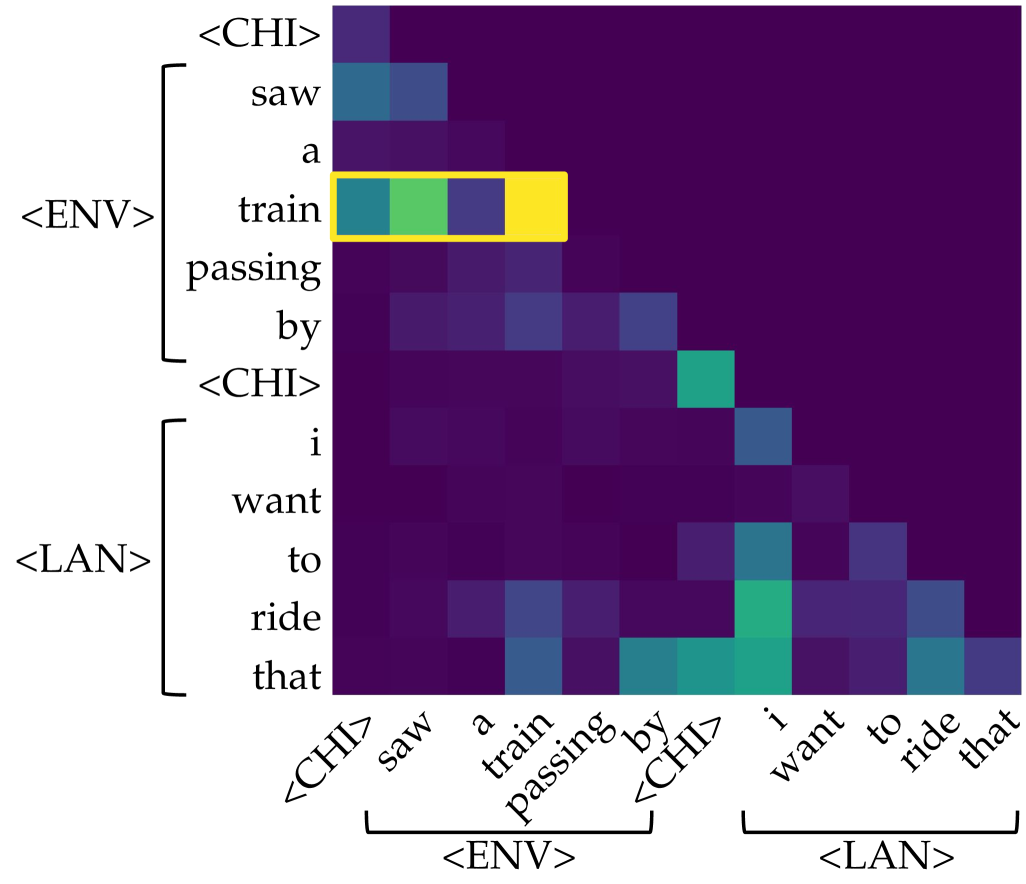
The image is a heatmap visualizing the alignment between two sentences. The x-axis and y-axis represent the words in the sentences. The color intensity of each cell indicates the strength of the alignment between the corresponding words. A yellow box highlights a specific region of interest.
### Components/Axes
* **X-axis:** The x-axis is labeled with the following words: "<CHI>", "saw", "a", "train", "passing", "by", "<CHI>", "i", "want", "to", "ride", "that". The words "saw" through "by" are grouped under the label "<ENV>", and the words "i" through "that" are grouped under the label "<LAN>".
* **Y-axis:** The y-axis is labeled with the same words as the x-axis: "<CHI>", "saw", "a", "train", "passing", "by", "<CHI>", "i", "want", "to", "ride", "that". The words "saw" through "by" are grouped under the label "<ENV>", and the words "i" through "that" are grouped under the label "<LAN>".
* **Color Scale:** The heatmap uses a color gradient where darker colors (purple/blue) indicate weaker alignment and lighter colors (green/yellow) indicate stronger alignment.
* **Highlighted Region:** A yellow box surrounds the cells corresponding to the word "train" on the y-axis and the words "saw", "a", "train" on the x-axis.
### Detailed Analysis
The heatmap shows the alignment strength between words in the two sentences. The intensity of the color indicates the strength of the alignment.
* **"<CHI>" Alignment:** The first "<CHI>" on the y-axis aligns strongly with the first "<CHI>" on the x-axis.
* **"saw" Alignment:** The word "saw" on the y-axis aligns strongly with the word "saw" on the x-axis.
* **"a" Alignment:** The word "a" on the y-axis aligns strongly with the word "a" on the x-axis.
* **"train" Alignment:** The word "train" on the y-axis aligns strongly with the words "saw", "a", and "train" on the x-axis. This region is highlighted with a yellow box.
* **"passing" Alignment:** The word "passing" on the y-axis aligns moderately with the word "passing" on the x-axis.
* **"by" Alignment:** The word "by" on the y-axis aligns moderately with the word "by" on the x-axis.
* **Second "<CHI>" Alignment:** The second "<CHI>" on the y-axis aligns strongly with the second "<CHI>" on the x-axis.
* **"i" Alignment:** The word "i" on the y-axis aligns strongly with the word "i" on the x-axis.
* **"want" Alignment:** The word "want" on the y-axis aligns moderately with the word "want" on the x-axis.
* **"to" Alignment:** The word "to" on the y-axis aligns moderately with the word "to" on the x-axis.
* **"ride" Alignment:** The word "ride" on the y-axis aligns moderately with the word "ride" on the x-axis.
* **"that" Alignment:** The word "that" on the y-axis aligns moderately with the word "that" on the x-axis.
### Key Observations
* The diagonal elements generally show stronger alignment, indicating that words tend to align with themselves.
* The highlighted region shows that the word "train" in the first sentence has a strong alignment with "saw", "a", and "train" in the second sentence.
* The alignment between the two sentences is not perfect, as some words have weaker or no alignment with their counterparts.
### Interpretation
The heatmap visualizes the alignment between two sentences, likely representing the output of a machine translation or natural language processing model. The stronger the alignment between two words, the more likely they are to be semantically related or correspond to each other in the translation. The highlighted region suggests that the model recognizes the relationship between "train" in the first sentence and the phrase "saw a train" in the second sentence. The labels "<CHI>", "<ENV>", and "<LAN>" likely represent different contexts or categories within the sentences, but without further context, their specific meanings are unclear. The heatmap provides a visual representation of how the model understands the relationship between the two sentences.