\n
## Diagram: Pixel-Based Representation
### Overview
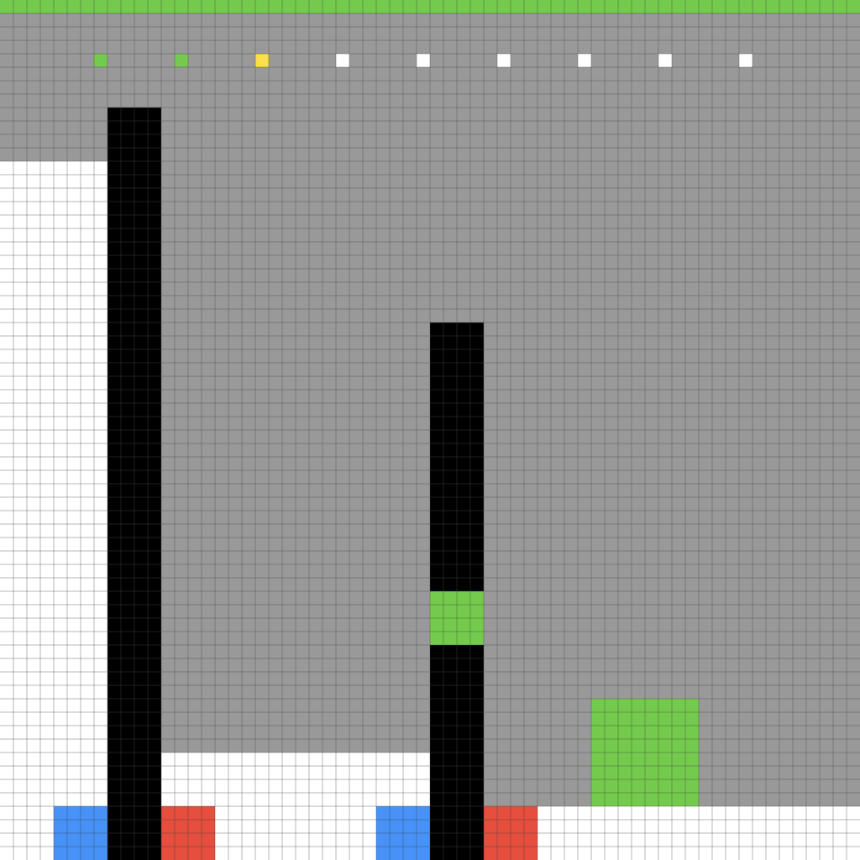
The image presents a pixelated diagram, resembling a simplified representation of a landscape or a structural arrangement. It consists of colored blocks (black, green, yellow, red, blue, and white) arranged on a gray grid background. There are no explicit axes or labels. The diagram appears to be a visual arrangement rather than a data-driven chart.
### Components/Axes
There are no explicit axes or scales. The components are defined by the colored blocks:
* **Black Blocks:** Vertical structures of varying heights.
* **Green Blocks:** Smaller, square blocks.
* **Yellow Block:** A single, small square block.
* **Red Blocks:** Small, square blocks.
* **Blue Blocks:** Small, square blocks.
* **White Blocks:** Small, square blocks.
* **Gray Background:** A grid pattern.
### Detailed Analysis or Content Details
The diagram can be broken down into sections:
* **Left Side:** A tall black block is present, extending from the bottom edge to near the top. A small green block is positioned on top of the black block. A blue block is at the base of the black block.
* **Center:** A shorter black block is present. A green block is positioned mid-way up the black block. A red block is at the base of the black block.
* **Right Side:** A green block is present.
* **Top:** A horizontal line of blocks is present, consisting of a yellow block, followed by several white blocks. The number of white blocks is approximately 6.
There is no numerical data associated with the diagram. The arrangement is purely visual.
### Key Observations
The diagram features two prominent vertical black structures. The presence of colored blocks at the base and top of the black structures suggests a potential relationship or connection. The horizontal line of blocks at the top could represent a boundary or a separate element. The diagram is highly abstract and lacks clear context.
### Interpretation
The diagram appears to be a symbolic or abstract representation, potentially illustrating a concept of structure, support, or hierarchy. The black blocks could represent foundational elements, while the colored blocks might signify different components or attributes. The arrangement could be a simplified model of a building, a landscape, or a more abstract system. Without additional context, it is difficult to determine the precise meaning or purpose of the diagram. The diagram does not contain any factual data, but rather a visual arrangement of elements. It is likely a conceptual illustration rather than a data visualization. The diagram's simplicity suggests it may be intended for illustrative or educational purposes.