## Network Graph: Node and Edge Visualization
### Overview
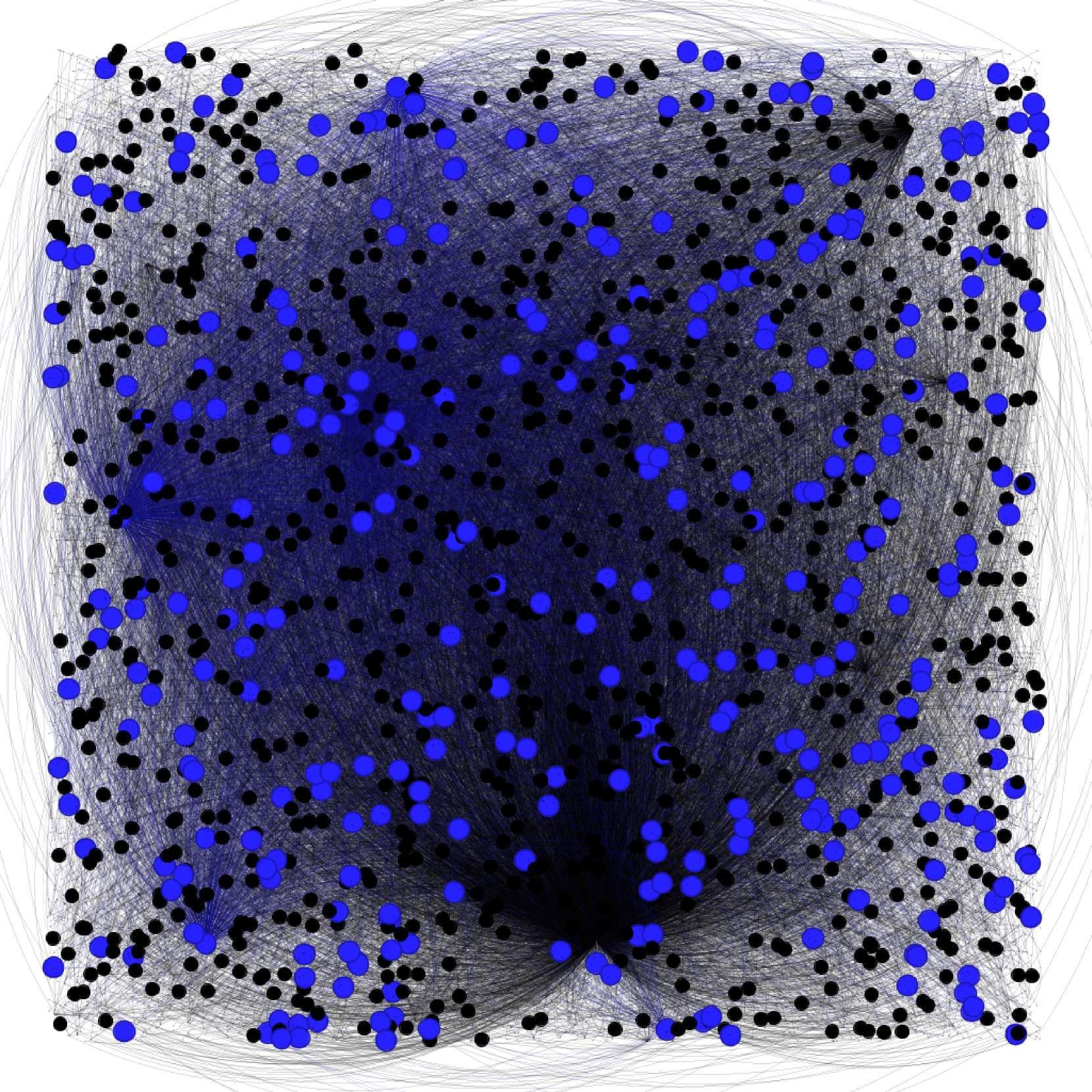
The image displays a complex network graph. It consists of numerous nodes, represented by black and blue circles, connected by a dense web of thin lines (edges). The nodes are distributed across the entire canvas, with a noticeable concentration of edges in the central and lower-central regions, creating a gradient effect from dark blue to black towards the center. There is no explicit legend or axis information provided, making it impossible to determine the exact meaning of the node colors or their spatial arrangement.
### Components/Axes
* **Nodes:** Two distinct types of nodes are visible:
* **Black Circles:** These are smaller in diameter compared to the blue circles. They are scattered throughout the network.
* **Blue Circles:** These are larger in diameter than the black circles. They are also distributed throughout the network, but appear to be more concentrated in certain areas, particularly towards the periphery and in clusters within the denser central region.
* **Edges:** Thin, light gray to dark blue lines connecting the nodes. The density of these edges is highest in the central and lower-central areas, creating a visual "core" or "hub" effect. The color of the edges appears to transition from lighter gray at the periphery to darker blue/black towards the center, possibly indicating a density or strength attribute.
* **Background:** The background is white, with a subtle dark blue to black gradient emanating from the center of the graph.
### Detailed Analysis or Content Details
Due to the absence of labels, axes, or a legend, a precise quantitative analysis of data points or trends is not possible. However, qualitative observations can be made:
* **Node Distribution:** Both black and blue nodes are present across the entire graph. There isn't a clear separation of node types into distinct regions.
* **Edge Density:** The edges are most densely packed in the central and lower-central areas of the graph. This suggests a high degree of connectivity or interaction within this region. The density decreases towards the edges of the graph.
* **Color Gradient:** The dark blue/black gradient in the center, coinciding with the high edge density, might represent a region of high activity, importance, or a specific characteristic of the network.
### Key Observations
* The network exhibits a non-uniform distribution of connectivity, with a clear central cluster of high-density connections.
* The presence of two distinct node types (black and blue) suggests a categorization or differentiation of network elements. The larger size of the blue nodes might indicate a higher degree of importance or a different attribute compared to the black nodes.
* The visual density of edges, particularly in the center, implies a core structure or a highly interconnected subgraph.
### Interpretation
This network graph likely represents a system with interconnected entities. The two types of nodes (black and blue) could represent different categories of elements within this system, such as users and content, different types of servers, or distinct communities. The larger blue nodes might represent more significant entities or those with a higher number of connections.
The dense central region with a dark blue/black gradient and numerous edges strongly suggests a core or hub within the network. This could be a central server, a critical piece of infrastructure, or a highly active group of interconnected entities. The sparser connections at the periphery indicate that entities further from this core are less interconnected or interact with fewer other entities.
Without further context or a legend, it is speculative to assign specific meanings. However, the visualization effectively communicates the structure and connectivity of a complex system, highlighting areas of high interaction and potential central importance. The visual design itself, with the gradient and varying node sizes, is used to convey information about the network's topology and potentially the attributes of its components. The lack of explicit labels or scales means this is a qualitative representation of network structure rather than a quantitative data display.