## Diagram: Split Learning / Vertical Federated Learning Architecture
### Overview
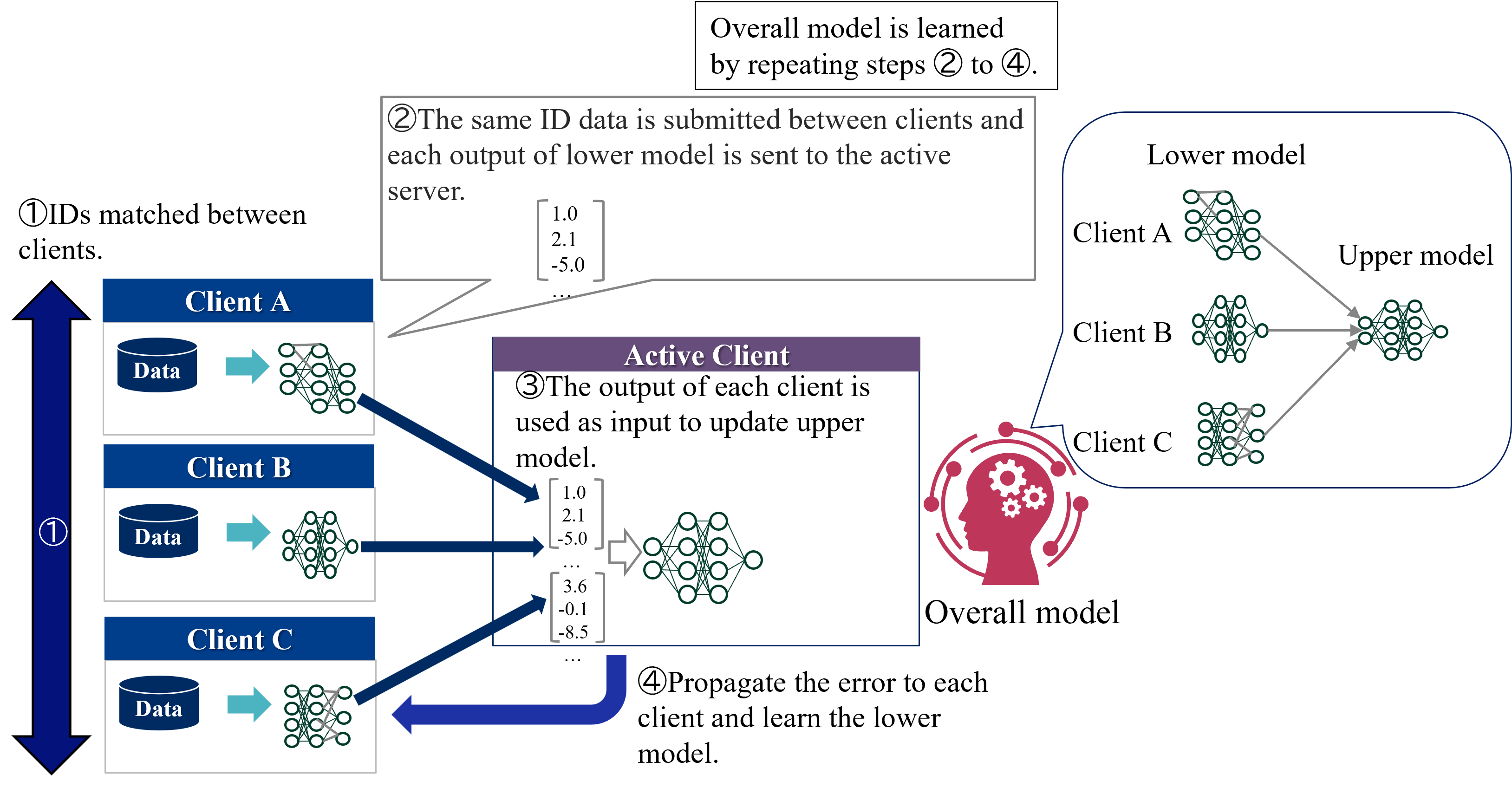
This diagram illustrates a distributed machine learning workflow, specifically a "Split Learning" or "Vertical Federated Learning" architecture. The process involves multiple clients (A, B, and C) collaborating to train an "Overall model" without sharing raw data. The model is partitioned into a "Lower model" (residing on clients) and an "Upper model" (residing on an "Active Client" or server). The system operates through an iterative process of forward propagation of intermediate data and backward propagation of error.
### Components/Axes
* **Left Column (Clients):** Three distinct blocks labeled "Client A", "Client B", and "Client C". Each contains a database icon labeled "Data" and a neural network icon representing the "Lower model".
* **Center Box (Active Client):** A central processing unit labeled "Active Client". It contains two vector representations and a neural network icon representing the "Upper model".
* **Right Side (Overall Model):** A large bubble labeled "Overall model" containing a schematic of the architecture: three "Lower model" networks feeding into a single "Upper model" network.
* **Workflow Steps:** Four numbered steps (1-4) define the operational sequence.
* **Vertical Axis (Left):** A large blue double-headed arrow labeled "(1)" indicating the alignment of data IDs across clients.
### Detailed Analysis
#### 1. Workflow Steps
* **(1) IDs matched between clients:** Located on the far left, this indicates that the data across Client A, B, and C is vertically aligned (i.e., they share the same sample IDs).
* **(2) The same ID data is submitted between clients and each output of lower model is sent to the active server:** Located at the top center. This step describes the forward pass where intermediate activations (represented by the vector $[1.0, 2.1, -5.0]^T$) are sent from the clients to the Active Client.
* **(3) The output of each client is used as input to update upper model:** Located in the center box. The Active Client receives the vectors (e.g., $[1.0, 2.1, -5.0]^T$ and $[3.6, -0.1, -8.5]^T$) and processes them through the "Upper model" neural network.
* **(4) Propagate the error to each client and learn the lower model:** Located at the bottom center. A large blue arrow points from the Active Client back to the clients, indicating the backpropagation of gradients to update the local "Lower models".
* **Iterative Loop:** A text box at the top center states: "Overall model is learned by repeating steps (2) to (4)."
#### 2. Data Representations
* **Intermediate Vectors:** The diagram explicitly shows two column vectors being processed:
* Vector 1: $\begin{bmatrix} 1.0 \\ 2.1 \\ -5.0 \end{bmatrix}$
* Vector 2: $\begin{bmatrix} 3.6 \\ -0.1 \\ -8.5 \end{bmatrix}$
* These represent the "smashed data" or intermediate activations sent from the lower models to the upper model.
### Key Observations
* **Architecture Split:** The "Overall model" is clearly bifurcated. The "Lower model" is distributed across clients (feature extraction), while the "Upper model" is centralized (decision/classification).
* **Communication Flow:** The communication is bidirectional. Forward pass sends activations (vectors) to the Active Client; backward pass sends error gradients back to the clients.
* **Active Client Role:** The Active Client acts as the central orchestrator, holding the "Upper model" and managing the training loop.
* **Visual Logic:** The diagram uses a color-coded system where blue arrows indicate the flow of data and error signals, and the red icon (a head with gears) symbolizes the "Overall model" intelligence.
### Interpretation
This diagram depicts a privacy-preserving machine learning technique. By splitting the model, the raw data never leaves the client's local environment. Instead, only the intermediate representations (the vectors shown) are transmitted.
* **Why it matters:** This architecture is critical for scenarios where data is siloed across different organizations (e.g., hospitals or banks) that cannot share raw data due to privacy regulations (like GDPR or HIPAA) but wish to collaborate on a shared predictive model.
* **Peircean Investigative Insight:** The "Active Client" is the point of vulnerability and control. It is the only component that sees the intermediate representations from all clients. If the "Upper model" is compromised, the intermediate representations could potentially be inverted to reconstruct the raw data. The "Overall model" bubble on the right serves as a conceptual abstraction, while the center box represents the operational reality of the training process. The inclusion of specific vector values suggests that the system is sensitive to the dimensionality of the intermediate layers.