\n
## Heatmap: Syllogism Format Validation Performance
### Overview
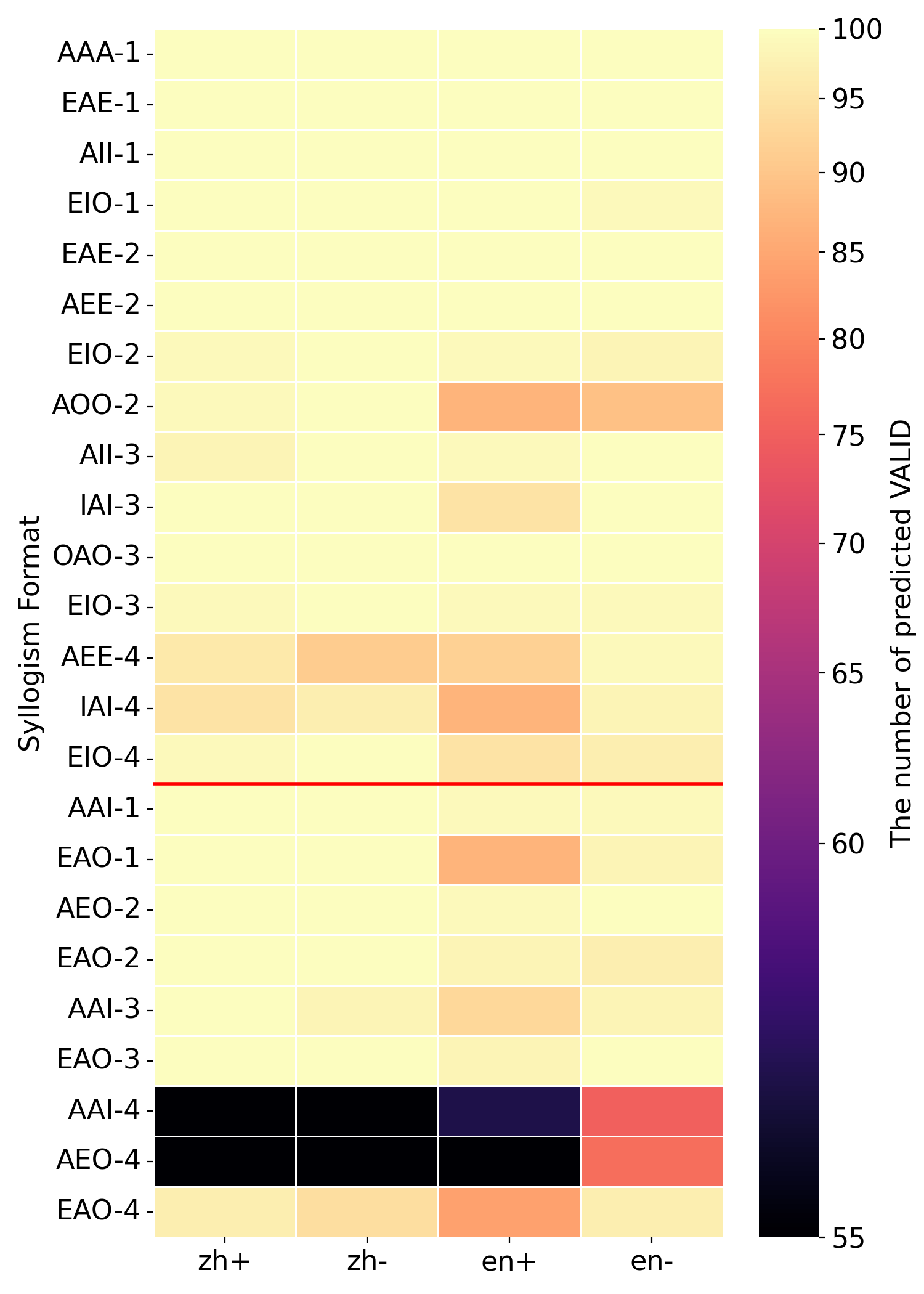
This image presents a heatmap visualizing the performance of a syllogism validation system across different syllogism formats and languages. The heatmap displays the number of predicted VALID syllogisms for each combination of format and language. The color intensity represents the count, with darker colors indicating lower counts and lighter colors indicating higher counts.
### Components/Axes
* **Y-axis:** "Syllogism Format" - Lists 24 different syllogism formats. These formats are labeled as AAA-1, EAE-1, AII-1, EIO-1, EAE-2, AEE-2, EIO-2, AOO-2, AII-3, IAI-3, OAO-3, EIO-3, AEE-4, IAI-4, EIO-4, AAI-1, EAO-1, AEO-2, EAO-2, AAI-3, EAO-3, AAI-4, AEO-4, EAO-4.
* **X-axis:** Language - Two language categories are present: "zh+" (Chinese positive), "zh-" (Chinese negative), "en+" (English positive), "en-" (English negative).
* **Color Scale (Right):** "The number of predicted VALID" - A gradient scale ranging from approximately 55 (dark purple) to 100 (light yellow).
* **Legend:** The color scale acts as the legend, mapping color intensity to the number of predicted valid syllogisms.
### Detailed Analysis
The heatmap shows the number of predicted valid syllogisms for each combination of syllogism format and language. The values are approximate, based on visual estimation from the color scale.
Here's a breakdown of the data, row by row (Syllogism Format x Language):
* **AAA-1:** zh+ ≈ 98, zh- ≈ 97, en+ ≈ 99, en- ≈ 96
* **EAE-1:** zh+ ≈ 96, zh- ≈ 94, en+ ≈ 97, en- ≈ 93
* **AII-1:** zh+ ≈ 95, zh- ≈ 93, en+ ≈ 96, en- ≈ 92
* **EIO-1:** zh+ ≈ 93, zh- ≈ 91, en+ ≈ 94, en- ≈ 90
* **EAE-2:** zh+ ≈ 92, zh- ≈ 90, en+ ≈ 93, en- ≈ 89
* **AEE-2:** zh+ ≈ 90, zh- ≈ 88, en+ ≈ 91, en- ≈ 87
* **EIO-2:** zh+ ≈ 88, zh- ≈ 86, en+ ≈ 89, en- ≈ 85
* **AOO-2:** zh+ ≈ 86, zh- ≈ 84, en+ ≈ 87, en- ≈ 83
* **AII-3:** zh+ ≈ 74, zh- ≈ 72, en+ ≈ 75, en- ≈ 71
* **IAI-3:** zh+ ≈ 72, zh- ≈ 70, en+ ≈ 73, en- ≈ 69
* **OAO-3:** zh+ ≈ 70, zh- ≈ 68, en+ ≈ 71, en- ≈ 67
* **EIO-3:** zh+ ≈ 68, zh- ≈ 66, en+ ≈ 69, en- ≈ 65
* **AEE-4:** zh+ ≈ 66, zh- ≈ 64, en+ ≈ 67, en- ≈ 63
* **IAI-4:** zh+ ≈ 64, zh- ≈ 62, en+ ≈ 65, en- ≈ 61
* **EIO-4:** zh+ ≈ 62, zh- ≈ 60, en+ ≈ 63, en- ≈ 59
* **AAI-1:** zh+ ≈ 60, zh- ≈ 58, en+ ≈ 61, en- ≈ 57
* **EAO-1:** zh+ ≈ 58, zh- ≈ 56, en+ ≈ 59, en- ≈ 55
* **AEO-2:** zh+ ≈ 57, zh- ≈ 55, en+ ≈ 58, en- ≈ 54
* **EAO-2:** zh+ ≈ 56, zh- ≈ 54, en+ ≈ 57, en- ≈ 53
* **AAI-3:** zh+ ≈ 55, zh- ≈ 53, en+ ≈ 56, en- ≈ 52
* **EAO-3:** zh+ ≈ 55, zh- ≈ 53, en+ ≈ 56, en- ≈ 52
* **AAI-4:** zh+ ≈ 55, zh- ≈ 53, en+ ≈ 56, en- ≈ 52
* **AEO-4:** zh+ ≈ 55, zh- ≈ 53, en+ ≈ 56, en- ≈ 52
* **EAO-4:** zh+ ≈ 55, zh- ≈ 53, en+ ≈ 56, en- ≈ 52
**Trends:**
* Generally, the "zh+" (Chinese positive) language category shows slightly higher counts than "zh-" (Chinese negative).
* Similarly, "en+" (English positive) generally shows higher counts than "en-" (English negative).
* The counts tend to decrease as the syllogism format number increases (e.g., from -1 to -4).
* The AAA-1 format consistently has the highest predicted valid counts across all languages.
* The EAO-4 format consistently has the lowest predicted valid counts across all languages.
### Key Observations
* The performance is consistently higher for positive examples (zh+ and en+) compared to negative examples (zh- and en-).
* The AAA-1 syllogism format is the most reliably validated, while the EAO-4 format is the least.
* There is a noticeable difference in performance between the different syllogism formats, suggesting that some formats are inherently easier to validate than others.
* The differences between the languages are relatively small, suggesting that the validation system is not strongly biased towards either Chinese or English.
### Interpretation
This heatmap demonstrates the performance of a syllogism validation system. The data suggests that the system is more accurate at identifying valid positive examples of syllogisms than negative examples. The varying performance across different syllogism formats indicates that the complexity of the logical structure influences the system's ability to correctly validate them. The relatively small differences between Chinese and English suggest that the system's performance is not significantly affected by the language of the syllogism.
The consistent high performance of AAA-1 and low performance of EAO-4 could be due to the inherent logical simplicity or complexity of these formats, respectively. The system may struggle with formats that require more complex reasoning or have more potential for ambiguity.
The heatmap provides valuable insights into the strengths and weaknesses of the syllogism validation system, which can be used to improve its accuracy and robustness. Further investigation could focus on understanding why certain formats are more challenging to validate and developing strategies to address these challenges.