TECHNICAL ASSET FINGERPRINT
51d6c63ddf640306fd588efd
Click to view fullscreen
Press ESC or click to close
FOUND IN PAPERS
EXPERT: gemini-2.0-flash VERSION 1
RUNTIME: nugit/gemini/gemini-2.0-flash
INTEL_VERIFIED
## Flow Diagram: Conversation Loop for Automotive Performance Table Description
### Overview
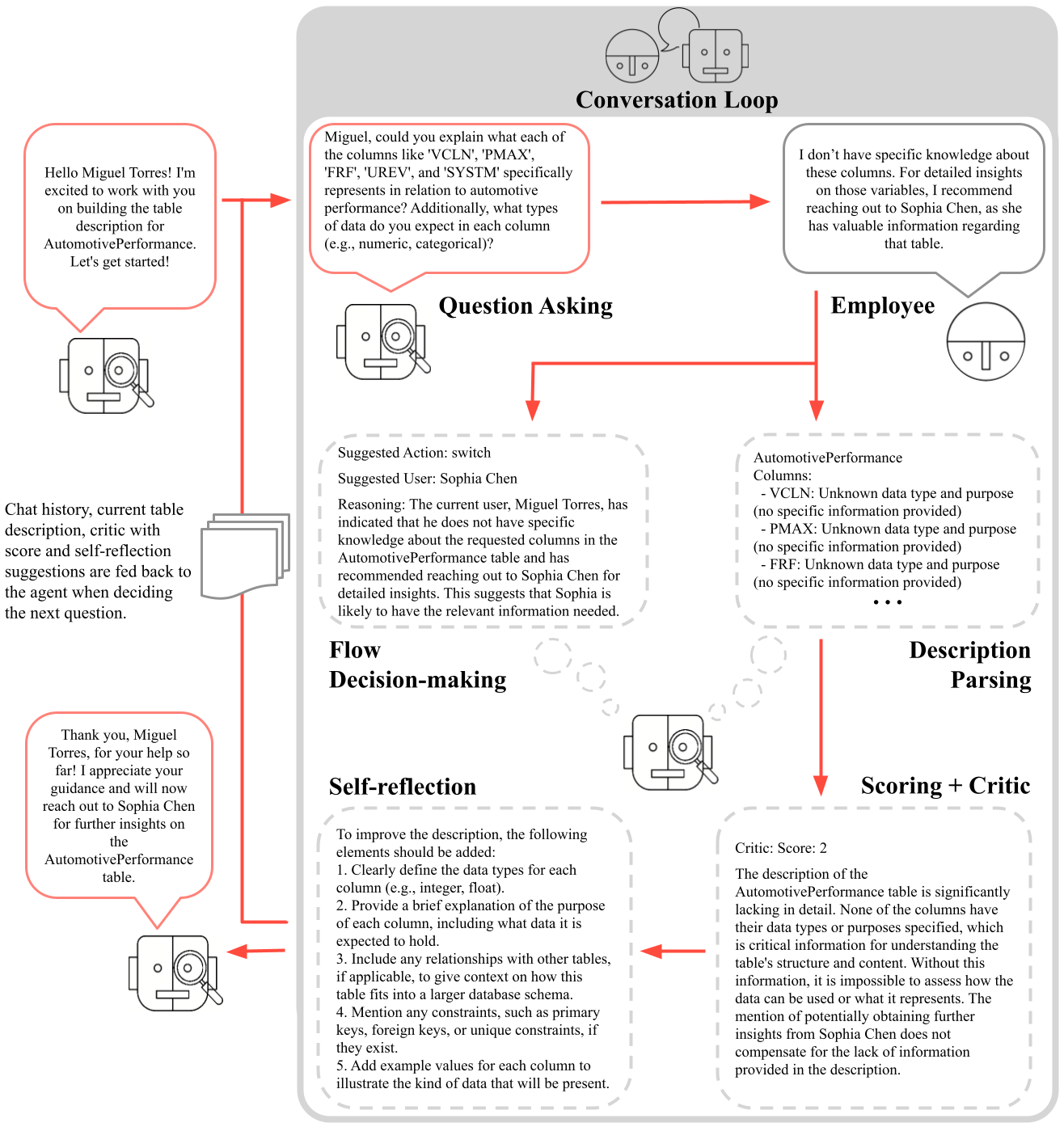
The image is a flow diagram illustrating a conversation loop between a user (Miguel Torres), an employee (Sophia Chen), and an AI agent to improve the description of an "AutomotivePerformance" table. The diagram outlines the steps of question asking, decision-making, description parsing, scoring, and self-reflection within the loop.
### Components/Axes
The diagram consists of the following components:
1. **Conversation Loop:** The central theme, represented by a loop connecting different stages.
2. **Question Asking:** The AI agent asks Miguel Torres about the columns 'VCLN', 'PMAX', 'FRF', 'UREV', and 'SYSTM' in relation to automotive performance, and the expected data types.
3. **Employee:** Miguel Torres states he lacks specific knowledge and recommends reaching out to Sophia Chen.
4. **Flow Decision-making:** The AI agent decides to switch to Sophia Chen based on Miguel's recommendation.
* Suggested Action: switch
* Suggested User: Sophia Chen
* Reasoning: The current user, Miguel Torres, has indicated that he does not have specific knowledge about the requested columns in the AutomotivePerformance table and has recommended reaching out to Sophia Chen for detailed insights. This suggests that Sophia is likely to have the relevant information needed.
5. **Description Parsing:** The AI agent parses the current description of the "AutomotivePerformance" table.
* AutomotivePerformance Columns:
* VCLN: Unknown data type and purpose (no specific information provided)
* PMAX: Unknown data type and purpose (no specific information provided)
* FRF: Unknown data type and purpose (no specific information provided)
6. **Scoring + Critic:** The AI agent scores the description and provides a critique.
* Critic: Score: 2
* The description of the AutomotivePerformance table is significantly lacking in detail. None of the columns have their data types or purposes specified, which is critical information for understanding the table's structure and content. Without this information, it is impossible to assess how the data can be used or what it represents. The mention of potentially obtaining further insights from Sophia Chen does not compensate for the lack of information provided in the description.
7. **Self-reflection:** The AI agent suggests improvements to the description.
* To improve the description, the following elements should be added:
1. Clearly define the data types for each column (e.g., integer, float).
2. Provide a brief explanation of the purpose of each column, including what data it is expected to hold.
3. Include any relationships with other tables, if applicable, to give context on how this table fits into a larger database schema.
4. Mention any constraints, such as primary keys, foreign keys, or unique constraints, if they exist.
5. Add example values for each column to illustrate the kind of data that will be present.
8. **Chat history, current table description, critic with score and self-reflection suggestions are fed back to the agent when deciding the next question.**
9. **Initial Message:** "Hello Miguel Torres! I'm excited to work with you on building the table description for AutomotivePerformance. Let's get started!"
10. **Final Message:** "Thank you, Miguel Torres, for your help so far! I appreciate your guidance and will now reach out to Sophia Chen for further insights on the AutomotivePerformance table."
### Detailed Analysis or ### Content Details
The flow starts with the AI agent initiating a conversation with Miguel Torres to gather information about the "AutomotivePerformance" table. When Miguel indicates a lack of specific knowledge, the agent decides to switch to Sophia Chen. The agent then parses the existing table description, scores it (Critic: Score: 2), and provides suggestions for improvement. The suggestions emphasize the need for clear data type definitions, purpose explanations, relationship context, constraint mentions, and example values for each column. The chat history, table description, critic score, and self-reflection suggestions are fed back to the agent to inform the next question.
### Key Observations
* The AI agent relies on human input to gather information about the table.
* The agent can identify gaps in the existing table description.
* The agent provides specific and actionable suggestions for improving the description.
* The agent uses a scoring system to evaluate the quality of the description.
### Interpretation
The diagram illustrates an iterative process of refining a table description using a combination of human expertise and AI capabilities. The AI agent acts as a facilitator, guiding the conversation, identifying gaps in knowledge, and providing suggestions for improvement. The process highlights the importance of clear and comprehensive table descriptions for effective data understanding and utilization. The loop emphasizes the continuous nature of improvement, where feedback and self-reflection are used to refine the description iteratively. The reliance on human expertise (Sophia Chen) suggests that AI is not a replacement for human knowledge but rather a tool to augment and enhance it.
DECODING INTELLIGENCE...
EXPERT: gemini-3.1-flash-lite-preview-free VERSION 1
RUNTIME: google-free/gemini-3.1-flash-lite-preview
INTEL_VERIFIED
## Diagram: AI Agent Conversation Loop for Table Documentation
### Overview
This diagram illustrates an iterative workflow for an AI agent tasked with documenting a database table named "AutomotivePerformance." The process depicts a "Conversation Loop" where the agent interacts with a user, parses information, evaluates the quality of the documentation via a "Critic" module, and performs "Self-reflection" to improve future outputs. The diagram highlights the transition from initial data gathering to critical evaluation and actionable improvement steps.
### Components/Axes
The diagram is organized into a large central container labeled "Conversation Loop," with an external agent interaction flow on the left.
* **External Agent Interaction (Left):** Features an AI agent icon (Miguel Torres) interacting with a user.
* **Conversation Loop (Center/Right):**
* **Top Section:** "Question Asking" (Left) and "Employee" (Right) dialogue blocks.
* **Middle Section:** "Flow Decision-making" (Left) and "Description Parsing" (Right) blocks.
* **Bottom Section:** "Self-reflection" (Left) and "Scoring + Critic" (Right) blocks.
* **Flow Indicators:** Red arrows indicate the direction of information flow, decision-making, and feedback loops.
### Detailed Analysis
#### 1. External Agent Interaction (Left)
* **Top Bubble:** "Hello Miguel Torres! I'm excited to work with you on building the table description for AutomotivePerformance. Let's get started!"
* **Central Text:** "Chat history, current table description, critic with score and self-reflection suggestions are fed back to the agent when deciding the next question."
* **Bottom Bubble:** "Thank you, Miguel Torres, for your help so far! I appreciate your guidance and will now reach out to Sophia Chen for further insights on the AutomotivePerformance table."
#### 2. Conversation Loop - Top (Question/Answer)
* **Question Asking (Left):** "Miguel, could you explain what each of the columns like 'VCLN', 'PMAX', 'FRF', 'UREV', and 'SYSTM' specifically represents in relation to automotive performance? Additionally, what types of data do you expect in each column (e.g., numeric, categorical)?"
* **Employee (Right):** "I don't have specific knowledge about these columns. For detailed insights on those variables, I recommend reaching out to Sophia Chen, as she has valuable information regarding that table."
#### 3. Conversation Loop - Middle (Processing)
* **Flow Decision-making (Left):**
* **Suggested Action:** switch
* **Suggested User:** Sophia Chen
* **Reasoning:** The current user, Miguel Torres, has indicated that he does not have specific knowledge about the requested columns in the AutomotivePerformance table and has recommended reaching out to Sophia Chen for detailed insights. This suggests that Sophia is likely to have the relevant information needed.
* **Description Parsing (Right):**
* **AutomotivePerformance Columns:**
* VCLN: Unknown data type and purpose (no specific information provided)
* PMAX: Unknown data type and purpose (no specific information provided)
* FRF: Unknown data type and purpose (no specific information provided)
* ...
#### 4. Conversation Loop - Bottom (Evaluation/Improvement)
* **Scoring + Critic (Right):**
* **Critic: Score: 2**
* **Analysis:** The description of the AutomotivePerformance table is significantly lacking in detail. None of the columns have their data types or purposes specified, which is critical information for understanding the table's structure and content. Without this information, it is impossible to assess how the data can be used or what it represents. The mention of potentially obtaining further insights from Sophia Chen does not compensate for the lack of information provided in the description.
* **Self-reflection (Left):**
* To improve the description, the following elements should be added:
1. Clearly define the data types for each column (e.g., integer, float).
2. Provide a brief explanation of the purpose of each column, including what data it is expected to hold.
3. Include any relationships with other tables, if applicable, to give context on how this table fits into a larger database schema.
4. Mention any constraints, such as primary keys, foreign keys, or unique constraints, if they exist.
5. Add example values for each column to illustrate the kind of data that will be present.
### Key Observations
* **Iterative Feedback:** The diagram explicitly shows that the "Critic" and "Self-reflection" outputs are fed back into the agent's decision-making process (indicated by the arrow returning to the agent icon).
* **Low Quality Threshold:** The "Critic" assigns a low score (2) because the input data is incomplete, demonstrating that the system is designed to reject "I don't know" answers as insufficient documentation.
* **Actionable Guidance:** The "Self-reflection" block provides a structured checklist for what constitutes a "good" table description, acting as a prompt-engineering guide for the agent.
### Interpretation
This diagram represents a **Data Documentation Agent** workflow. It demonstrates a sophisticated approach to AI-assisted database management where the agent is not merely a passive recorder of information but an active auditor.
The "Critic" and "Self-reflection" modules are the most critical components here. They function as a quality-control layer, ensuring that the documentation meets specific standards (data types, constraints, relationships). The workflow acknowledges that the AI agent may encounter "knowledge gaps" (e.g., the user not knowing the column definitions) and handles this by pivoting to a subject matter expert (Sophia Chen) rather than hallucinating or accepting incomplete data. This is a robust design for ensuring data governance and high-quality metadata generation.
DECODING INTELLIGENCE...
EXPERT: nemotron-free VERSION 1
RUNTIME: free/nvidia/nemotron-nano-12b-v2-vl:free
INTEL_VERIFIED
## Flowchart: Conversation Loop for AutomotivePerformance Table Description
### Overview
The diagram illustrates a multi-step process for refining a table description through iterative questioning, employee consultation, self-reflection, and scoring. It begins with a user (Miguel Torres) requesting clarification about columns in an "AutomotivePerformance" table, followed by an AI agent's inability to answer, a suggestion to consult an employee (Sophia Chen), and subsequent refinement of the description based on feedback.
### Components/Axes
1. **Conversation Loop** (Top Section)
- Contains two speech bubbles:
- **User Query**: "Hello Miguel Torres! I'm excited to work with you on building the table description for AutomotivePerformance. Let's get started!"
- **Agent Response**: "Miguel, could you explain what each of the columns like 'VCLN', 'PMAX', 'FRF', 'UREV', and 'SYSTEM' specifically represents in relation to automotive performance? Additionally, what types of data do you expect in each column (e.g., numeric, categorical)?"
2. **Question Asking** (Left Section)
- Arrows point to **Employee** (right section) with:
- **Suggested Action**: "switch"
- **Suggested User**: "Sophia Chen"
- **Reasoning**: The agent lacks knowledge about the columns and recommends consulting Sophia Chen for detailed insights.
3. **Flow Decision-making** (Central Section)
- Arrows connect **Employee** to **Description Parsing** and **Scoring + Critic**.
4. **Self-reflection** (Bottom Left)
- Lists five improvement elements for the description:
1. Define data types (e.g., integer, float)
2. Explain column purposes
3. Include relationships with other tables
4. Mention constraints (e.g., primary keys)
5. Add example values
5. **Description Parsing** (Bottom Right)
- Contains a critic's feedback:
- **Critic Score**: 2/5
- **Criticism**: The description lacks data types, purposes, and relationships for columns like VCLN, PMAX, FRF, and UREV. The suggestion to consult Sophia Chen does not compensate for the missing information.
### Detailed Analysis
- **Initial Interaction**: Miguel Torres initiates the conversation, requesting clarification about specific columns in the AutomotivePerformance table.
- **Agent Limitation**: The agent acknowledges its inability to answer due to insufficient knowledge about the columns' data types and purposes.
- **Employee Consultation**: The agent suggests switching to Sophia Chen, implying she has expertise in the table's structure.
- **Self-Reflection**: The agent identifies five critical gaps in the description, emphasizing the need for technical details (data types, constraints, examples).
- **Scoring**: The critic assigns a low score (2/5) due to the absence of essential metadata, highlighting the description's inadequacy for practical use.
### Key Observations
1. **Knowledge Gaps**: The agent's inability to answer basic questions about column definitions suggests either incomplete training data or a lack of access to domain-specific documentation.
2. **Human-AI Collaboration**: The process relies on human experts (Sophia Chen) to fill knowledge gaps, indicating a hybrid workflow where AI handles routine tasks while deferring complex queries to specialists.
3. **Iterative Improvement**: The self-reflection phase demonstrates a feedback loop where the agent actively works to enhance its outputs based on structured criteria.
### Interpretation
This flowchart represents a **knowledge refinement system** where an AI agent collaborates with human experts to document technical data structures. The low critic score underscores the importance of **explicit metadata** (data types, purposes, relationships) for usability. The process highlights two critical insights:
1. **AI Limitations**: Without access to domain-specific knowledge, AI systems cannot reliably interpret or describe complex datasets.
2. **Human-in-the-Loop Necessity**: Technical documentation requires human expertise to validate and contextualize information, especially for specialized tables like AutomotivePerformance.
The diagram also reveals a **workflow dependency** between AI agents and human experts, where the agent acts as a triage system—identifying when human intervention is necessary and facilitating knowledge transfer. The self-reflection phase suggests an attempt to automate quality assurance, though its effectiveness depends on the agent's ability to implement the suggested improvements.
DECODING INTELLIGENCE...