\n
## Diagram: Dynamic Programming State Transition
### Overview
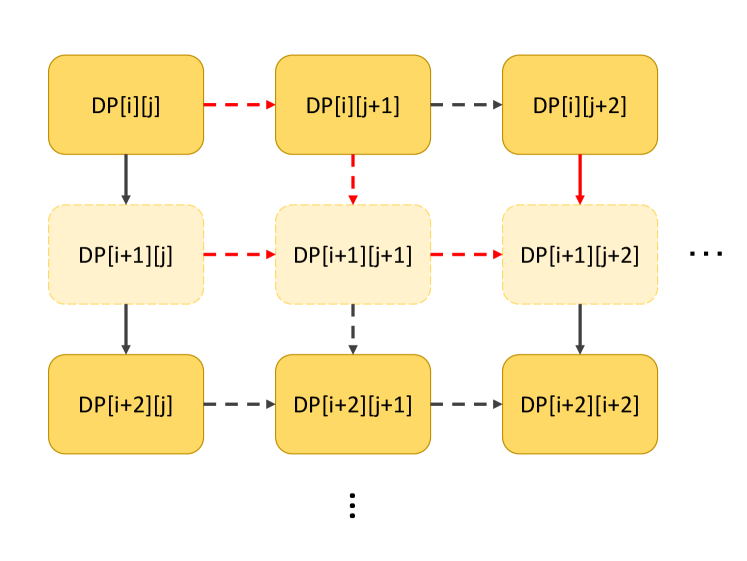
The image depicts a diagram illustrating a state transition process, likely related to dynamic programming. It shows a grid-like structure of interconnected nodes labeled with `DP[i][j]` and its variations, connected by arrows indicating dependencies. The diagram suggests a recursive or iterative calculation where the value of a state depends on the values of previous states.
### Components/Axes
The diagram consists of rectangular nodes, each labeled with `DP[i][j]` where `i` and `j` are indices. The arrows represent transitions between states. There are no explicit axes or scales. The diagram extends downwards and to the right, indicated by the ellipsis (`...`).
### Detailed Analysis or Content Details
The diagram shows a 3x3 grid of `DP` states, with an indication that this pattern continues. The nodes are arranged as follows:
* **Top Row:** `DP[i][j]`, `DP[i][j+1]`, `DP[i][j+2]`
* **Middle Row:** `DP[i+1][j]`, `DP[i+1][j+1]`, `DP[i+1][j+2]`
* **Bottom Row:** `DP[i+2][j]`, `DP[i+2][j+1]`, `DP[i+2][j+2]`
The arrows indicate the following dependencies:
* `DP[i][j]` -> `DP[i][j+1]` (solid red arrow)
* `DP[i][j+1]` -> `DP[i][j+2]` (dashed red arrow)
* `DP[i][j]` -> `DP[i+1][j]` (solid yellow arrow)
* `DP[i+1][j]` -> `DP[i+2][j]` (solid yellow arrow)
* `DP[i][j+1]` -> `DP[i+1][j+1]` (dashed yellow arrow)
* `DP[i+1][j+1]` -> `DP[i+2][j+1]` (dashed yellow arrow)
* `DP[i][j+2]` -> `DP[i+1][j+2]` (solid red arrow)
* `DP[i+1][j+2]` -> `DP[i+2][j+2]` (solid red arrow)
The diagram shows a pattern of dependencies where each state `DP[i][j]` depends on states in the same row and the row above. The solid arrows represent a stronger dependency, while the dashed arrows represent a weaker or different type of dependency.
### Key Observations
The diagram illustrates a dynamic programming approach where the solution to a problem is built up from solutions to subproblems. The indices `i` and `j` likely represent dimensions or stages in the problem. The use of both solid and dashed arrows suggests different types of transitions or dependencies between states. The ellipsis indicates that the grid extends indefinitely, implying a potentially large state space.
### Interpretation
This diagram likely represents a state transition diagram for a dynamic programming algorithm. The `DP[i][j]` notation suggests that the algorithm is storing intermediate results in a table or matrix. The arrows indicate how the value of a state `DP[i][j]` is calculated based on the values of other states. The solid and dashed arrows could represent different costs or weights associated with the transitions.
The diagram suggests that the problem being solved can be broken down into smaller, overlapping subproblems. The dynamic programming approach allows the algorithm to avoid redundant calculations by storing the solutions to subproblems and reusing them when needed. The pattern of dependencies indicates that the algorithm is likely solving a problem with a grid-like structure, such as a pathfinding problem or a matrix optimization problem. The diagram does not provide specific data or numerical values, but it illustrates the general structure of a dynamic programming solution.