## Diagram: 3D Isometric Block with 2D Top-View Options
### Overview
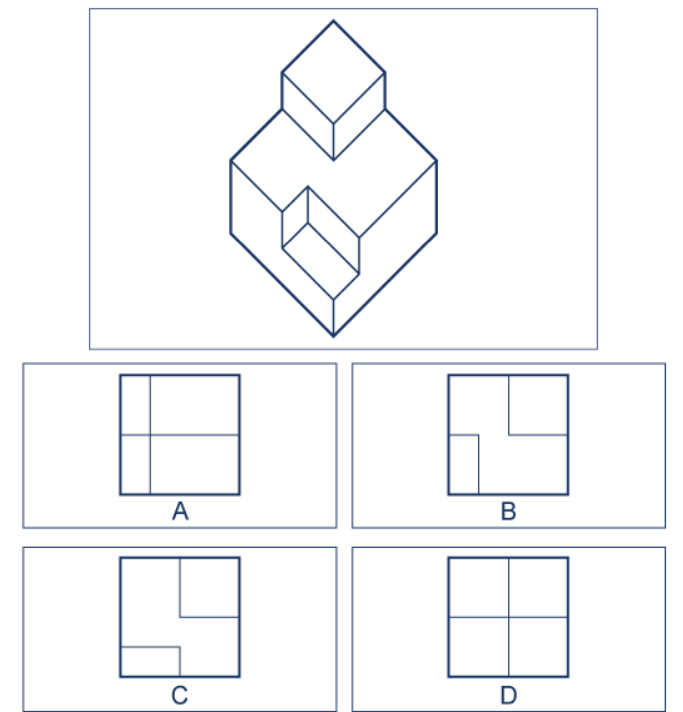
The image presents a spatial reasoning puzzle. It consists of two main sections: a large, centrally positioned isometric line drawing of a 3D block structure at the top, and a set of four smaller, labeled 2D diagrams (A, B, C, D) arranged in a 2x2 grid below it. The task implied is to identify which of the four 2D diagrams correctly represents the top-down view of the 3D structure.
### Components/Axes
* **Primary Element (Top):** A single isometric projection of a composite 3D block. The drawing uses blue lines on a white background.
* **Secondary Elements (Bottom):** Four rectangular frames, each containing a 2D square diagram composed of internal lines. Each frame has a centered label below it:
* **A** (Bottom-left of the grid)
* **B** (Bottom-right of the grid)
* **C** (Top-left of the grid)
* **D** (Top-right of the grid)
* **Text:** The only textual elements are the single capital letters "A", "B", "C", and "D" serving as labels for the 2D options.
### Detailed Analysis
**1. 3D Structure Analysis (Top Image):**
* The object is a large cube or rectangular prism.
* A smaller cube is stacked on top of the main block, aligned with its top-rear corner (from the viewer's isometric perspective).
* A rectangular notch or cutout is present on the front-left vertical face of the main block. This notch extends inward, creating an L-shaped profile when viewed from the front.
**2. 2D Diagram Analysis (Options A-D):**
Each diagram is a square divided by internal lines, representing a potential top-down view.
* **Diagram A:** The square is divided by one vertical line (left of center) and one horizontal line (below center), creating four unequal rectangular sections.
* **Diagram B:** The square contains an L-shaped region formed by a vertical line on the left and a horizontal line near the top. This leaves a smaller square in the top-right corner and a larger L-shaped area occupying the bottom and left.
* **Diagram C:** Similar to B but mirrored. It contains an L-shaped region formed by a vertical line on the right and a horizontal line near the top. This leaves a smaller square in the top-left corner and a larger L-shaped area occupying the bottom and right.
* **Diagram D:** The square is divided by one vertical and one horizontal line, both centered, creating four equal smaller squares (a 2x2 grid).
### Key Observations
* The 3D structure has two key features visible from a top-down perspective: the smaller cube on top and the notch cut into the side.
* The smaller top cube would appear as a smaller square within the larger square outline in a top view.
* The side notch would manifest as a missing or indented section in the perimeter of the larger square's top view, creating an L-shaped or irregular outer boundary for the main block's footprint.
* **Diagram D** is the only option with perfect symmetry and no indication of a notch or a smaller top cube, making it an unlikely match.
* **Diagram A** shows asymmetry but lacks a clear, isolated square representing the top cube.
* **Diagrams B and C** both show a smaller square in a corner (top-right for B, top-left for C) and an L-shaped region, which are the most plausible representations of the 3D structure's top view. The correct choice between them depends on the rotational orientation of the top view relative to the isometric projection.
### Interpretation
This image is a classic spatial visualization test, likely from an engineering, architecture, or aptitude assessment. It evaluates the ability to mentally rotate a 3D object and derive its correct 2D orthographic projection.
* **What the data suggests:** The puzzle implies there is one correct 2D top view among the four options that accurately corresponds to the given 3D isometric drawing.
* **Relationship between elements:** The 3D drawing is the problem statement. The 2D diagrams are the multiple-choice answers. The solver must perform a mental transformation from 3D to 2D.
* **Notable pattern/anomaly:** The critical reasoning step is correlating the position of the smaller top cube and the side notch with the internal lines in the 2D options. The notch on the front-left face of the 3D block (from the viewer's perspective) would, when viewed from directly above, create an indentation on the corresponding side of the square outline. Assuming a standard top-view orientation where the "front" of the isometric view maps to the "bottom" of the top view, the notch would appear on the bottom or left side of the 2D square. This logic would favor **Diagram B** (notch implied on the left/bottom, small square top-right) over **Diagram C** (notch implied on the right/bottom, small square top-left). However, without an explicit arrow indicating the "front" direction for the top view, a degree of ambiguity remains, which is common in such puzzles to test careful assumption-checking.