## Simulation Interface: LLM-Enhanced Flocking Behavior
### Overview
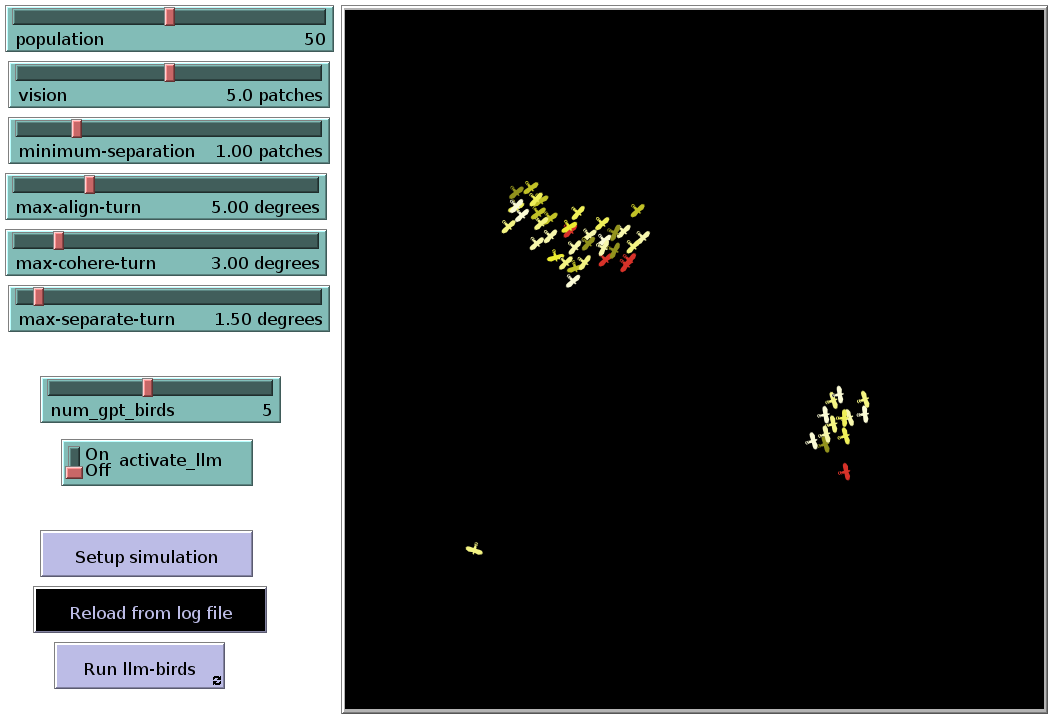
The image is a screenshot of a graphical user interface (GUI) for a computer simulation, likely modeling collective animal behavior such as bird flocking. The interface is divided into two primary sections: a **control panel** on the left with adjustable parameters and action buttons, and a **visualization canvas** on the right displaying the simulated entities (birds) in a black void. The simulation appears to incorporate a Large Language Model (LLM) component, as indicated by specific controls.
### Components/Axes
#### Left Control Panel
The panel contains a series of sliders, a toggle switch, and buttons, all labeled with their current values.
**Sliders (from top to bottom):**
1. **Label:** `population`
* **Value:** `50`
* **Description:** Sets the total number of bird agents in the simulation.
2. **Label:** `vision`
* **Value:** `5.0 patches`
* **Description:** Defines the perceptual range (in simulation units called "patches") for each bird.
3. **Label:** `minimum-separation`
* **Value:** `1.00 patches`
* **Description:** The minimum distance birds attempt to maintain from each other to avoid collision.
4. **Label:** `max-align-turn`
* **Value:** `5.00 degrees`
* **Description:** The maximum angle (in degrees) a bird can turn to align its heading with nearby flockmates.
5. **Label:** `max-cohere-turn`
* **Value:** `3.00 degrees`
* **Description:** The maximum angle a bird can turn to move toward the average position of nearby flockmates (cohesion).
6. **Label:** `max-separate-turn`
* **Value:** `1.50 degrees`
* **Description:** The maximum angle a bird can turn to move away from a nearby bird that is too close (separation).
7. **Label:** `num_gpt_birds`
* **Value:** `5`
* **Description:** Specifies the number of birds whose behavior is governed by a GPT-based model (likely the LLM component).
**Toggle Switch:**
* **Label:** `activate_llm`
* **State:** `Off` (The red indicator is on the "Off" side).
* **Description:** A master switch to enable or disable the LLM-driven behavior for the designated birds.
**Buttons (from top to bottom):**
1. **Label:** `Setup simulation`
* **Color:** Light purple.
* **Function:** Likely initializes or resets the simulation with the current parameter settings.
2. **Label:** `Reload from log file`
* **Color:** Black with white text.
* **Function:** Suggests the ability to load a previous simulation state or data from a saved log.
3. **Label:** `Run llm-birds`
* **Color:** Light purple.
* **Function:** Presumably starts or executes the simulation run with the LLM-enabled birds.
#### Right Visualization Canvas
* **Background:** Solid black.
* **Entities:** Numerous small, stylized bird icons. The majority are **yellow**, with a few **red** ones interspersed.
* **Spatial Distribution:** The birds are not uniformly distributed. They form distinct clusters:
* A **large, dense cluster** is located in the **upper-left quadrant** of the canvas. This group contains both yellow and red birds.
* A **smaller, looser cluster** is positioned in the **lower-right quadrant**. This group also contains both colors.
* A **single, isolated yellow bird** is visible near the **bottom-left edge** of the canvas.
### Detailed Analysis
The simulation parameters are configured to model a flock of 50 birds. The core behavioral rules are defined by the `vision` (5.0 patches) and three turning constraints: `max-align-turn` (5.00°), `max-cohere-turn` (3.00°), and `max-separate-turn` (1.50°). These values suggest that alignment (matching direction) is given the strongest influence, followed by cohesion (moving toward the group center), with separation (avoiding crowding) having the weakest influence per time step.
A key feature is the integration of an LLM. Five birds (`num_gpt_birds: 5`) are designated to have their behavior potentially influenced by a GPT model, but the `activate_llm` switch is currently **Off**. This means the simulation is likely running on standard algorithmic rules (like the classic Boids model) at this moment, and the LLM component is inactive.
The visual output shows emergent flocking behavior, with birds forming cohesive groups. The presence of red birds within the yellow flocks could indicate the designated "GPT birds" or another sub-category, though the interface does not explicitly label the color coding. The single isolated bird may represent an individual that has become separated from the main groups.
### Key Observations
1. **Parameter Hierarchy:** The turning constraints are set in descending order of magnitude: Alignment (5.00°) > Cohesion (3.00°) > Separation (1.50°). This prioritizes group direction matching over group centering and collision avoidance.
2. **LLM Integration Point:** The simulation is designed to test or demonstrate the effect of an LLM on collective behavior, but it is not active in this snapshot.
3. **Emergent Clustering:** Despite simple local rules, the birds have self-organized into at least two distinct clusters, demonstrating a classic emergent property of such systems.
4. **Color-Coded Subgroups:** The use of two colors (yellow and red) for the birds implies a categorical distinction, most plausibly between standard algorithmic birds and the LLM-influenced birds.
### Interpretation
This interface represents a research or educational tool for exploring **collective behavior and swarm intelligence**, with a novel twist: the potential integration of a Large Language Model to influence agent decision-making.
The data suggests an experiment in progress. The current state shows the baseline flocking behavior generated by tuned parameters (`population=50`, specific vision and turn limits). The clusters indicate the rules are effective in producing cohesion. The critical variable is the inactive LLM component (`activate_llm: Off`, `num_gpt_birds: 5`). The setup implies a comparative study: one could run the simulation with the LLM off to establish a control behavior, then activate it to observe how the GPT-influenced birds (likely the red ones) affect the flock's dynamics—potentially altering migration patterns, group decision-making, or response to stimuli.
The "Reload from log file" button is particularly telling, indicating that simulation runs are logged and can be re-analyzed, which is essential for scientific reproducibility. The overall purpose is likely to investigate whether an LLM can introduce more complex, context-aware, or goal-directed behaviors into a traditionally rule-based multi-agent system, bridging the gap between simple algorithmic flocking and more "intelligent" collective motion.