TECHNICAL ASSET FINGERPRINT
54ad6bb5ed3c6952de2c2498
Click to view fullscreen
Press ESC or click to close
FOUND IN PAPERS
EXPERT: healer-alpha-free VERSION 1
RUNTIME: free/openrouter/healer-alpha
INTEL_VERIFIED
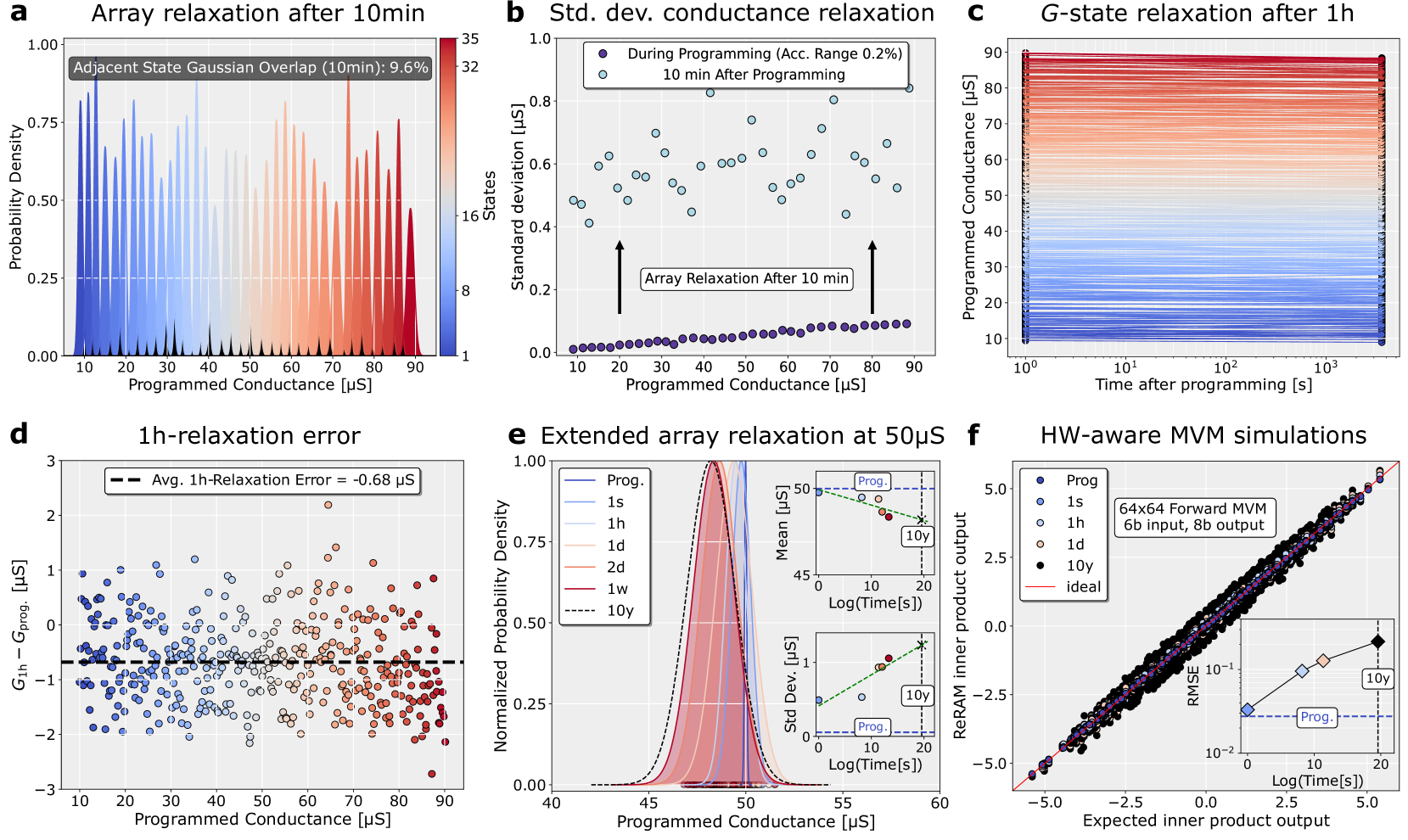
## Multi-Panel Scientific Figure: Conductance Relaxation in Memory Arrays
### Overview
This image is a composite scientific figure containing six panels (a-f) that collectively analyze the relaxation (drift or decay) of conductance states in an analog memory array (likely ReRAM or a similar technology) over time. The data explores how programmed conductance values change after programming, the resulting errors, and the impact on hardware-aware matrix-vector multiplication (MVM) simulations.
### Components/Axes
The figure is divided into six distinct panels, labeled **a** through **f** in the top-left corner of each subplot.
* **Panel a:** Histogram titled "Array relaxation after 10min".
* **X-axis:** "Programmed Conductance [µS]" (range: ~10 to 90 µS).
* **Y-axis:** "Probability Density" (range: 0.00 to 1.00).
* **Color Bar (Right):** Labeled "States", scale from 1 (blue) to 35 (red).
* **Annotation:** A text box in the upper left states "Adjacent State Gaussian Overlap (10min): 9.6%".
* **Panel b:** Scatter plot titled "Std. dev. conductance relaxation".
* **X-axis:** "Programmed Conductance [µS]" (range: 10 to 90 µS).
* **Y-axis:** "Standard deviation [µS]" (range: 0.0 to 1.0 µS).
* **Legend (Top-Left):** Two entries: "During Programming (Acc. Range 0.2%)" (filled purple circles) and "10 min After Programming" (open light-blue circles).
* **Annotation:** Two black arrows point from the "During Programming" data series upward to the "10 min After" series, with a label "Array Relaxation After 10 min".
* **Panel c:** Line plot titled "G-state relaxation after 1h".
* **X-axis:** "Time after programming [s]" (logarithmic scale, range: 10⁰ to ~10³ seconds).
* **Y-axis:** "Programmed Conductance [µS]" (range: 10 to 90 µS).
* **Data:** Multiple lines, each representing a single memory cell's conductance over time. Lines are colored on a gradient from blue (low initial conductance) to red (high initial conductance).
* **Panel d:** Scatter plot titled "1h-relaxation error".
* **X-axis:** "Programmed Conductance [µS]" (range: 10 to 90 µS).
* **Y-axis:** "G₁ₕ - G_prog [µS]" (range: -3 to 3 µS). This represents the error after 1 hour.
* **Annotation:** A horizontal dashed black line is drawn at y = -0.68 µS. A text box states "Avg. 1h-Relaxation Error = -0.68 µS".
* **Data Points:** Colored circles, with color corresponding to the "States" color bar from panel **a** (blue for low states, red for high states).
* **Panel e:** Composite plot titled "Extended array relaxation at 50µS".
* **Main Plot (Left):**
* **X-axis:** "Programmed Conductance [µS]" (range: 40 to 60 µS).
* **Y-axis:** "Normalized Probability Density" (range: 0.00 to 1.00).
* **Legend:** Seven entries: "Prog.", "1s", "1h", "1d", "2d", "1w", "10y". Each corresponds to a distribution curve at a different time after programming.
* **Top Inset (Right):**
* **X-axis:** "Log(Time[s])" (range: 0 to 20).
* **Y-axis:** "Mean [µS]" (range: 45 to 50 µS).
* **Data:** Points showing the mean conductance decaying over log time. A dashed green line connects the "Prog." point to the "10y" point.
* **Bottom Inset (Right):**
* **X-axis:** "Log(Time[s])" (range: 0 to 20).
* **Y-axis:** "Std Dev. [µS]" (range: 0 to 1 µS).
* **Data:** Points showing the standard deviation increasing over log time. A dashed green line connects the "Prog." point to the "10y" point.
* **Panel f:** Scatter plot titled "HW-aware MVM simulations".
* **X-axis:** "Expected inner product output" (range: -5.0 to 5.0).
* **Y-axis:** "ReRAM inner product output" (range: -5.0 to 5.0).
* **Legend (Top-Left):** Six entries: "Prog", "1s", "1h", "1d", "10y" (different colored circles), and "ideal" (solid red line).
* **Annotation:** A text box states "64x64 Forward MVM 6b input, 8b output".
* **Inset (Bottom-Right):**
* **X-axis:** "Log(Time[s])" (range: 0 to 20).
* **Y-axis:** "RMSE" (logarithmic scale, range: 10⁻² to 10⁻¹).
* **Data:** Points showing the Root Mean Square Error of the MVM output increasing over log time. A dashed blue line connects the "Prog." point to the "10y" point.
### Detailed Analysis
* **Panel a:** The histogram shows the distribution of conductance states across the array 10 minutes after programming. The distribution is multi-modal, with distinct peaks corresponding to the 35 programmed states. The color gradient visually maps the state number (1-35) to the conductance value. The 9.6% Gaussian overlap quantifies the probability of misidentifying adjacent states due to relaxation-induced broadening.
* **Panel b:** This plot directly compares the precision of programming. The "During Programming" data (purple) shows very low standard deviation (< ~0.1 µS), indicating tight control. After 10 minutes of relaxation (light blue), the standard deviation increases significantly (to ~0.4-0.8 µS), and this increase is more pronounced for higher programmed conductance values (positive slope in the light blue data).
* **Panel c:** This plot visualizes the temporal drift of individual cells. All conductance lines show a downward trend (decay) over the 1-hour period (~3600 seconds). The decay appears more severe (steeper initial slope) for cells programmed to higher conductance values (red lines) compared to lower ones (blue lines).
* **Panel d:** The scatter plot shows the error (final - initial conductance) for each cell after 1 hour. The data is scattered around a negative mean (-0.68 µS), indicating a systematic downward drift. The spread (variance) of the error appears relatively consistent across the programmed conductance range, though there may be a slight increase in spread for mid-range conductances.
* **Panel e:** This panel focuses on the long-term statistical evolution of a single conductance state (centered at 50 µS). The main plot shows the probability distribution broadening and shifting left (to lower conductance) over time, from "Prog." to "10y". The insets quantify this: the mean conductance decays linearly with log(time), while the standard deviation increases linearly with log(time). This is characteristic of a logarithmic relaxation process.
* **Panel f:** This panel assesses the functional impact of relaxation on a computational task (64x64 matrix-vector multiplication). The main plot shows that the actual ReRAM output correlates very strongly with the expected output (data points cluster tightly around the red "ideal" line) for all time points. The inset quantifies the degradation: the RMSE of the computation increases with log(time), but remains below 0.1 even after a simulated 10 years.
### Key Observations
1. **Systematic Negative Drift:** Conductance states consistently decay over time, with an average 1-hour error of -0.68 µS (Panel d).
2. **Increased Variability:** Relaxation not only shifts the mean but also increases the standard deviation (spread) of conductance values (Panels b, e).
3. **Logarithmic Time Dependence:** Both the mean decay and the increase in standard deviation follow a linear relationship with the logarithm of time (Panel e insets).
4. **State-Dependent Effects:** Higher conductance states exhibit greater absolute standard deviation after relaxation (Panel b) and potentially faster initial decay (Panel c).
5. **Robustness in Computation:** Despite significant analog drift at the device level, the system-level performance (MVM accuracy) degrades gracefully, with RMSE increasing only moderately over a simulated decade (Panel f).
### Interpretation
This figure presents a comprehensive characterization of conductance drift in an analog memory array, a critical challenge for neuromorphic computing and analog AI hardware. The data demonstrates that while individual devices undergo significant and predictable relaxation following a logarithmic law (Panels c, e), the collective behavior of a large array can be statistically modeled (Panels a, b, d). The key insight is the translation from device-level physics to system-level functionality. The "Adjacent State Gaussian Overlap" (9.6%) is a crucial metric for determining the feasibility of multi-level cell storage. Most importantly, Panel f provides a hardware-aware simulation that bridges this gap, showing that the inherent redundancy and error tolerance in neural network computations (like MVM) can mitigate the effects of analog drift. The system maintains functional accuracy even as individual components degrade, which is a promising result for the long-term reliability of analog AI accelerators. The outlier in Panel d (a point near -3 µS error) suggests occasional catastrophic failure or measurement error in single cells, which would need to be addressed through error correction or circuit design.
DECODING INTELLIGENCE...