\n
## Diagram: Federated Learning System Architecture
### Overview
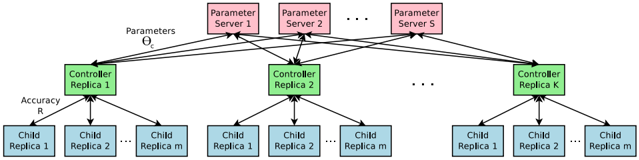
The image depicts a diagram of a federated learning system architecture. It illustrates the flow of parameters and accuracy information between parameter servers, controllers, and child replicas. The system appears to be designed for distributed machine learning, where models are trained across multiple devices without centralizing the training data.
### Components/Axes
The diagram consists of three main types of components:
* **Parameter Servers:** Labeled "Parameter Server 1", "Parameter Server 2", up to "Parameter Server S". These servers store and distribute model parameters.
* **Controllers:** Labeled "Controller Replica 1", "Controller Replica 2", up to "Controller Replica K". These controllers manage the training process and coordinate with the child replicas.
* **Child Replicas:** Labeled "Child Replica 1", "Child Replica 2", up to "Child Replica m". These replicas perform the actual model training on local data.
There are two labeled arrows:
* "Parameters Θ" pointing from the Parameter Servers to the Controllers.
* "Accuracy R" pointing from the Controllers to the Child Replicas.
### Detailed Analysis / Content Details
The diagram shows a multi-layered structure:
1. **Parameter Servers Layer (Top):** There are 'S' parameter servers. Each server holds model parameters.
2. **Controller Layer (Middle):** There are 'K' controller replicas. Each controller receives parameters from all 'S' parameter servers.
3. **Child Replica Layer (Bottom):** Each controller manages 'm' child replicas. Each child replica receives accuracy information from its respective controller.
The connections between the layers are as follows:
* Each parameter server sends parameters (Θ) to every controller replica. This indicates a broadcast mechanism.
* Each controller replica sends accuracy information (R) to all of its child replicas.
* The diagram does not show any connections *from* the child replicas to the controllers or parameter servers, suggesting that updates are not directly sent back, but rather aggregated and communicated through the controllers.
The number of parameter servers is 'S', the number of controller replicas is 'K', and the number of child replicas per controller is 'm'. These are variables representing the scale of the system.
### Key Observations
* The architecture is highly distributed.
* The parameter servers act as a central repository for model parameters, but the controllers manage the training process.
* The child replicas perform the local training and provide accuracy feedback to the controllers.
* The diagram does not specify how the parameters are updated or how the accuracy information is used.
* The use of "Replica" in the labels suggests redundancy and fault tolerance.
### Interpretation
This diagram illustrates a federated learning setup. The parameter servers maintain the global model parameters, while the controllers orchestrate the training process across multiple child replicas. The child replicas train the model on their local data and report accuracy back to the controllers. This allows for distributed model training without sharing the raw data, preserving privacy.
The architecture suggests a synchronous or semi-synchronous training process, where the controllers wait for feedback from all child replicas before updating the global model parameters. The broadcast of parameters from the servers to all controllers implies a desire for consistency across the replicas.
The variables 'S', 'K', and 'm' allow for scaling the system to handle large datasets and complex models. The lack of direct connections from child replicas to parameter servers suggests that the controllers aggregate the updates before sending them to the parameter servers, potentially to reduce communication overhead or to implement privacy-preserving mechanisms like differential privacy.
The diagram is a high-level overview and does not provide details about the specific algorithms or protocols used for parameter updates or accuracy aggregation. It focuses on the overall system architecture and the flow of information between the different components.