## Bar Chart: Effective Bandwidth Comparison with/without CC
### Overview
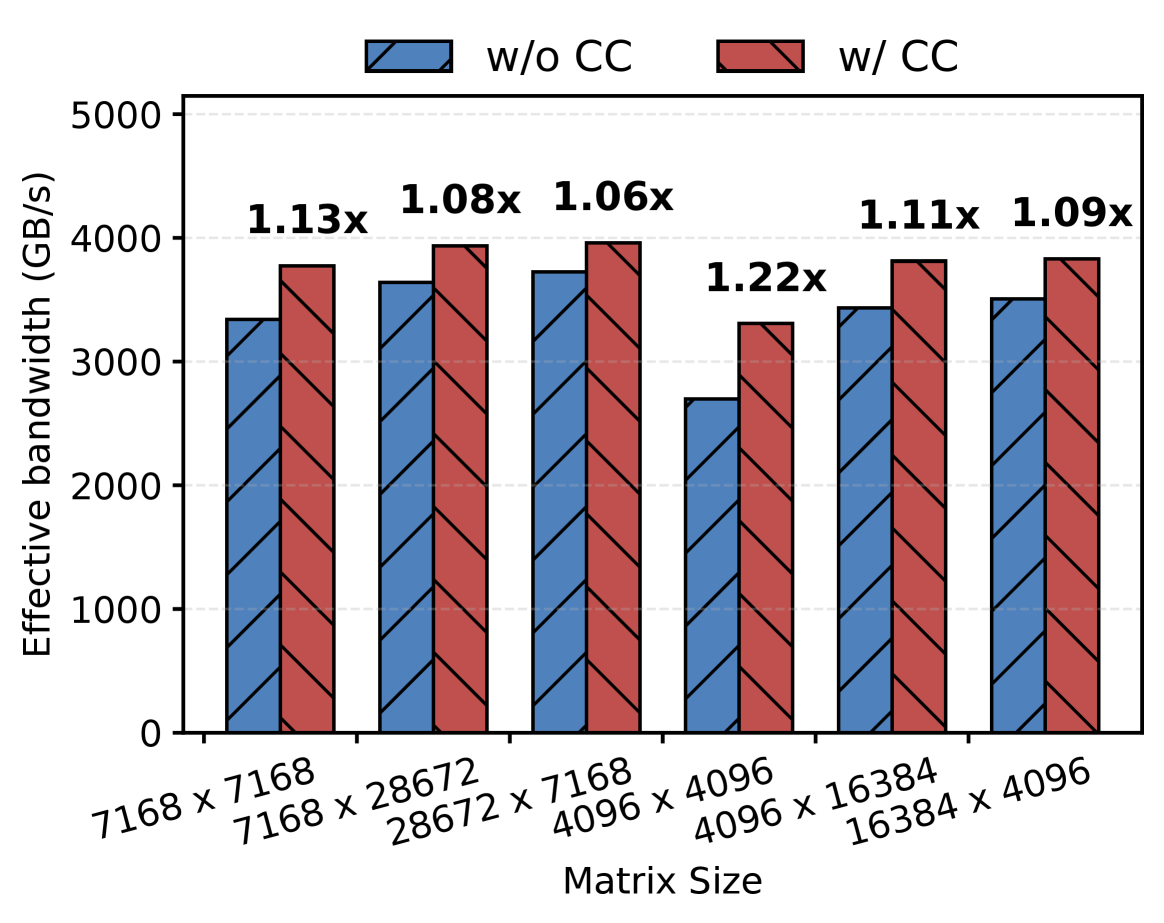
The chart compares the effective bandwidth (in GB/s) of matrix operations with and without a compression/optimization technique labeled "CC" across six different matrix sizes. Each matrix size has two bars: blue (w/o CC) and red (w/ CC), with performance gains (multipliers) annotated on the red bars.
### Components/Axes
- **X-axis (Matrix Size)**:
- 7168 x 7168
- 28672 x 28672
- 7168 x 28672
- 4096 x 4096
- 16384 x 4096
- 4096 x 4096 (duplicate entry)
- **Y-axis (Effective Bandwidth)**: 0–5000 GB/s, with increments of 1000.
- **Legend**:
- Blue (w/o CC)
- Red (w/ CC)
- **Annotations**: Multipliers (e.g., 1.13x) on red bars.
### Detailed Analysis
1. **7168 x 7168**:
- w/o CC: ~3300 GB/s
- w/ CC: ~3700 GB/s (1.13x gain)
2. **28672 x 28672**:
- w/o CC: ~3700 GB/s
- w/ CC: ~4000 GB/s (1.08x gain)
3. **7168 x 28672**:
- w/o CC: ~3700 GB/s
- w/ CC: ~4000 GB/s (1.06x gain)
4. **4096 x 4096**:
- w/o CC: ~2700 GB/s
- w/ CC: ~3300 GB/s (1.22x gain)
5. **16384 x 4096**:
- w/o CC: ~3400 GB/s
- w/ CC: ~3800 GB/s (1.11x gain)
6. **4096 x 4096 (duplicate)**:
- w/o CC: ~2700 GB/s
- w/ CC: ~3300 GB/s (1.09x gain)
### Key Observations
- **Performance Gains**: The highest gain (1.22x) occurs for the 4096 x 4096 matrix, while the largest matrices (28672 x 28672 and 7168 x 28672) show the lowest gains (1.08x and 1.06x).
- **Trends**:
- Smaller matrices (e.g., 4096 x 4096) benefit more from CC.
- Larger matrices exhibit diminishing returns.
- Rectangular matrices (e.g., 7168 x 28672, 16384 x 4096) show intermediate gains.
- **Anomalies**: The duplicate 4096 x 4096 entry with a 1.09x gain (vs. 1.22x for the same size) may indicate a data inconsistency or experimental variation.
### Interpretation
The data suggests that the CC technique significantly improves bandwidth efficiency for smaller matrices (e.g., 4096 x 4096), likely due to optimized memory access or algorithmic adjustments at that scale. Larger matrices (e.g., 28672 x 28672) show minimal gains, implying that CC’s effectiveness diminishes with increased problem size, possibly due to memory bandwidth saturation or algorithmic overhead. The rectangular matrices (e.g., 16384 x 4096) demonstrate moderate improvements, highlighting that aspect ratios may influence CC’s impact. These findings could guide optimization strategies for computational workloads, prioritizing CC for smaller or specific matrix dimensions.