## Diagram: Federated Learning Workflow with Privacy Enhancements
### Overview
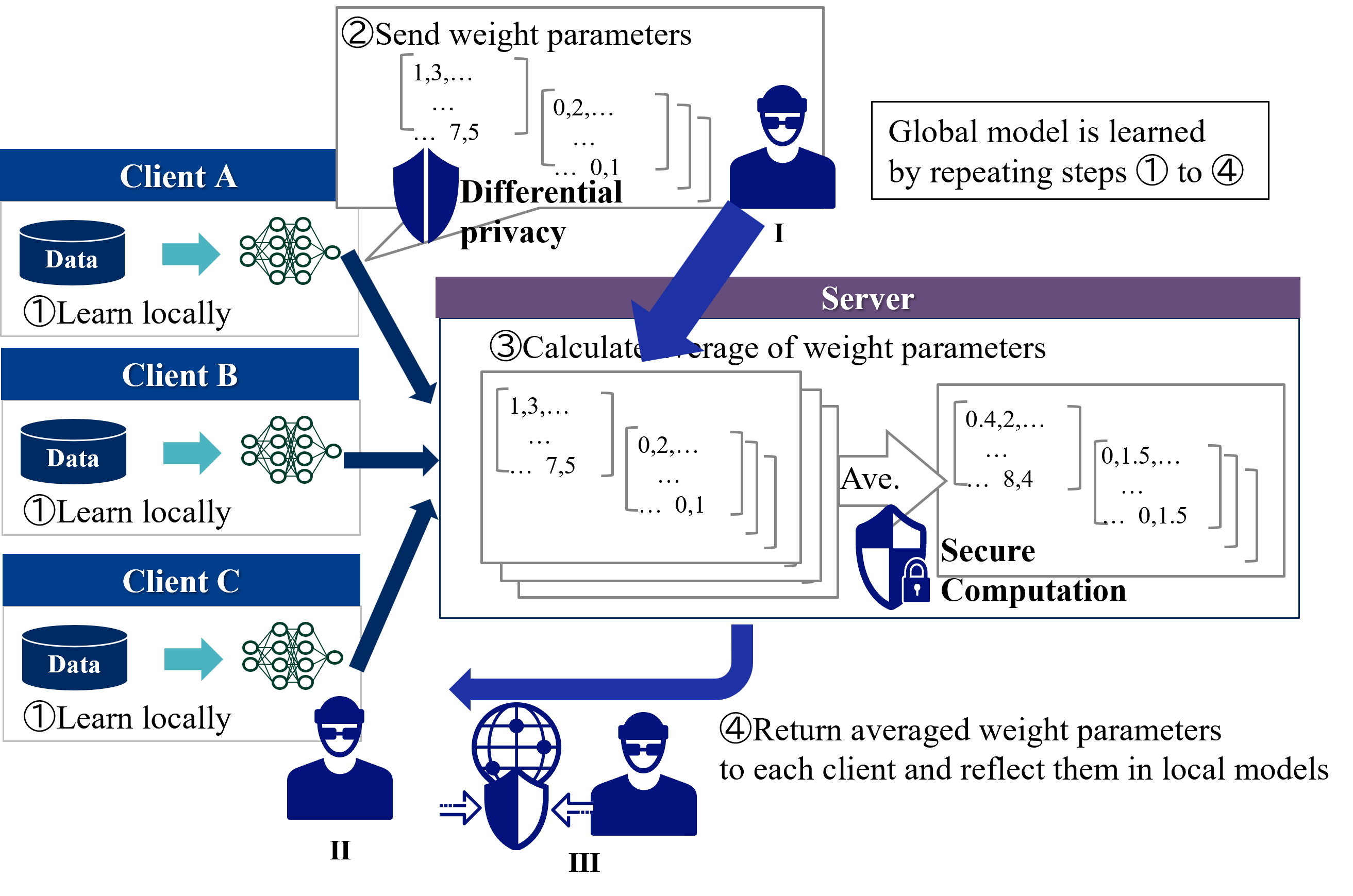
This diagram illustrates a Federated Learning (FL) system architecture. It depicts the iterative process of training a global model across multiple distributed clients (A, B, and C) while maintaining data privacy. The workflow is divided into four distinct steps, incorporating privacy-preserving technologies—specifically Differential Privacy and Secure Computation—to protect against potential adversaries (represented by figures I, II, and III).
### Components/Axes
The diagram is organized into three primary functional areas:
1. **Client Side (Left):** Three identical blocks labeled "Client A", "Client B", and "Client C". Each contains:
* A cylinder icon labeled "Data".
* A neural network diagram.
* The label "1 Learn locally".
2. **Server Side (Center/Right):** A large rectangular box labeled "Server".
* Contains the label "3 Calculate average of weight parameters".
* Contains an "Ave." (Average) operation block.
* Contains a "Secure Computation" shield icon.
3. **Process Flow & Security:**
* **Numbered Steps:** 1 through 4, indicating the cyclical nature of the learning process.
* **Security Icons:** Two shield icons. One labeled "Differential privacy" (associated with Step 2) and one labeled "Secure Computation" (associated with Step 3).
* **Adversaries:** Three stylized figures labeled I, II, and III.
* **Text Box (Top Right):** "Global model is learned by repeating steps 1 to 4".
### Detailed Analysis
#### Step-by-Step Workflow
* **Step 1 (Learn locally):** Clients A, B, and C train their local neural network models using their respective local "Data".
* **Step 2 (Send weight parameters):** Clients transmit their trained weight parameters to the server.
* *Visual Representation:* Matrices are shown as `[1,3,...]` and `[0,2,...]`.
* *Security:* A shield icon labeled "Differential privacy" is positioned here, indicating that noise or perturbation is added to the weights before transmission to prevent information leakage.
* *Adversary I:* Positioned near the transmission path, suggesting an attempt to intercept or infer data from the raw weight updates.
* **Step 3 (Calculate average of weight parameters):** The server receives the parameters and performs an aggregation.
* *Operation:* The "Ave." block processes the incoming matrices.
* *Security:* A shield icon labeled "Secure Computation" is positioned here, indicating that the aggregation is performed in a way that the server cannot see the individual client updates.
* *Resulting Data:* The output matrices are shown as `[0.4,2,...]` and `[0,1.5,...]`.
* **Step 4 (Return averaged weight parameters):** The server sends the aggregated global model weights back to the clients.
* *Action:* The clients update their local models with these averaged parameters.
* *Adversaries II & III:* Positioned at the bottom, interacting with a globe icon and a shield, suggesting potential threats during the return phase or global communication.
### Key Observations
* **Cyclical Nature:** The diagram explicitly states that the global model is learned by repeating steps 1 through 4, confirming this is an iterative training loop.
* **Privacy Layering:** The diagram distinguishes between two types of privacy:
* **Differential Privacy:** Applied at the client-side output (Step 2) to protect individual client data from being inferred from the gradients.
* **Secure Computation:** Applied at the server-side aggregation (Step 3) to ensure the server performs the average without accessing the raw, unmasked weights.
* **Adversary Modeling:** The inclusion of figures I, II, and III suggests a threat model analysis. Figure I represents an eavesdropper on the uplink; Figures II and III represent threats related to the global network or the return path.
### Interpretation
This diagram demonstrates a robust **Privacy-Preserving Federated Learning (PPFL)** architecture.
The data suggests that the system is designed to mitigate the inherent privacy risks of Federated Learning, where sharing model weights can sometimes leak information about the underlying training data (e.g., via model inversion attacks).
* **Why it matters:** By combining Differential Privacy (which adds statistical noise to the weights) and Secure Computation (which uses cryptographic protocols to aggregate weights without revealing them), the system creates a "defense-in-depth" strategy.
* **Reading between the lines:** The change in matrix values from the input (e.g., `1,3`) to the output (e.g., `0.4,2`) visually represents the aggregation and potential perturbation process. The presence of the adversary figures implies that the system is designed to be resilient against "honest-but-curious" servers or malicious network observers. The diagram effectively communicates that privacy is not a single feature but a multi-stage requirement in distributed machine learning.