\n
## Screenshot: Copycat Problem Example
### Overview
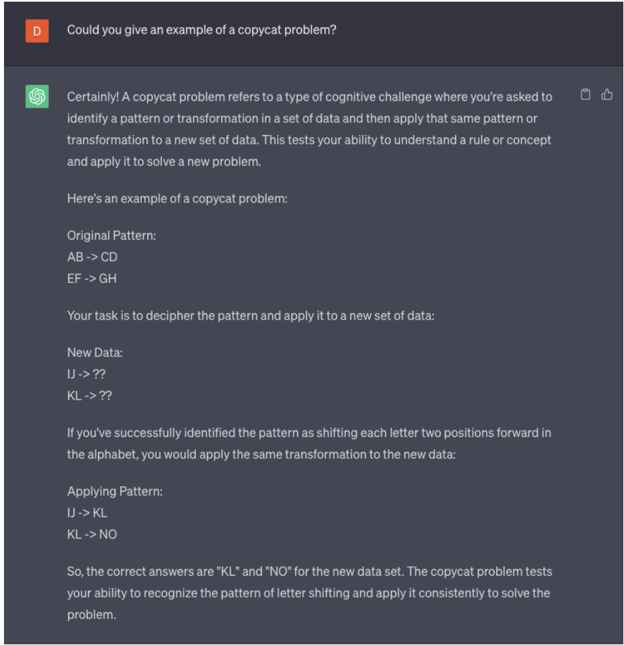
The image is a screenshot of a chat conversation, likely from a chatbot interface. The conversation details an explanation and example of a "copycat problem," a type of cognitive challenge involving pattern recognition and application. The screenshot displays the question "Could you give an example of a copycat problem?" and the chatbot's detailed response.
### Components/Axes
The screenshot contains the following components:
* **Chat Bubbles:** Two distinct chat bubbles, one from the user ("D") and one from the chatbot.
* **User Bubble:** Located on the left side, containing the question "Could you give an example of a copycat problem?".
* **Chatbot Bubble:** Located on the right side, containing the explanation and example.
* **Text Content:** The primary content is the text within the chatbot bubble, detailing the definition, example, and solution to a copycat problem.
### Content Details
The chatbot's response is transcribed below:
"Certainly! A copycat problem refers to a type of cognitive challenge where you’re asked to identify a pattern or transformation in a set of data and then apply that same pattern or transformation to a new set of data. This tests your ability to understand a rule or concept and apply it to solve a new problem.
Here’s an example of a copycat problem:
Original Pattern:
AB -> CD
EF -> GH
Your task is to decipher the pattern and apply it to a new set of data:
New Data:
IJ -> ??
KL -> ??
If you’ve successfully identified the pattern as shifting each letter two positions forward in the alphabet, you would apply the same transformation to the new data:
Applying Pattern:
IJ -> KL
KL -> NO
So, the correct answers are “KL” and “NO” for the new data set. The copycat problem tests your ability to recognize the pattern of letter shifting and apply it consistently to the problem."
### Key Observations
The text clearly defines a copycat problem and provides a step-by-step example. The example demonstrates a pattern of shifting letters forward by two positions in the alphabet. The solution is provided, confirming the pattern. The text is formatted with headings ("Original Pattern", "New Data", "Applying Pattern") to improve readability.
### Interpretation
The screenshot demonstrates a pedagogical approach to explaining a cognitive concept. The chatbot uses a clear definition, a concrete example, and a step-by-step solution to illustrate the concept of a copycat problem. The example is designed to test the user's ability to identify and apply a pattern. The use of "->" notation indicates a transformation or mapping between input and output. The problem highlights the importance of abstract reasoning and pattern recognition skills. The chatbot's response is well-structured and easy to understand, making it an effective learning tool. The problem is a simple example, but it effectively conveys the core principles of copycat problems.