## Diagram: EG-MLA Architecture
### Overview
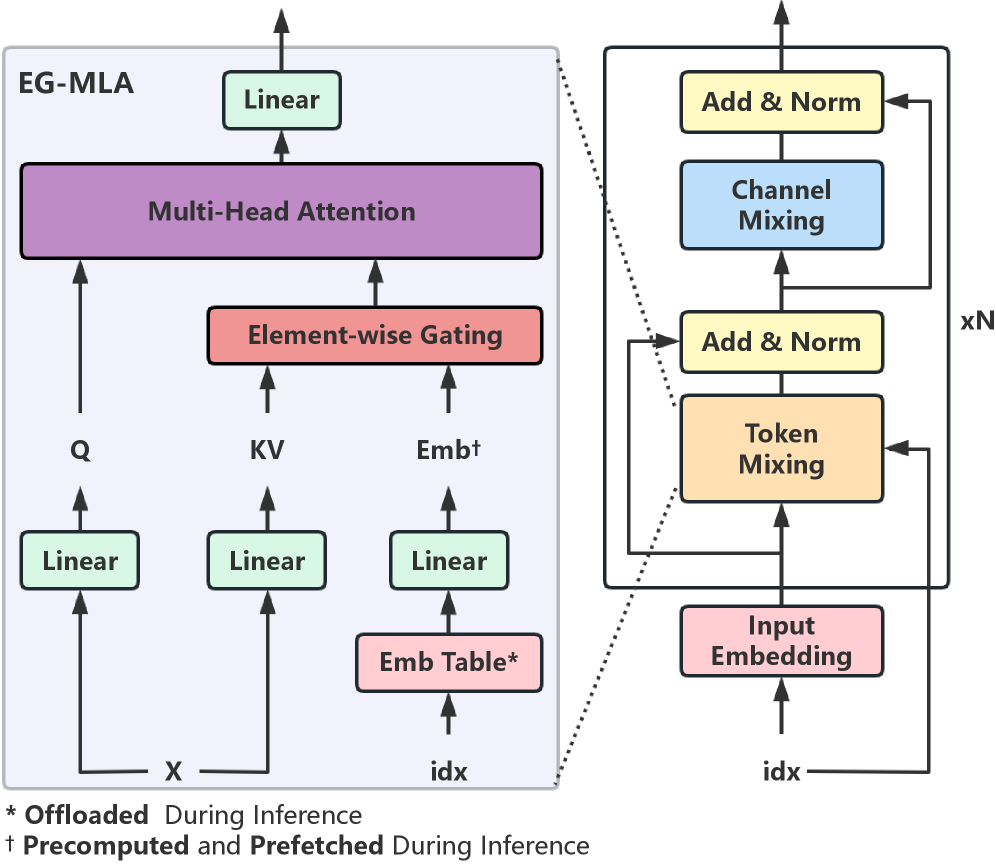
The image is a technical architecture diagram illustrating a neural network module labeled "EG-MLA" (left) and its integration into a standard transformer-style block (right). The diagram highlights data flow, specific processing layers, and optimization strategies (offloading and prefetching) used during inference.
### Components/Axes
**Left Region (EG-MLA Module):**
* **Inputs:** "X" and "idx".
* **Processing Blocks:**
* Three "Linear" layers (light green).
* "Emb Table*" (light pink).
* "Element-wise Gating" (light red).
* "Multi-Head Attention" (purple).
* **Intermediate Variables:** "Q", "KV", "Embt" (light blue/text).
**Right Region (Transformer Block):**
* **Inputs:** "idx".
* **Processing Blocks:**
* "Input Embedding" (light pink).
* "Token Mixing" (light orange).
* "Add & Norm" (light yellow, appears twice).
* "Channel Mixing" (light blue).
* **Structure:** The entire block is enclosed in a box labeled "xN" on the right, indicating this block is repeated N times.
**Footer (Legend):**
* `*`: "Offloaded During Inference"
* `†`: "Precomputed and Prefetched During Inference"
### Detailed Analysis
**1. EG-MLA Module (Left):**
* **Input Processing:**
* Input "X" splits into two paths, each passing through a "Linear" layer to produce "Q" and "KV".
* Input "idx" passes through "Emb Table*" (marked with `*`) and then a "Linear" layer to produce "Embt" (marked with `†`).
* **Gating and Attention:**
* "KV" and "Embt" serve as inputs to the "Element-wise Gating" layer.
* The output of "Element-wise Gating" and the "Q" variable are fed into the "Multi-Head Attention" layer.
* The output of "Multi-Head Attention" passes through a final "Linear" layer.
**2. Transformer Block (Right):**
* **Flow:**
* Input "idx" enters "Input Embedding".
* The output flows into "Token Mixing".
* A dotted line connects the "EG-MLA" block on the left to the "Token Mixing" block on the right, indicating that EG-MLA is the specific implementation or replacement for this component.
* The output of "Token Mixing" flows into an "Add & Norm" layer.
* The output of "Add & Norm" flows into "Channel Mixing".
* The output of "Channel Mixing" flows into a second "Add & Norm" layer.
* **Residual Connections:** Arrows loop back from the output of the first "Add & Norm" to the input of "Token Mixing", and from the output of the second "Add & Norm" to the input of "Channel Mixing".
### Key Observations
* **Optimization Strategy:** The diagram explicitly marks components for inference optimization. The "Emb Table" is offloaded, and the "Embt" (embedding) values are precomputed and prefetched.
* **Integration:** The dotted line indicates that the EG-MLA module is a specialized version of the "Token Mixing" component found in the standard transformer block.
* **Data Flow:** The architecture separates the query (Q) and key-value (KV) generation, with the KV path being augmented by precomputed embeddings ("Embt") via element-wise gating before entering the attention mechanism.
### Interpretation
This diagram illustrates an optimized attention mechanism designed to reduce computational overhead during inference.
By offloading the embedding table and precomputing/prefetching the embeddings ("Embt"), the system avoids performing these operations in real-time. The "Element-wise Gating" layer suggests that the model dynamically modulates the Key-Value (KV) information using these precomputed embeddings before the attention calculation. This architecture likely aims to reduce latency or memory bandwidth requirements in large language models by replacing standard token mixing with this gated, precomputed approach. The "xN" notation confirms this is a modular component within a larger, repeating transformer stack.