## 3D Rendered Geometric Primitives Scene
### Overview
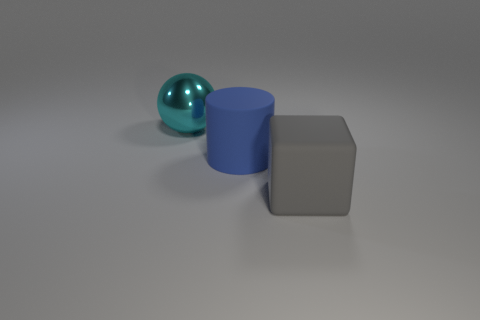
This is a simple 3D rendered scene featuring three basic geometric objects arranged on a flat, uniform light gray surface. The scene demonstrates different material properties (metallic vs. matte) and spatial positioning of 3D shapes, with no textual data, labels, or quantitative information present.
### Components
The scene contains three distinct objects, arranged in a diagonal line from the back-left to front-right of the frame:
1. **Metallic Cyan Sphere**: Positioned at the back-left, behind the cylinder. It has a highly reflective, shiny surface with bright specular highlights, indicating a polished metallic material. Its color is a bright teal/cyan.
2. **Matte Blue Cylinder**: Positioned in the center of the scene, between the sphere and cube. It is an upright, solid cylinder with a non-reflective, matte blue surface.
3. **Matte Gray Cube**: Positioned at the front-right, in front of the cylinder. It is a solid cube with a non-reflective, matte gray surface; three faces (front, top, right side) are visible.
The background is a plain, uniform light gray surface, with soft, diffused shadows cast by each object toward the lower-right, indicating a primary light source originating from the upper-left of the scene.
### Detailed Analysis
No textual labels, axes, data points, or quantitative data are present in this image. The scene is purely visual, focused on 3D form, material, and spatial arrangement.
### Key Observations
- The sphere is the only object with a reflective (metallic) material, creating a clear contrast with the matte surfaces of the cylinder and cube.
- The staggered arrangement of objects creates a clear sense of depth in the 3D space.
- Consistent shadow direction across all objects confirms a single primary light source in the scene.
### Interpretation
This image is a basic demonstration of 3D rendering fundamentals, likely intended to showcase:
1. The ability to render distinct geometric primitives (sphere, cylinder, cube)
2. Differentiation between material properties (metallic vs. matte surfaces)
3. Spatial depth and directional lighting in a 3D environment
There is no quantitative or textual data to interpret; the image serves as a visual example of core 3D graphics concepts.