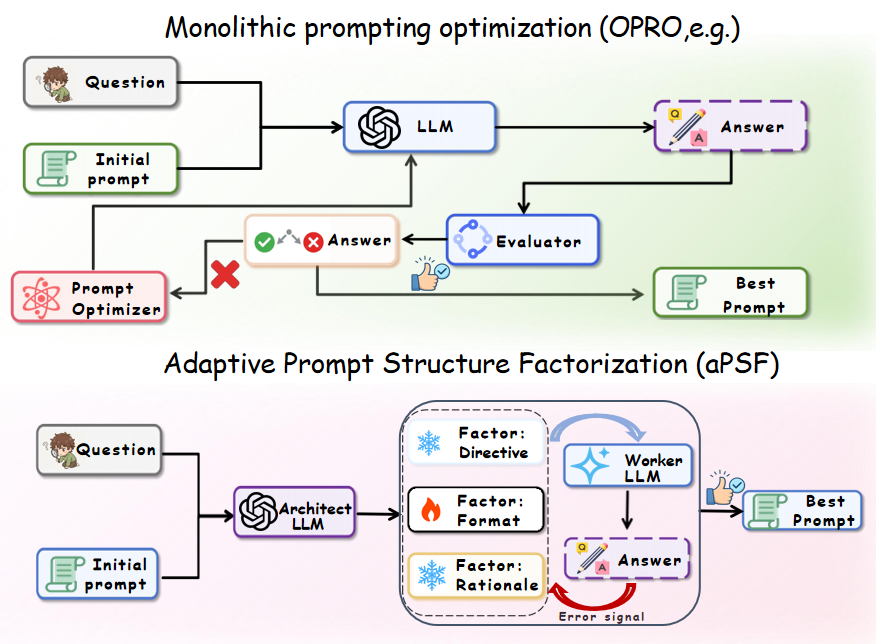
## Diagram: Comparative Analysis of Prompt Optimization Methods (OPRO vs. aPSF)
### Overview
The diagram compares two prompt optimization methodologies: **Monolithic Prompting Optimization (OPRO)** and **Adaptive Prompt Structure Factorization (aPSF)**. Both workflows involve iterative refinement of prompts to improve LLM output quality, but differ in architectural design and feedback mechanisms.
### Components/Axes
#### Monolithic Prompting Optimization (OPRO)
1. **Core Components**:
- **Question**: Input query (top-left, human icon)
- **Initial Prompt**: Starting template (green document icon)
- **LLM**: Language Model (blue gear icon)
- **Answer**: Generated response (pencil icon)
- **Evaluator**: Quality assessment module (blue circle with checkmark)
- **Prompt Optimizer**: Refinement engine (red atom icon)
- **Best Prompt**: Final optimized prompt (green document icon)
2. **Flow**:
- Question → Initial Prompt → LLM → Answer
- Answer → Evaluator (✓/✗ feedback)
- ❌ Answer → Prompt Optimizer → LLM (iterative loop)
- ✓ Answer → Best Prompt (termination)
3. **Visual Elements**:
- Red X for incorrect answers
- Green checkmark for correct answers
- Thumbs-up icon for successful evaluation
#### Adaptive Prompt Structure Factorization (aPSF)
1. **Core Components**:
- **Architect LLM**: Decomposition module (purple gear icon)
- **Worker LLM**: Execution module (blue gear icon)
- **Factors**:
- Directive (snowflake icon)
- Format (fire icon)
- Rationale (snowflake icon)
- **Error Signal**: Feedback loop (red arrow)
2. **Flow**:
- Question → Initial Prompt → Architect LLM
- Architect LLM → Factors → Worker LLM → Answer
- Answer → Error Signal (↔️ loop to Architect LLM)
- ✓ Answer → Best Prompt (termination)
3. **Visual Elements**:
- Dashed box for factor decomposition
- Red arrow for error signal feedback
- Thumbs-up icon for successful evaluation
### Detailed Analysis
#### OPRO Workflow
1. **Initialization**: Starts with a question and initial prompt
2. **Generation**: LLM produces an answer
3. **Evaluation**: Binary feedback (✓/✗) determines next steps
4. **Optimization**: Incorrect answers trigger prompt refinement
5. **Termination**: Correct answers produce the "Best Prompt"
#### aPSF Workflow
1. **Decomposition**: Architect LLM breaks prompts into modular factors
2. **Parallel Processing**: Factors are processed independently
3. **Error Handling**: Explicit feedback loop for incorrect answers
4. **Modular Optimization**: Each factor can be refined separately
5. **Structured Output**: Final prompt maintains factor integrity
### Key Observations
1. **Feedback Mechanisms**:
- OPRO uses binary evaluation (correct/incorrect)
- aPSF implements continuous error signaling
2. **Architectural Complexity**:
- OPRO: Linear workflow with single LLM
- aPSF: Hierarchical architecture with specialized components
3. **Optimization Scope**:
- OPRO: Global prompt refinement
- aPSF: Component-wise optimization
### Interpretation
The diagram reveals fundamental differences in optimization philosophy:
- **OPRO** represents traditional iterative refinement, suitable for simple QA tasks where binary feedback suffices
- **aPSF** introduces structural decomposition, enabling:
- Parallel processing of prompt components
- Targeted error correction
- More nuanced feedback through error signals
- The error signal loop in aPSF suggests superior adaptability to complex tasks requiring multi-faceted responses
- OPRO's simplicity may offer faster convergence for straightforward problems
The visual representation emphasizes that aPSF's modular approach could potentially handle more complex reasoning tasks through its factor-based architecture, while OPRO's monolithic design prioritizes simplicity and direct feedback.